

Beams and Beam Physics
21
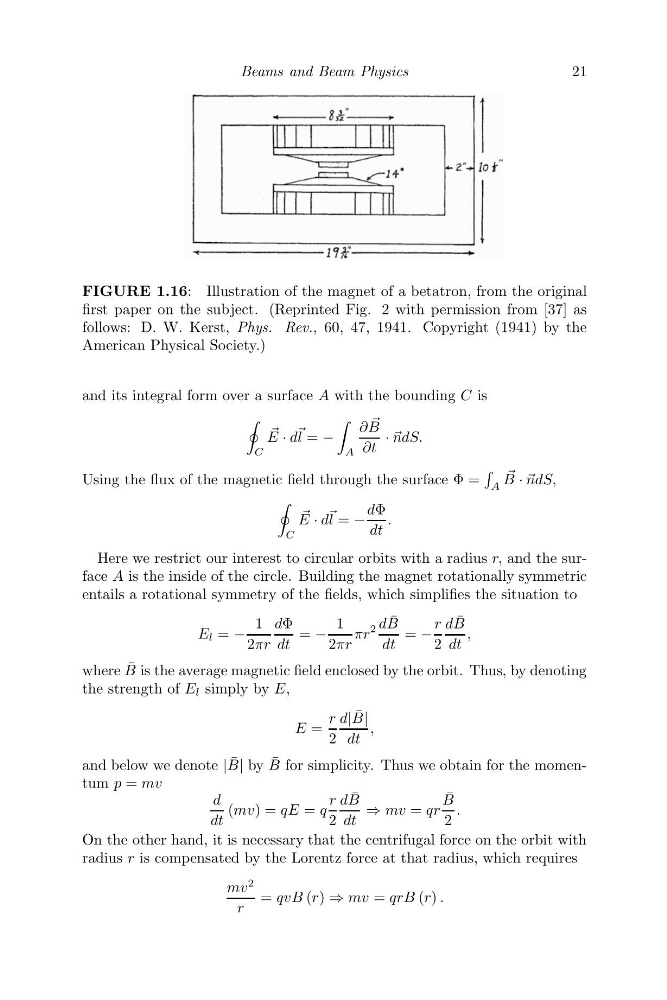
FIGURE 1.16: Illustration of the magnet of a betatron, from the original
first paper on the subject. (Reprinted Fig. 2 with permission from [37] as
follows: D. W. Kerst, Phys. Rev., 60, 47, 1941. Copyright (1941) by the
American Physical Society.)
and its integral form over a surface A with the bounding C is
C
E · d l = −
A
∂
B
∂t
· ndS.
Using the flux of the magnetic field through the surface Φ =
A
B · ndS,
C
E · d l = −
dΦ
dt
.
Here we restrict our interest to circular orbits with a radius r, and the surface A is the inside of the circle. Building the magnet rotationally symmetric
entails a rotational symmetry of the fields, which simplifies the situation to
E l = −
1
2πr
dΦ
dt
= −
1
2πr
πr
2 d ¯
B
dt
= −
r
2
d ¯
B
dt
,
where ¯
B is the average magnetic field enclosed by the orbit. Thus, by denoting
the strength of E l simply by E,
E =
r
2
d| ¯
B|
dt
,
and below we denote | ¯
B| by ¯
B for simplicity. Thus we obtain for the momentum p = mv
d
dt
(mv) = qE = q
r
2
d ¯
B
dt
⇒ mv = qr
¯
B
2
.
On the other hand, it is necessary that the centrifugal force on the orbit with
radius r is compensated by the Lorentz force at that radius, which requires
mv
2
r
= qvB (r) ⇒ mv = qrB (r) .
21
FIGURE 1.16: Illustration of the magnet of a betatron, from the original
first paper on the subject. (Reprinted Fig. 2 with permission from [37] as
follows: D. W. Kerst, Phys. Rev., 60, 47, 1941. Copyright (1941) by the
American Physical Society.)
and its integral form over a surface A with the bounding C is
C
E · d l = −
A
∂
B
∂t
· ndS.
Using the flux of the magnetic field through the surface Φ =
A
B · ndS,
C
E · d l = −
dΦ
dt
.
Here we restrict our interest to circular orbits with a radius r, and the surface A is the inside of the circle. Building the magnet rotationally symmetric
entails a rotational symmetry of the fields, which simplifies the situation to
E l = −
1
2πr
dΦ
dt
= −
1
2πr
πr
2 d ¯
B
dt
= −
r
2
d ¯
B
dt
,
where ¯
B is the average magnetic field enclosed by the orbit. Thus, by denoting
the strength of E l simply by E,
E =
r
2
d| ¯
B|
dt
,
and below we denote | ¯
B| by ¯
B for simplicity. Thus we obtain for the momentum p = mv
d
dt
(mv) = qE = q
r
2
d ¯
B
dt
⇒ mv = qr
¯
B
2
.
On the other hand, it is necessary that the centrifugal force on the orbit with
radius r is compensated by the Lorentz force at that radius, which requires
mv
2
r
= qvB (r) ⇒ mv = qrB (r) .