

18
An Introduction to Beam Physics
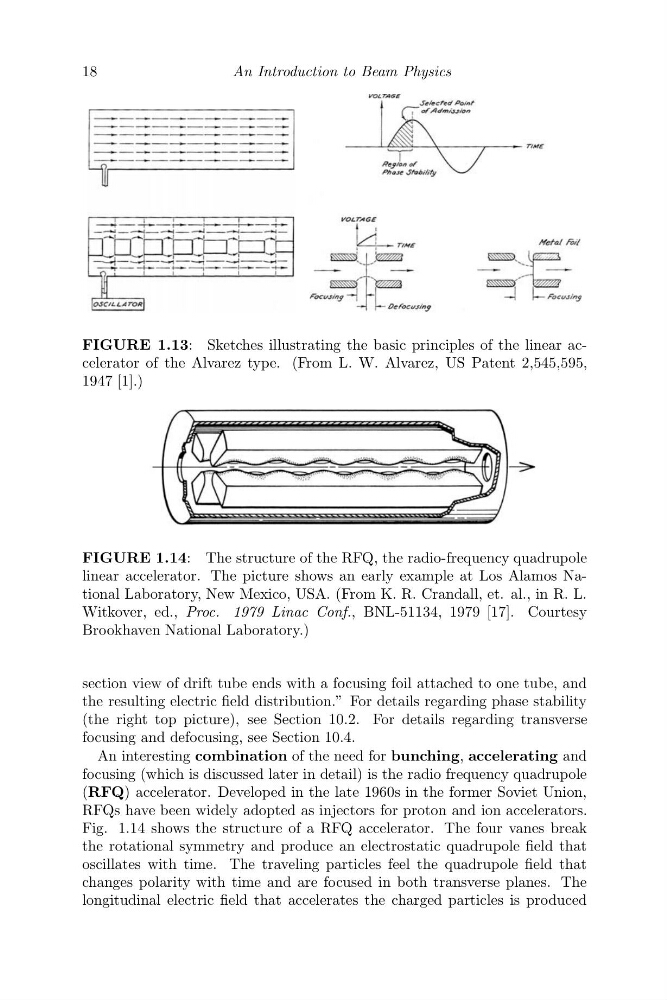
FIGURE 1.13: Sketches illustrating the basic principles of the linear accelerator of the Alvarez type. (From L. W. Alvarez, US Patent 2,545,595,
1947 [1].)
FIGURE 1.14: The structure of the RFQ, the radio-frequency quadrupole
linear accelerator. The picture shows an early example at Los Alamos National Laboratory, New Mexico, USA. (From K. R. Crandall, et. al., in R. L.
Witkover, ed., Proc. 1979 Linac Conf., BNL-51134, 1979 [17]. Courtesy
Brookhaven National Laboratory.)
section view of drift tube ends with a focusing foil attached to one tube, and
the resulting electric field distribution.” For details regarding phase stability
(the right top picture), see Section 10.2. For details regarding transverse
focusing and defocusing, see Section 10.4.
An interesting combination of the need for bunching, accelerating and
focusing (which is discussed later in detail) is the radio frequency quadrupole
(RFQ) accelerator. Developed in the late 1960s in the former Soviet Union,
RFQs have been widely adopted as injectors for proton and ion accelerators.
Fig. 1.14 shows the structure of a RFQ accelerator. The four vanes break
the rotational symmetry and produce an electrostatic quadrupole field that
oscillates with time. The traveling particles feel the quadrupole field that
changes polarity with time and are focused in both transverse planes. The
longitudinal electric field that accelerates the charged particles is produced
An Introduction to Beam Physics
FIGURE 1.13: Sketches illustrating the basic principles of the linear accelerator of the Alvarez type. (From L. W. Alvarez, US Patent 2,545,595,
1947 [1].)
FIGURE 1.14: The structure of the RFQ, the radio-frequency quadrupole
linear accelerator. The picture shows an early example at Los Alamos National Laboratory, New Mexico, USA. (From K. R. Crandall, et. al., in R. L.
Witkover, ed., Proc. 1979 Linac Conf., BNL-51134, 1979 [17]. Courtesy
Brookhaven National Laboratory.)
section view of drift tube ends with a focusing foil attached to one tube, and
the resulting electric field distribution.” For details regarding phase stability
(the right top picture), see Section 10.2. For details regarding transverse
focusing and defocusing, see Section 10.4.
An interesting combination of the need for bunching, accelerating and
focusing (which is discussed later in detail) is the radio frequency quadrupole
(RFQ) accelerator. Developed in the late 1960s in the former Soviet Union,
RFQs have been widely adopted as injectors for proton and ion accelerators.
Fig. 1.14 shows the structure of a RFQ accelerator. The four vanes break
the rotational symmetry and produce an electrostatic quadrupole field that
oscillates with time. The traveling particles feel the quadrupole field that
changes polarity with time and are focused in both transverse planes. The
longitudinal electric field that accelerates the charged particles is produced