

16
An Introduction to Beam Physics
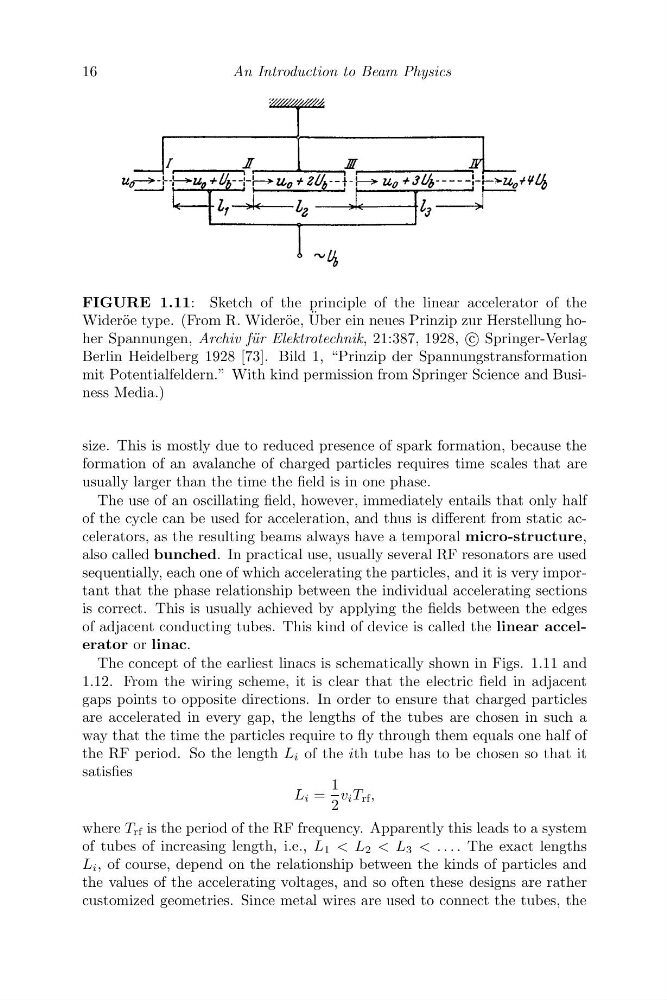
FIGURE 1.11: Sketch of the principle of the linear accelerator of the
Wider¨ oe type. (From R. Wider¨ oe, ¨
Uber ein neues Prinzip zur Herstellung hoher Spannungen, Archiv f¨ ur Elektrotechnik, 21:387, 1928, c
Springer-Verlag
Berlin Heidelberg 1928 [73]. Bild 1, “Prinzip der Spannungstransformation
mit Potentialfeldern.” With kind permission from Springer Science and Business Media.)
size. This is mostly due to reduced presence of spark formation, because the
formation of an avalanche of charged particles requires time scales that are
usually larger than the time the field is in one phase.
The use of an oscillating field, however, immediately entails that only half
of the cycle can be used for acceleration, and thus is different from static accelerators, as the resulting beams always have a temporal micro-structure,
also called bunched. In practical use, usually several RF resonators are used
sequentially, each one of which accelerating the particles, and it is very important that the phase relationship between the individual accelerating sections
is correct. This is usually achieved by applying the fields between the edges
of adjacent conducting tubes. This kind of device is called the linear accelerator or linac.
The concept of the earliest linacs is schematically shown in Figs. 1.11 and
1.12. From the wiring scheme, it is clear that the electric field in adjacent
gaps points to opposite directions. In order to ensure that charged particles
are accelerated in every gap, the lengths of the tubes are chosen in such a
way that the time the particles require to fly through them equals one half of
the RF period. So the length L i of the ith tube has to be chosen so that it
satisfies
L i =
1
2
v i T rf ,
where T rf is the period of the RF frequency. Apparently this leads to a system
of tubes of increasing length, i.e., L 1 < L 2 < L 3 < . . . . The exact lengths
L i , of course, depend on the relationship between the kinds of particles and
the values of the accelerating voltages, and so often these designs are rather
customized geometries. Since metal wires are used to connect the tubes, the
An Introduction to Beam Physics
FIGURE 1.11: Sketch of the principle of the linear accelerator of the
Wider¨ oe type. (From R. Wider¨ oe, ¨
Uber ein neues Prinzip zur Herstellung hoher Spannungen, Archiv f¨ ur Elektrotechnik, 21:387, 1928, c
Springer-Verlag
Berlin Heidelberg 1928 [73]. Bild 1, “Prinzip der Spannungstransformation
mit Potentialfeldern.” With kind permission from Springer Science and Business Media.)
size. This is mostly due to reduced presence of spark formation, because the
formation of an avalanche of charged particles requires time scales that are
usually larger than the time the field is in one phase.
The use of an oscillating field, however, immediately entails that only half
of the cycle can be used for acceleration, and thus is different from static accelerators, as the resulting beams always have a temporal micro-structure,
also called bunched. In practical use, usually several RF resonators are used
sequentially, each one of which accelerating the particles, and it is very important that the phase relationship between the individual accelerating sections
is correct. This is usually achieved by applying the fields between the edges
of adjacent conducting tubes. This kind of device is called the linear accelerator or linac.
The concept of the earliest linacs is schematically shown in Figs. 1.11 and
1.12. From the wiring scheme, it is clear that the electric field in adjacent
gaps points to opposite directions. In order to ensure that charged particles
are accelerated in every gap, the lengths of the tubes are chosen in such a
way that the time the particles require to fly through them equals one half of
the RF period. So the length L i of the ith tube has to be chosen so that it
satisfies
L i =
1
2
v i T rf ,
where T rf is the period of the RF frequency. Apparently this leads to a system
of tubes of increasing length, i.e., L 1 < L 2 < L 3 < . . . . The exact lengths
L i , of course, depend on the relationship between the kinds of particles and
the values of the accelerating voltages, and so often these designs are rather
customized geometries. Since metal wires are used to connect the tubes, the