

290
An Introduction to Beam Physics
That is
e
iμ(m−2k∓1) = 1,
which is fulfilled when
μ (m − 2k ∓ 1) = 2πn,
where n is an integer. Apparently, the solutions of this equation can be divided
into two classes: one that is independent of μ, which is k = (m ∓ 1)/2, and
the other that depends on μ. The solutions that depend on μ are called the
resonance conditions, which can be avoided with the choice of μ. The ones that
are independent of μ provide the terms that cannot be removed from the map
regardless of the choice of the tune. First, let us consider the case of m = 2.
Since both m and 2k are even, under no circumstance m − 2k ∓ 1 = 0. This
is consistent with the fact that a solution was found above that transforms
the second order map into a linear map. For the μ dependent solutions, it
is straightforward to verify that all six solutions are included in one simple
relation, which is 3μ = 2πn. Note that this is none other than the condition
of the third–integer resonance. Second, we consider the case of m = 3. There
are two solutions that are independent of μ, which are k = 2 for the top row
and k = 1 for the bottom row. Again, all eight solutions that are dependent
on μ are included in the expression 4μ = 2πn, which is the condition of the
fourth–integer resonance. In case of the sextupole, it drives the third–integer
resonance to the first order of k s and the fourth–integer resonance to the
second order of k s . Since we usually set the tune away from the third and
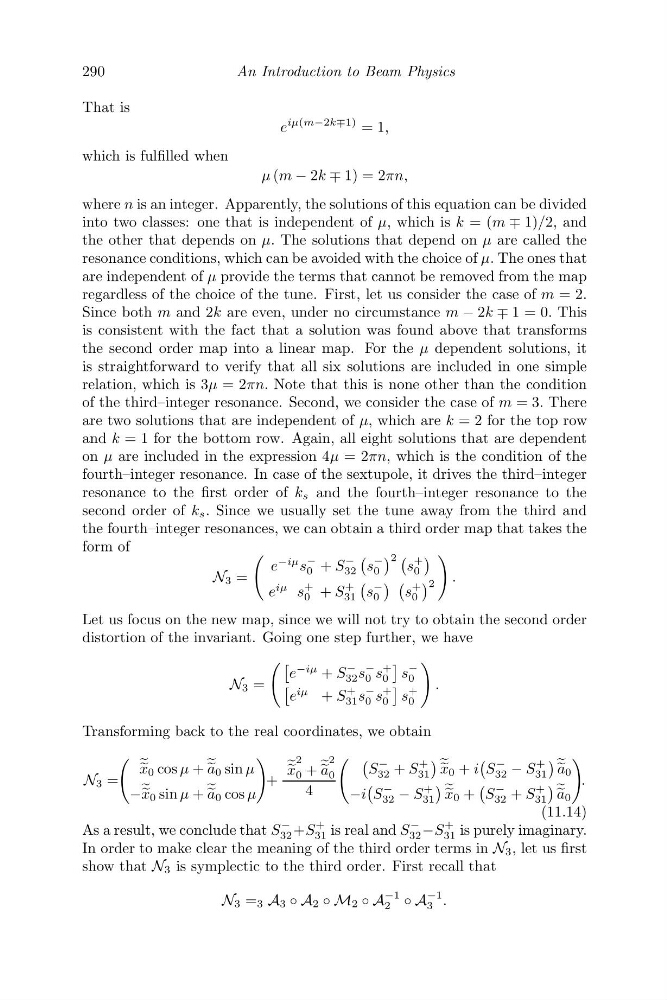
the fourth–integer resonances, we can obtain a third order map that takes the
form of
N 3 =
e
−iμ s
−
0 + S
−
32
s
−
0
2
s
+
0
e
iμ s
+
0 + S
+
31
s
−
0
s
+
0
2
.
Let us focus on the new map, since we will not try to obtain the second order
distortion of the invariant. Going one step further, we have
N 3 =
e
−iμ + S
−
32 s
−
0 s
+
0
s
−
0
e
iμ + S
+
31 s
−
0 s
+
0
s
+
0
.
Transforming back to the real coordinates, we obtain
N 3 =
x 0 cos μ + a 0 sin μ
−
x 0 sin μ + a 0 cos μ
+
x
2
0 + a
2
0
4
S
−
32 + S
+
31
x 0 + i
S
−
32 − S
+
31
a 0
−i
S
−
32 − S
+
31
x 0 +
S
−
32 + S
+
31
a 0
.
(11.14)
As a result, we conclude that S
−
32 +S
+
31 is real and S
−
32 −S
+
31 is purely imaginary.
In order to make clear the meaning of the third order terms in N 3 , let us first
show that N 3 is symplectic to the third order. First recall that
N 3 = 3 A 3 ◦ A 2 ◦ M 2 ◦ A
−1
2 ◦ A
−1
3 .
An Introduction to Beam Physics
That is
e
iμ(m−2k∓1) = 1,
which is fulfilled when
μ (m − 2k ∓ 1) = 2πn,
where n is an integer. Apparently, the solutions of this equation can be divided
into two classes: one that is independent of μ, which is k = (m ∓ 1)/2, and
the other that depends on μ. The solutions that depend on μ are called the
resonance conditions, which can be avoided with the choice of μ. The ones that
are independent of μ provide the terms that cannot be removed from the map
regardless of the choice of the tune. First, let us consider the case of m = 2.
Since both m and 2k are even, under no circumstance m − 2k ∓ 1 = 0. This
is consistent with the fact that a solution was found above that transforms
the second order map into a linear map. For the μ dependent solutions, it
is straightforward to verify that all six solutions are included in one simple
relation, which is 3μ = 2πn. Note that this is none other than the condition
of the third–integer resonance. Second, we consider the case of m = 3. There
are two solutions that are independent of μ, which are k = 2 for the top row
and k = 1 for the bottom row. Again, all eight solutions that are dependent
on μ are included in the expression 4μ = 2πn, which is the condition of the
fourth–integer resonance. In case of the sextupole, it drives the third–integer
resonance to the first order of k s and the fourth–integer resonance to the
second order of k s . Since we usually set the tune away from the third and
the fourth–integer resonances, we can obtain a third order map that takes the
form of
N 3 =
e
−iμ s
−
0 + S
−
32
s
−
0
2
s
+
0
e
iμ s
+
0 + S
+
31
s
−
0
s
+
0
2
.
Let us focus on the new map, since we will not try to obtain the second order
distortion of the invariant. Going one step further, we have
N 3 =
e
−iμ + S
−
32 s
−
0 s
+
0
s
−
0
e
iμ + S
+
31 s
−
0 s
+
0
s
+
0
.
Transforming back to the real coordinates, we obtain
N 3 =
x 0 cos μ + a 0 sin μ
−
x 0 sin μ + a 0 cos μ
+
x
2
0 + a
2
0
4
S
−
32 + S
+
31
x 0 + i
S
−
32 − S
+
31
a 0
−i
S
−
32 − S
+
31
x 0 +
S
−
32 + S
+
31
a 0
.
(11.14)
As a result, we conclude that S
−
32 +S
+
31 is real and S
−
32 −S
+
31 is purely imaginary.
In order to make clear the meaning of the third order terms in N 3 , let us first
show that N 3 is symplectic to the third order. First recall that
N 3 = 3 A 3 ◦ A 2 ◦ M 2 ◦ A
−1
2 ◦ A
−1
3 .