

Resonances in Repetitive Systems
289
The inverse is
x
a
=
1
√
2
1 1
−i i
s
−
s
+
.
(11.12)
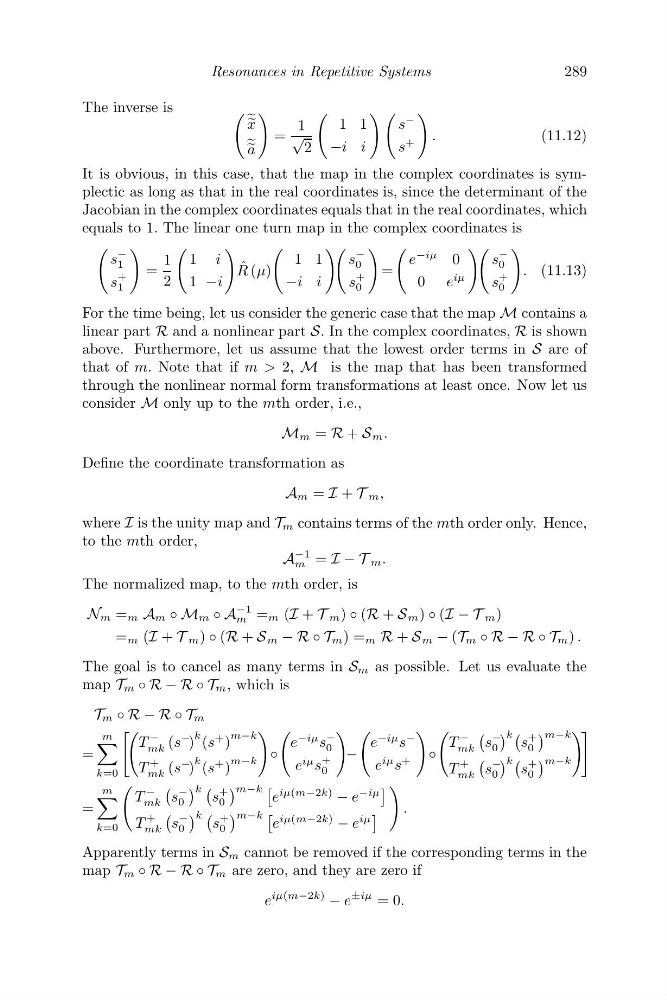
It is obvious, in this case, that the map in the complex coordinates is symplectic as long as that in the real coordinates is, since the determinant of the
Jacobian in the complex coordinates equals that in the real coordinates, which
equals to 1. The linear one turn map in the complex coordinates is
s
−
1
s
+
1
=
1
2
1 i
1 −i
ˆ
R (μ)
1 1
−i i
s
−
0
s
+
0
=
e
−iμ 0
0 e
iμ
s
−
0
s
+
0
. (11.13)
For the time being, let us consider the generic case that the map M contains a
linear part R and a nonlinear part S. In the complex coordinates, R is shown
above. Furthermore, let us assume that the lowest order terms in S are of
that of m. Note that if m > 2, M is the map that has been transformed
through the nonlinear normal form transformations at least once. Now let us
consider M only up to the mth order, i.e.,
M m = R + S m .
Define the coordinate transformation as
A m = I + T m ,
where I is the unity map and T m contains terms of the mth order only. Hence,
to the mth order,
A
−1
m = I − T m .
The normalized map, to the mth order, is
N m = m A m ◦ M m ◦ A
−1
m = m (I + T m ) ◦ (R + S m ) ◦ (I − T m )
= m (I + T m ) ◦ (R + S m − R ◦ T m ) = m R + S m − (T m ◦ R − R ◦ T m ) .
The goal is to cancel as many terms in S m as possible. Let us evaluate the
map T m ◦ R − R ◦ T m , which is
T m ◦ R − R ◦ T m
=
m
k=0
T
−
mk (s
−
)
k (s
+ )
m−k
T
+
mk (s
−
)
k (s
+ )
m−k
◦
e
−iμ s
−
0
e
iμ s
+
0
−
e
−iμ s
−
e
iμ s
+
◦
T
−
mk
s
−
0
k
s
+
0
m−k
T
+
mk
s
−
0
k
s
+
0
m−k
=
m
k=0
T
−
mk
s
−
0
k
s
+
0
m−k
e
iμ(m−2k)
− e
−iμ
T
+
mk
s
−
0
k
s
+
0
m−k
e
iμ(m−2k)
− e
iμ
.
Apparently terms in S m cannot be removed if the corresponding terms in the
map T m ◦ R − R ◦ T m are zero, and they are zero if
e
iμ(m−2k)
− e
±iμ = 0.
289
The inverse is
x
a
=
1
√
2
1 1
−i i
s
−
s
+
.
(11.12)
It is obvious, in this case, that the map in the complex coordinates is symplectic as long as that in the real coordinates is, since the determinant of the
Jacobian in the complex coordinates equals that in the real coordinates, which
equals to 1. The linear one turn map in the complex coordinates is
s
−
1
s
+
1
=
1
2
1 i
1 −i
ˆ
R (μ)
1 1
−i i
s
−
0
s
+
0
=
e
−iμ 0
0 e
iμ
s
−
0
s
+
0
. (11.13)
For the time being, let us consider the generic case that the map M contains a
linear part R and a nonlinear part S. In the complex coordinates, R is shown
above. Furthermore, let us assume that the lowest order terms in S are of
that of m. Note that if m > 2, M is the map that has been transformed
through the nonlinear normal form transformations at least once. Now let us
consider M only up to the mth order, i.e.,
M m = R + S m .
Define the coordinate transformation as
A m = I + T m ,
where I is the unity map and T m contains terms of the mth order only. Hence,
to the mth order,
A
−1
m = I − T m .
The normalized map, to the mth order, is
N m = m A m ◦ M m ◦ A
−1
m = m (I + T m ) ◦ (R + S m ) ◦ (I − T m )
= m (I + T m ) ◦ (R + S m − R ◦ T m ) = m R + S m − (T m ◦ R − R ◦ T m ) .
The goal is to cancel as many terms in S m as possible. Let us evaluate the
map T m ◦ R − R ◦ T m , which is
T m ◦ R − R ◦ T m
=
m
k=0
T
−
mk (s
−
)
k (s
+ )
m−k
T
+
mk (s
−
)
k (s
+ )
m−k
◦
e
−iμ s
−
0
e
iμ s
+
0
−
e
−iμ s
−
e
iμ s
+
◦
T
−
mk
s
−
0
k
s
+
0
m−k
T
+
mk
s
−
0
k
s
+
0
m−k
=
m
k=0
T
−
mk
s
−
0
k
s
+
0
m−k
e
iμ(m−2k)
− e
−iμ
T
+
mk
s
−
0
k
s
+
0
m−k
e
iμ(m−2k)
− e
iμ
.
Apparently terms in S m cannot be removed if the corresponding terms in the
map T m ◦ R − R ◦ T m are zero, and they are zero if
e
iμ(m−2k)
− e
±iμ = 0.