

Resonances in Repetitive Systems
275
The upper right block of the matrix can be obtained by switching μ y and
μ y of the results above. In summary the transfer matrix at the limit of
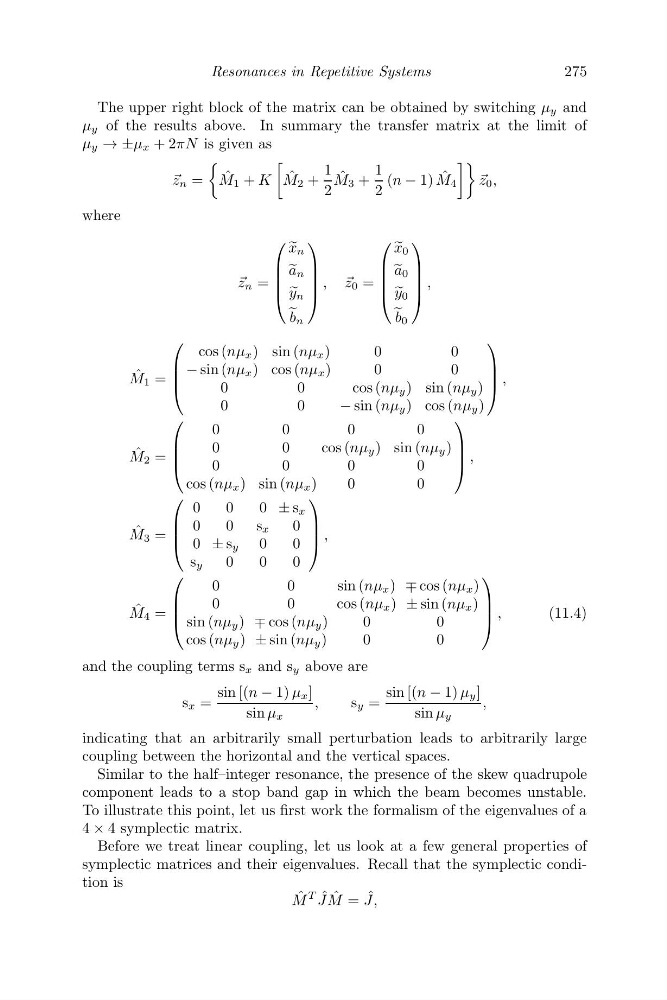
μ y → ±μ x + 2πN is given as
z n =
ˆ
M 1 + K
ˆ
M 2 +
1
2
ˆ
M 3 +
1
2
(n − 1) ˆ
M 4
z 0 ,
where
z n =
⎛
⎜
⎜
⎜
⎝
x n
a n
y n
b n
⎞
⎟
⎟
⎟
⎠
, , z 0 =
⎛
⎜
⎜
⎜
⎝
x 0
a 0
y 0
b 0
⎞
⎟
⎟
⎟
⎠
,
ˆ
M 1 =
⎛
⎜
⎜
⎝
cos (nμ x ) sin (nμ x )
0
0
− sin (nμ x ) cos(nμ x )
0
0
0
0
c o s ( nμ y ) sin (nμ y )
0
0
− sin (nμ y ) cos(nμ y )
⎞
⎟
⎟
⎠ ,
ˆ
M 2 =
⎛
⎜
⎜
⎝
0
0
0
0
0
0
c o s( nμ y ) sin (nμ y )
0
0
0
0
cos (nμ x ) sin (nμ x )
0
0
⎞
⎟
⎟
⎠ ,
ˆ
M 3 =
⎛
⎜
⎜
⎝
0
0
0 ± s x
0
0
s x
0
0 ± s y 0
0
s y
0
0
0
⎞
⎟
⎟
⎠ ,
ˆ
M 4 =
⎛
⎜
⎜
⎝
0
0
s i n( nμ x ) ∓ cos (nμ x )
0
0
c o s( nμ x ) ± sin (nμ x )
sin (nμ y ) ∓ cos (nμ y )
0
0
cos (nμ y ) ± sin (nμ y )
0
0
⎞
⎟
⎟
⎠ ,
(11.4)
and the coupling terms s x and s y above are
s x =
sin [(n − 1) μ x ]
sin μ x
,
s y =
sin [(n − 1) μ y ]
sin μ y
,
indicating that an arbitrarily small perturbation leads to arbitrarily large
coupling between the horizontal and the vertical spaces.
Similar to the half–integer resonance, the presence of the skew quadrupole
component leads to a stop band gap in which the beam becomes unstable.
To illustrate this point, let us first work the formalism of the eigenvalues of a
4 × 4 symplectic matrix.
Before we treat linear coupling, let us look at a few general properties of
symplectic matrices and their eigenvalues. Recall that the symplectic condition is
ˆ
M
T ˆ
J ˆ
M = ˆ
J,
275
The upper right block of the matrix can be obtained by switching μ y and
μ y of the results above. In summary the transfer matrix at the limit of
μ y → ±μ x + 2πN is given as
z n =
ˆ
M 1 + K
ˆ
M 2 +
1
2
ˆ
M 3 +
1
2
(n − 1) ˆ
M 4
z 0 ,
where
z n =
⎛
⎜
⎜
⎜
⎝
x n
a n
y n
b n
⎞
⎟
⎟
⎟
⎠
, , z 0 =
⎛
⎜
⎜
⎜
⎝
x 0
a 0
y 0
b 0
⎞
⎟
⎟
⎟
⎠
,
ˆ
M 1 =
⎛
⎜
⎜
⎝
cos (nμ x ) sin (nμ x )
0
0
− sin (nμ x ) cos(nμ x )
0
0
0
0
c o s ( nμ y ) sin (nμ y )
0
0
− sin (nμ y ) cos(nμ y )
⎞
⎟
⎟
⎠ ,
ˆ
M 2 =
⎛
⎜
⎜
⎝
0
0
0
0
0
0
c o s( nμ y ) sin (nμ y )
0
0
0
0
cos (nμ x ) sin (nμ x )
0
0
⎞
⎟
⎟
⎠ ,
ˆ
M 3 =
⎛
⎜
⎜
⎝
0
0
0 ± s x
0
0
s x
0
0 ± s y 0
0
s y
0
0
0
⎞
⎟
⎟
⎠ ,
ˆ
M 4 =
⎛
⎜
⎜
⎝
0
0
s i n( nμ x ) ∓ cos (nμ x )
0
0
c o s( nμ x ) ± sin (nμ x )
sin (nμ y ) ∓ cos (nμ y )
0
0
cos (nμ y ) ± sin (nμ y )
0
0
⎞
⎟
⎟
⎠ ,
(11.4)
and the coupling terms s x and s y above are
s x =
sin [(n − 1) μ x ]
sin μ x
,
s y =
sin [(n − 1) μ y ]
sin μ y
,
indicating that an arbitrarily small perturbation leads to arbitrarily large
coupling between the horizontal and the vertical spaces.
Similar to the half–integer resonance, the presence of the skew quadrupole
component leads to a stop band gap in which the beam becomes unstable.
To illustrate this point, let us first work the formalism of the eigenvalues of a
4 × 4 symplectic matrix.
Before we treat linear coupling, let us look at a few general properties of
symplectic matrices and their eigenvalues. Recall that the symplectic condition is
ˆ
M
T ˆ
J ˆ
M = ˆ
J,