

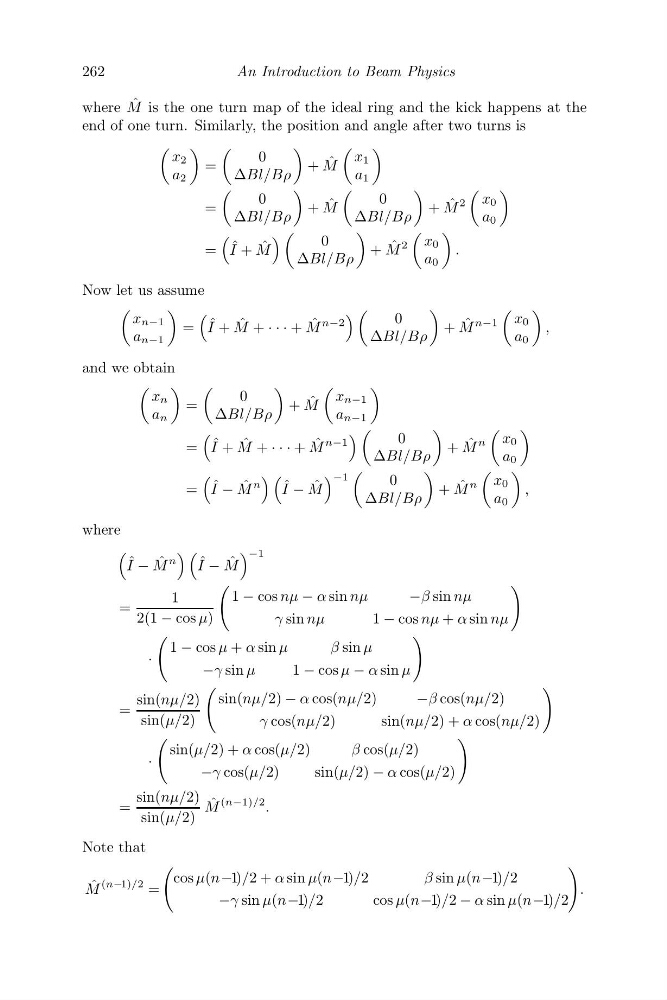
262
An Introduction to Beam Physics
where ˆ
M is the one turn map of the ideal ring and the kick happens at the
end of one turn. Similarly, the position and angle after two turns is
x 2
a 2
=
0
ΔBl/Bρ
+ ˆ
M
x 1
a 1
=
0
ΔBl/Bρ
+ ˆ
M
0
ΔBl/Bρ
+ ˆ
M
2
x 0
a 0
=
ˆ
I + ˆ
M
0
ΔBl/Bρ
+ ˆ
M
2
x 0
a 0
.
Now let us assume
x n−1
a n−1
=
ˆ
I + ˆ
M + · · · + ˆ
M
n−2
0
ΔBl/Bρ
+ ˆ
M
n−1
x 0
a 0
,
and we obtain
x n
a n
=
0
ΔBl/Bρ
+ ˆ
M
x n−1
a n−1
=
ˆ
I + ˆ
M + · · · + ˆ
M
n−1
0
ΔBl/Bρ
+ ˆ
M
n
x 0
a 0
=
ˆ
I − ˆ
M
n
ˆ
I − ˆ
M
−1
0
ΔBl/Bρ
+ ˆ
M
n
x 0
a 0
,
where
ˆ
I − ˆ
M
n
ˆ
I − ˆ
M
−1
=
1
2(1 − cos μ)
1 − cos nμ − α sin nμ
−β sin nμ
γ sin nμ
1 − cos nμ + α sin nμ
·
1 − cos μ + α sin μ
βsin μ
−γ sin μ
1 − cos μ − α sin μ
=
sin(nμ/2)
sin(μ/2)
sin(nμ/2) − α cos(nμ/2)
−β cos(nμ/2)
γ cos(nμ/2)
sin(nμ/2) + α cos(nμ/2)
·
sin(μ/2) + α cos(μ/2)
β cos(μ/2)
−γ cos(μ/2)
sin(μ/2) − α cos(μ/2)
=
sin(nμ/2)
sin(μ/2)
ˆ
M
(n−1)/2 .
Note that
ˆ
M
(n−1)/2 =
cos μ(n−1)/2 + α sin μ(n−1)/2
β sin μ(n−1)/2
−γ sin μ(n−1)/2
c o sμ(n−1)/2 − α sin μ(n−1)/2
.
An Introduction to Beam Physics
where ˆ
M is the one turn map of the ideal ring and the kick happens at the
end of one turn. Similarly, the position and angle after two turns is
x 2
a 2
=
0
ΔBl/Bρ
+ ˆ
M
x 1
a 1
=
0
ΔBl/Bρ
+ ˆ
M
0
ΔBl/Bρ
+ ˆ
M
2
x 0
a 0
=
ˆ
I + ˆ
M
0
ΔBl/Bρ
+ ˆ
M
2
x 0
a 0
.
Now let us assume
x n−1
a n−1
=
ˆ
I + ˆ
M + · · · + ˆ
M
n−2
0
ΔBl/Bρ
+ ˆ
M
n−1
x 0
a 0
,
and we obtain
x n
a n
=
0
ΔBl/Bρ
+ ˆ
M
x n−1
a n−1
=
ˆ
I + ˆ
M + · · · + ˆ
M
n−1
0
ΔBl/Bρ
+ ˆ
M
n
x 0
a 0
=
ˆ
I − ˆ
M
n
ˆ
I − ˆ
M
−1
0
ΔBl/Bρ
+ ˆ
M
n
x 0
a 0
,
where
ˆ
I − ˆ
M
n
ˆ
I − ˆ
M
−1
=
1
2(1 − cos μ)
1 − cos nμ − α sin nμ
−β sin nμ
γ sin nμ
1 − cos nμ + α sin nμ
·
1 − cos μ + α sin μ
βsin μ
−γ sin μ
1 − cos μ − α sin μ
=
sin(nμ/2)
sin(μ/2)
sin(nμ/2) − α cos(nμ/2)
−β cos(nμ/2)
γ cos(nμ/2)
sin(nμ/2) + α cos(nμ/2)
·
sin(μ/2) + α cos(μ/2)
β cos(μ/2)
−γ cos(μ/2)
sin(μ/2) − α cos(μ/2)
=
sin(nμ/2)
sin(μ/2)
ˆ
M
(n−1)/2 .
Note that
ˆ
M
(n−1)/2 =
cos μ(n−1)/2 + α sin μ(n−1)/2
β sin μ(n−1)/2
−γ sin μ(n−1)/2
c o sμ(n−1)/2 − α sin μ(n−1)/2
.