

Chapter 11
*Resonances in Repetitive Systems
Unlike single pass systems, the dynamics of the beam in a repetitive system
such as a storage ring is not necessarily dominated by the largest aberrations
in the one turn transfer map. Due to the fact that particles go around many
times, the impact of those terms that are nearly in phase with the linear
motion are amplified and the dynamics is, to a large extent, shaped by
them. The motion generated by one of those terms is called a resonance. As
a result, we need a different way to evaluate the relative significance of the
aberrations that is directly suited for rings.
Since resonances appear in various physical systems, many different methods have been developed to describe this phenomenon. Here we have adopted
a method that is based on the map method that has been developed here and
does not require advanced techniques such as normal form theory as in [5].
As shown in the previous chapters, a large class of single pass systems
are imaging. Yet the entire ring cannot be imaging, since it will be linearly
unstable if |M | | = 1, where M is the magnification. Moreover, the ring is
unstable with the presence of arbitrarily small errors when |M | = 1.
11.1 Integer Resonance
In this section we will study the dynamics in a ring when one or more dipole
magnets have errors in the field. Let us first consider the case that one magnet
has a dipole error in the field, which is ΔB. Without lost of generality, we
adopt the thin lens approximation, since a thick dipole can always be cut into
a number of thin slices and the contribution of the whole is the sum of each
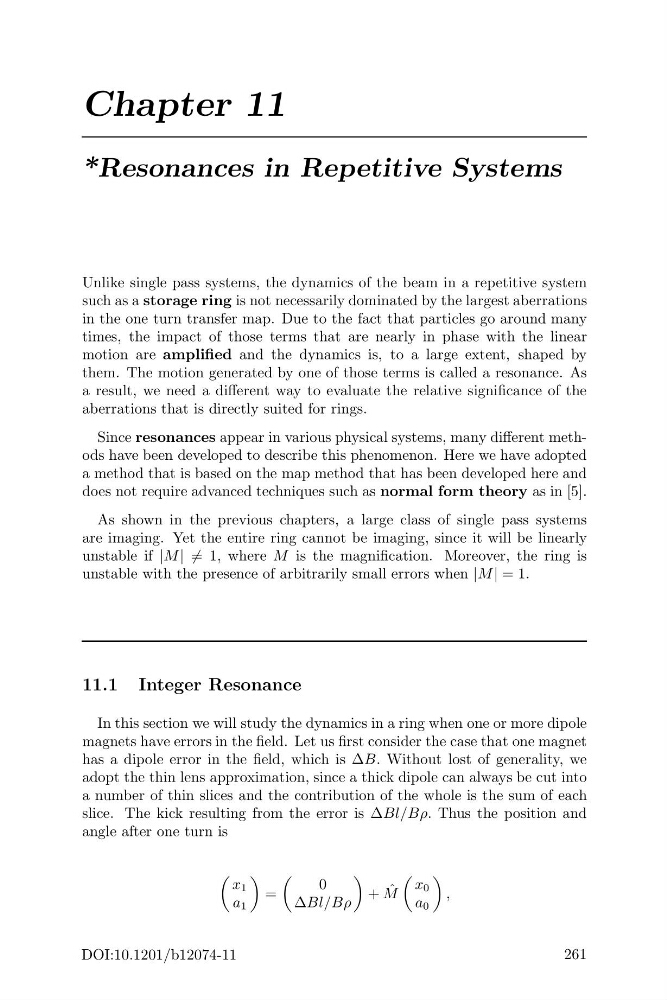
slice. The kick resulting from the error is ΔBl/Bρ. Thus the position and
angle after one turn is
x 1
a 1
=
0
ΔBl/Bρ
+ ˆ
M
x 0
a 0
,
261
DOI:10.1201/b12074-11
*Resonances in Repetitive Systems
Unlike single pass systems, the dynamics of the beam in a repetitive system
such as a storage ring is not necessarily dominated by the largest aberrations
in the one turn transfer map. Due to the fact that particles go around many
times, the impact of those terms that are nearly in phase with the linear
motion are amplified and the dynamics is, to a large extent, shaped by
them. The motion generated by one of those terms is called a resonance. As
a result, we need a different way to evaluate the relative significance of the
aberrations that is directly suited for rings.
Since resonances appear in various physical systems, many different methods have been developed to describe this phenomenon. Here we have adopted
a method that is based on the map method that has been developed here and
does not require advanced techniques such as normal form theory as in [5].
As shown in the previous chapters, a large class of single pass systems
are imaging. Yet the entire ring cannot be imaging, since it will be linearly
unstable if |M | | = 1, where M is the magnification. Moreover, the ring is
unstable with the presence of arbitrarily small errors when |M | = 1.
11.1 Integer Resonance
In this section we will study the dynamics in a ring when one or more dipole
magnets have errors in the field. Let us first consider the case that one magnet
has a dipole error in the field, which is ΔB. Without lost of generality, we
adopt the thin lens approximation, since a thick dipole can always be cut into
a number of thin slices and the contribution of the whole is the sum of each
slice. The kick resulting from the error is ΔBl/Bρ. Thus the position and
angle after one turn is
x 1
a 1
=
0
ΔBl/Bρ
+ ˆ
M
x 0
a 0
,
261
DOI:10.1201/b12074-11