

250
An Introduction to Beam Physics
V, ΔE k
V, ΔE k
φ
φ
φ s
-φ s
π
2π
3π
0
π
2π
3π
0
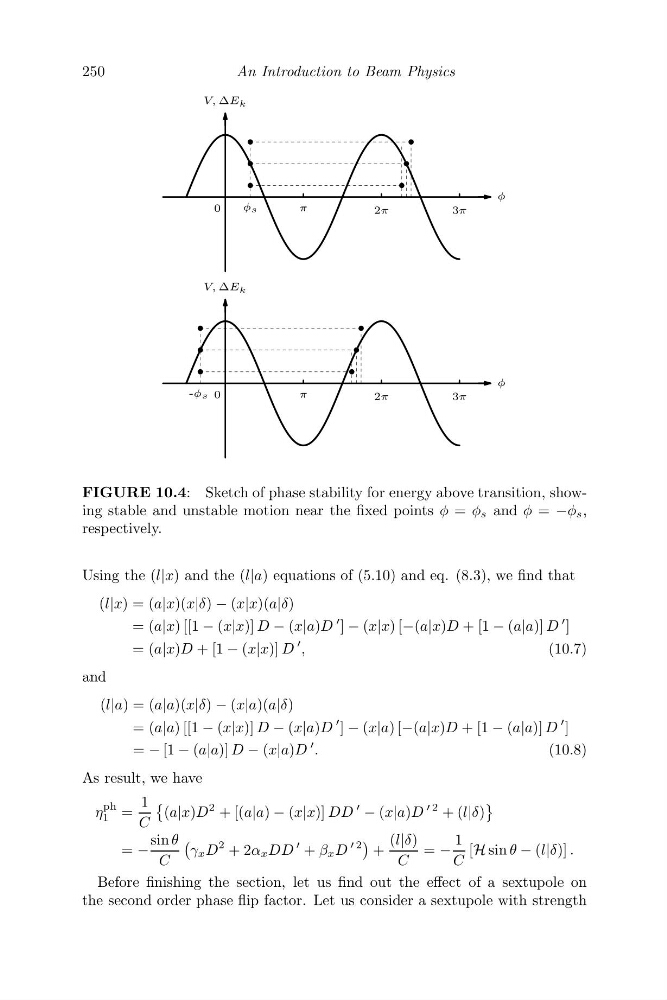
FIGURE 10.4: Sketch of phase stability for energy above transition, showing stable and unstable motion near the fixed points φ = φ s and φ = −φ s ,
respectively.
Using the (l|x) and the (l|a) equations of (5.10) and eq. (8.3), we find that
(l|x) = (a|x)(x|δ) − (x|x)(a|δ)
= (a|x) [[1 − (x|x)] D − (x|a)D
] − (x|x) [−(a|x)D + [1 − (a|a)] D
]
= (a|x)D + [1 − (x|x)] D
,
(10.7)
and
(l|a) = (a|a)(x|δ) − (x|a)(a|δ)
= (a|a) [[1 − (x|x)] D − (x|a)D
] − (x|a) [−(a|x)D + [1 − (a|a)] D
]
= − [1 − (a|a)] D − (x|a)D
.
(10.8)
As result, we have
η
ph
1 =
1
C
(a|x)D
2 + [(a|a) − (x|x)] DD
− (x|a)D
2 + (l|δ)
= −
sin θ
C
γ x D
2 + 2α x DD
+ β x D
2
+
(l|δ)
C
= −
1
C
[H sin θ − (l|δ)] .
Before finishing the section, let us find out the effect of a sextupole on
the second order phase flip factor. Let us consider a sextupole with strength
An Introduction to Beam Physics
V, ΔE k
V, ΔE k
φ
φ
φ s
-φ s
π
2π
3π
0
π
2π
3π
0
FIGURE 10.4: Sketch of phase stability for energy above transition, showing stable and unstable motion near the fixed points φ = φ s and φ = −φ s ,
respectively.
Using the (l|x) and the (l|a) equations of (5.10) and eq. (8.3), we find that
(l|x) = (a|x)(x|δ) − (x|x)(a|δ)
= (a|x) [[1 − (x|x)] D − (x|a)D
] − (x|x) [−(a|x)D + [1 − (a|a)] D
]
= (a|x)D + [1 − (x|x)] D
,
(10.7)
and
(l|a) = (a|a)(x|δ) − (x|a)(a|δ)
= (a|a) [[1 − (x|x)] D − (x|a)D
] − (x|a) [−(a|x)D + [1 − (a|a)] D
]
= − [1 − (a|a)] D − (x|a)D
.
(10.8)
As result, we have
η
ph
1 =
1
C
(a|x)D
2 + [(a|a) − (x|x)] DD
− (x|a)D
2 + (l|δ)
= −
sin θ
C
γ x D
2 + 2α x DD
+ β x D
2
+
(l|δ)
C
= −
1
C
[H sin θ − (l|δ)] .
Before finishing the section, let us find out the effect of a sextupole on
the second order phase flip factor. Let us consider a sextupole with strength