

248
An Introduction to Beam Physics
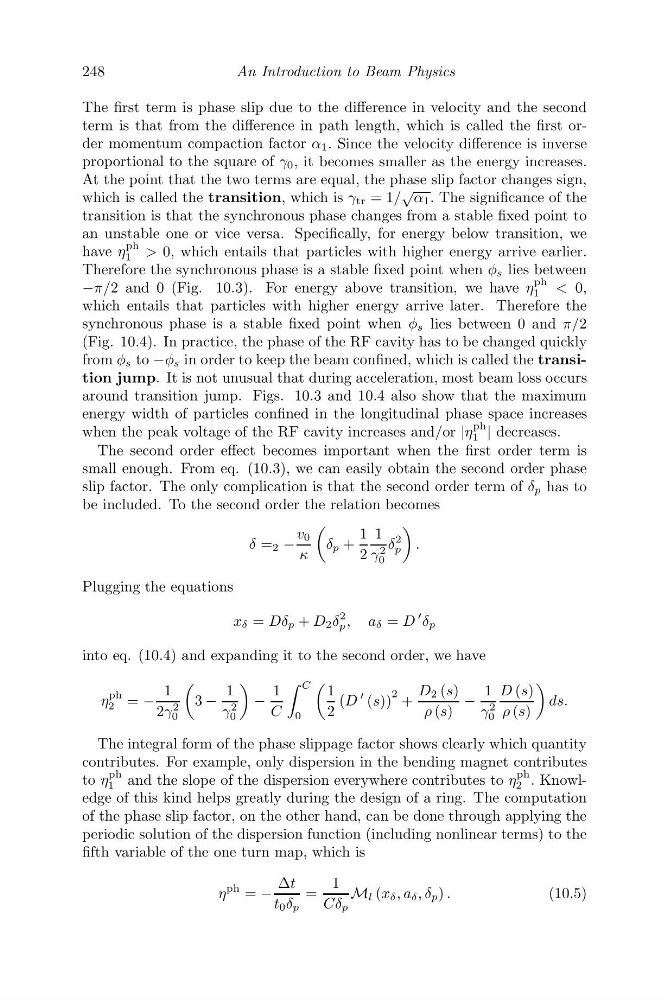
The first term is phase slip due to the difference in velocity and the second
term is that from the difference in path length, which is called the first order momentum compaction factor α 1 . Since the velocity difference is inverse
proportional to the square of γ 0 , it becomes smaller as the energy increases.
At the point that the two terms are equal, the phase slip factor changes sign,
which is called the transition, which is γ tr = 1/
√
α 1 . The significance of the
transition is that the synchronous phase changes from a stable fixed point to
an unstable one or vice versa. Specifically, for energy below transition, we
have η
ph
1 > 0, which entails that particles with higher energy arrive earlier.
Therefore the synchronous phase is a stable fixed point when φ s lies between
−π/2 and 0 (Fig. 10.3). For energy above transition, we have η
ph
1
< 0,
which entails that particles with higher energy arrive later. Therefore the
synchronous phase is a stable fixed point when φ s lies between 0 and π/2
(Fig. 10.4). In practice, the phase of the RF cavity has to be changed quickly
from φ s to −φ s in order to keep the beam confined, which is called the transition jump. It is not unusual that during acceleration, most beam loss occurs
around transition jump. Figs. 10.3 and 10.4 also show that the maximum
energy width of particles confined in the longitudinal phase space increases
when the peak voltage of the RF cavity increases and/or |η
ph
1 | decreases.
The second order effect becomes important when the first order term is
small enough. From eq. (10.3), we can easily obtain the second order phase
slip factor. The only complication is that the second order term of δ p has to
be included. To the second order the relation becomes
δ = 2 −
v 0
κ
δ p +
1
2
1
γ 2
0
δ
2
p
.
Plugging the equations
x δ = Dδ p + D 2 δ
2
p , a δ = D
δ p
into eq. (10.4) and expanding it to the second order, we have
η
ph
2 = −
1
2γ 2
0
3 −
1
γ 2
0
−
1
C
C
0
1
2
(D
(s))
2 +
D 2 (s)
ρ (s)
−
1
γ 2
0
D (s)
ρ (s)
ds.
The integral form of the phase slippage factor shows clearly which quantity
contributes. For example, only dispersion in the bending magnet contributes
to η
ph
1 and the slope of the dispersion everywhere contributes to η
ph
2 . Knowledge of this kind helps greatly during the design of a ring. The computation
of the phase slip factor, on the other hand, can be done through applying the
periodic solution of the dispersion function (including nonlinear terms) to the
fifth variable of the one turn map, which is
η
ph = −
Δt
t 0 δ p
=
1
Cδ p
M l (x δ , a δ , δ p ) .
(10.5)
An Introduction to Beam Physics
The first term is phase slip due to the difference in velocity and the second
term is that from the difference in path length, which is called the first order momentum compaction factor α 1 . Since the velocity difference is inverse
proportional to the square of γ 0 , it becomes smaller as the energy increases.
At the point that the two terms are equal, the phase slip factor changes sign,
which is called the transition, which is γ tr = 1/
√
α 1 . The significance of the
transition is that the synchronous phase changes from a stable fixed point to
an unstable one or vice versa. Specifically, for energy below transition, we
have η
ph
1 > 0, which entails that particles with higher energy arrive earlier.
Therefore the synchronous phase is a stable fixed point when φ s lies between
−π/2 and 0 (Fig. 10.3). For energy above transition, we have η
ph
1
< 0,
which entails that particles with higher energy arrive later. Therefore the
synchronous phase is a stable fixed point when φ s lies between 0 and π/2
(Fig. 10.4). In practice, the phase of the RF cavity has to be changed quickly
from φ s to −φ s in order to keep the beam confined, which is called the transition jump. It is not unusual that during acceleration, most beam loss occurs
around transition jump. Figs. 10.3 and 10.4 also show that the maximum
energy width of particles confined in the longitudinal phase space increases
when the peak voltage of the RF cavity increases and/or |η
ph
1 | decreases.
The second order effect becomes important when the first order term is
small enough. From eq. (10.3), we can easily obtain the second order phase
slip factor. The only complication is that the second order term of δ p has to
be included. To the second order the relation becomes
δ = 2 −
v 0
κ
δ p +
1
2
1
γ 2
0
δ
2
p
.
Plugging the equations
x δ = Dδ p + D 2 δ
2
p , a δ = D
δ p
into eq. (10.4) and expanding it to the second order, we have
η
ph
2 = −
1
2γ 2
0
3 −
1
γ 2
0
−
1
C
C
0
1
2
(D
(s))
2 +
D 2 (s)
ρ (s)
−
1
γ 2
0
D (s)
ρ (s)
ds.
The integral form of the phase slippage factor shows clearly which quantity
contributes. For example, only dispersion in the bending magnet contributes
to η
ph
1 and the slope of the dispersion everywhere contributes to η
ph
2 . Knowledge of this kind helps greatly during the design of a ring. The computation
of the phase slip factor, on the other hand, can be done through applying the
periodic solution of the dispersion function (including nonlinear terms) to the
fifth variable of the one turn map, which is
η
ph = −
Δt
t 0 δ p
=
1
Cδ p
M l (x δ , a δ , δ p ) .
(10.5)