

238
An Introduction to Beam Physics
From the mirror symmetry of the chicane, we can conclude that the module
is achromatic. For φ 1, the dispersion between the second and the third
bends is D = L 1 φ + R 0 φ
2 . It is worth noting that the focusing in the vertical
plane is insignificant. As a result the bunch compressor is transparent in
transverse dynamics.
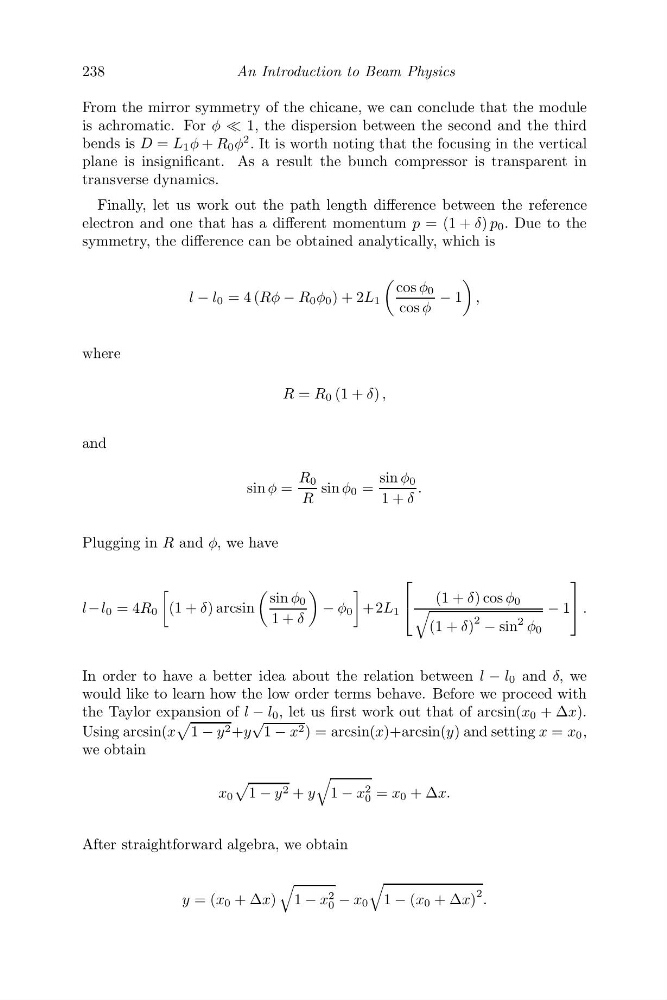
Finally, let us work out the path length difference between the reference
electron and one that has a different momentum p = (1 + δ) p 0 . Due to the
symmetry, the difference can be obtained analytically, which is
l − l 0 = 4 (Rφ − R 0 φ 0 ) + 2L 1
cos φ 0
cos φ
− 1
,
where
R = R 0 (1 + δ) ,
and
sin φ =
R 0
R
sin φ 0 =
sin φ 0
1 + δ
.
Plugging in R and φ, we have
l −l 0 = 4R 0
(1 + δ) arcsin
sin φ 0
1 + δ
− φ 0
+2L 1
⎡
⎣
(1 + δ) cos φ 0
(1 + δ)
2 − sin
2 φ 0
− 1
⎤
⎦ .
In order to have a better idea about the relation between l − l 0 and δ, we
would like to learn how the low order terms behave. Before we proceed with
the Taylor expansion of l − l 0 , let us first work out that of arcsin(x 0 + Δx).
Using arcsin(x
1 − y 2 +y
√
1 − x 2 ) = arcsin(x)+arcsin(y) and setting x = x 0 ,
we obtain
x 0
1 − y 2 + y
1 − x 2
0 = x 0 + Δx.
After straightforward algebra, we obtain
y = (x 0 + Δx)
1 − x 2
0 − x 0
1 − (x 0 + Δx)
2 .
An Introduction to Beam Physics
From the mirror symmetry of the chicane, we can conclude that the module
is achromatic. For φ 1, the dispersion between the second and the third
bends is D = L 1 φ + R 0 φ
2 . It is worth noting that the focusing in the vertical
plane is insignificant. As a result the bunch compressor is transparent in
transverse dynamics.
Finally, let us work out the path length difference between the reference
electron and one that has a different momentum p = (1 + δ) p 0 . Due to the
symmetry, the difference can be obtained analytically, which is
l − l 0 = 4 (Rφ − R 0 φ 0 ) + 2L 1
cos φ 0
cos φ
− 1
,
where
R = R 0 (1 + δ) ,
and
sin φ =
R 0
R
sin φ 0 =
sin φ 0
1 + δ
.
Plugging in R and φ, we have
l −l 0 = 4R 0
(1 + δ) arcsin
sin φ 0
1 + δ
− φ 0
+2L 1
⎡
⎣
(1 + δ) cos φ 0
(1 + δ)
2 − sin
2 φ 0
− 1
⎤
⎦ .
In order to have a better idea about the relation between l − l 0 and δ, we
would like to learn how the low order terms behave. Before we proceed with
the Taylor expansion of l − l 0 , let us first work out that of arcsin(x 0 + Δx).
Using arcsin(x
1 − y 2 +y
√
1 − x 2 ) = arcsin(x)+arcsin(y) and setting x = x 0 ,
we obtain
x 0
1 − y 2 + y
1 − x 2
0 = x 0 + Δx.
After straightforward algebra, we obtain
y = (x 0 + Δx)
1 − x 2
0 − x 0
1 − (x 0 + Δx)
2 .