

236
An Introduction to Beam Physics
VP
,3)
β P
β [
β \
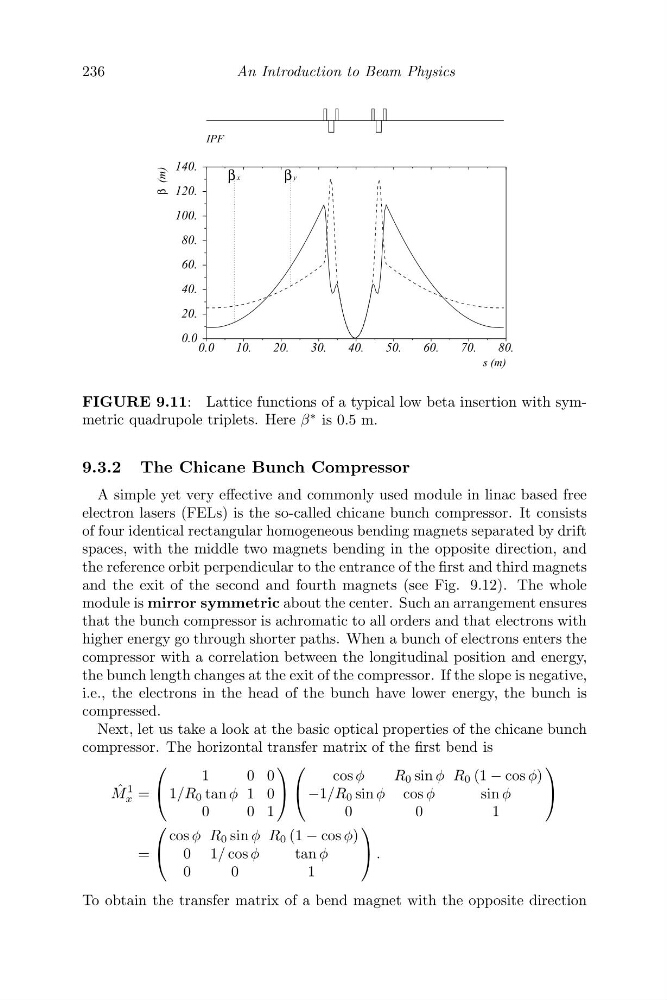
FIGURE 9.11: Lattice functions of a typical low beta insertion with symmetric quadrupole triplets. Here β
∗ is 0.5 m.
9.3.2 The Chicane Bunch Compressor
A simple yet very effective and commonly used module in linac based free
electron lasers (FELs) is the so-called chicane bunch compressor. It consists
of four identical rectangular homogeneous bending magnets separated by drift
spaces, with the middle two magnets bending in the opposite direction, and
the reference orbit perpendicular to the entrance of the first and third magnets
and the exit of the second and fourth magnets (see Fig. 9.12). The whole
module is mirror symmetric about the center. Such an arrangement ensures
that the bunch compressor is achromatic to all orders and that electrons with
higher energy go through shorter paths. When a bunch of electrons enters the
compressor with a correlation between the longitudinal position and energy,
the bunch length changes at the exit of the compressor. If the slope is negative,
i.e., the electrons in the head of the bunch have lower energy, the bunch is
compressed.
Next, let us take a look at the basic optical properties of the chicane bunch
compressor. The horizontal transfer matrix of the first bend is
ˆ
M
1
x =
⎛
⎝
1
0 0
1/R 0 tan φ 1 0
0
0 1
⎞
⎠
⎛
⎝
cos φ
R 0 sin φ R 0 (1 − cos φ)
−1/R 0 sin φ cos φ
sin φ
0
0
1
⎞
⎠
=
⎛
⎝
cos φ R 0 sin φ R 0 (1 − cos φ)
0 1/ cos φ
tan φ
0
0
1
⎞
⎠ .
To obtain the transfer matrix of a bend magnet with the opposite direction
An Introduction to Beam Physics
VP
,3)
β P
β [
β \
FIGURE 9.11: Lattice functions of a typical low beta insertion with symmetric quadrupole triplets. Here β
∗ is 0.5 m.
9.3.2 The Chicane Bunch Compressor
A simple yet very effective and commonly used module in linac based free
electron lasers (FELs) is the so-called chicane bunch compressor. It consists
of four identical rectangular homogeneous bending magnets separated by drift
spaces, with the middle two magnets bending in the opposite direction, and
the reference orbit perpendicular to the entrance of the first and third magnets
and the exit of the second and fourth magnets (see Fig. 9.12). The whole
module is mirror symmetric about the center. Such an arrangement ensures
that the bunch compressor is achromatic to all orders and that electrons with
higher energy go through shorter paths. When a bunch of electrons enters the
compressor with a correlation between the longitudinal position and energy,
the bunch length changes at the exit of the compressor. If the slope is negative,
i.e., the electrons in the head of the bunch have lower energy, the bunch is
compressed.
Next, let us take a look at the basic optical properties of the chicane bunch
compressor. The horizontal transfer matrix of the first bend is
ˆ
M
1
x =
⎛
⎝
1
0 0
1/R 0 tan φ 1 0
0
0 1
⎞
⎠
⎛
⎝
cos φ
R 0 sin φ R 0 (1 − cos φ)
−1/R 0 sin φ cos φ
sin φ
0
0
1
⎞
⎠
=
⎛
⎝
cos φ R 0 sin φ R 0 (1 − cos φ)
0 1/ cos φ
tan φ
0
0
1
⎞
⎠ .
To obtain the transfer matrix of a bend magnet with the opposite direction