

220
An Introduction to Beam Physics
and
n−1
m=0
cos
2mπ
n
+ φ x
=
n−1
m=0
e
i(2mπ/n+φx) + e
−i(2mπ/n+φx)
2
=
1
2
e
iφx 1 − e
in2π/n
1 − e i2π/n + e
−iφx 1 − e
−in2π/n
1 − e −i2π/n
= 0.
Every other term in the above expression can be written in the form of
n−1
m=0
cos
l
2mπ
n
+ φ j
sin
2−l
2mπ
n
+ φ j
=
n−1
m=0
e
i(2mπ/n+φj ) + e
−i(2mπ/n+φj )
2
l
e
i(2mπ/n+φj)
− e
−i(2mπ/n+φj )
2i
2−l
,
where l = 0, 1, 2, 2 and j = {x, y}. Dropping the common parts in each sum,
which are functions of φ j , there are only three kinds of sums
n−1
m=0
e
i4mπ/n =
1 − e
in4π/n
1 − e i4π/n ,
n−1
m=0
e
−i4mπ/n =
1 − e
−in4π/n
1 − e −i4π/n ,
n−1
m=0
1 = n,
where
n−1
m=0 e
i4mπ/n = 0 and
n−1
m=0 e
−i4mπ/n = 0 when n = 2. As a result,
we have
n−1
m=0
cos
2
2mπ
n
+ φ j
=
n
2
,
n−1
m=0
sin
2
2mπ
n
+ φ j
=
n
2
,
n−1
m=0
sin
2mπ
n
+ φ j
cos
2mπ
n
+ φ j
= 0.
The remaining terms are
x f
a f
=
n
2
0 C x
−C x 0
x i
a i
,
y f
b f
=
n
2
0 C y
−C y 0
y i
b i
,
where
C x =
1
β x
T x,aδ δ −
β
2
x T a,xδ − α
2
x T x,aδ
β x
δ, C y =
1
β y
T y,bδ δ −
β
2
y T b,yδ − α
2
y T y,bδ
β y
δ,
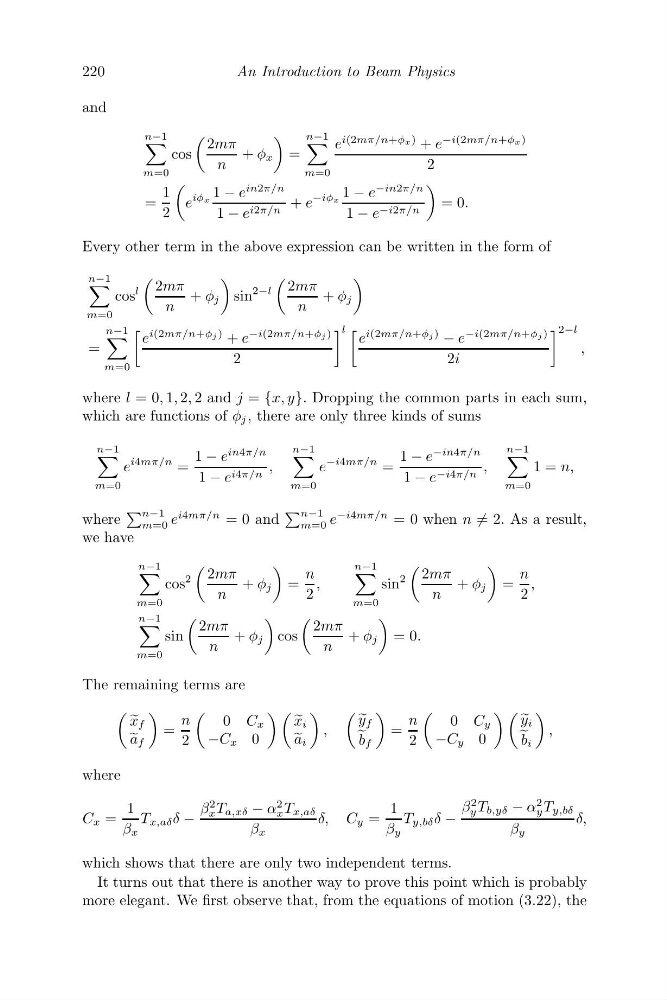
which shows that there are only two independent terms.
It turns out that there is another way to prove this point which is probably
more elegant. We first observe that, from the equations of motion (3.22), the
An Introduction to Beam Physics
and
n−1
m=0
cos
2mπ
n
+ φ x
=
n−1
m=0
e
i(2mπ/n+φx) + e
−i(2mπ/n+φx)
2
=
1
2
e
iφx 1 − e
in2π/n
1 − e i2π/n + e
−iφx 1 − e
−in2π/n
1 − e −i2π/n
= 0.
Every other term in the above expression can be written in the form of
n−1
m=0
cos
l
2mπ
n
+ φ j
sin
2−l
2mπ
n
+ φ j
=
n−1
m=0
e
i(2mπ/n+φj ) + e
−i(2mπ/n+φj )
2
l
e
i(2mπ/n+φj)
− e
−i(2mπ/n+φj )
2i
2−l
,
where l = 0, 1, 2, 2 and j = {x, y}. Dropping the common parts in each sum,
which are functions of φ j , there are only three kinds of sums
n−1
m=0
e
i4mπ/n =
1 − e
in4π/n
1 − e i4π/n ,
n−1
m=0
e
−i4mπ/n =
1 − e
−in4π/n
1 − e −i4π/n ,
n−1
m=0
1 = n,
where
n−1
m=0 e
i4mπ/n = 0 and
n−1
m=0 e
−i4mπ/n = 0 when n = 2. As a result,
we have
n−1
m=0
cos
2
2mπ
n
+ φ j
=
n
2
,
n−1
m=0
sin
2
2mπ
n
+ φ j
=
n
2
,
n−1
m=0
sin
2mπ
n
+ φ j
cos
2mπ
n
+ φ j
= 0.
The remaining terms are
x f
a f
=
n
2
0 C x
−C x 0
x i
a i
,
y f
b f
=
n
2
0 C y
−C y 0
y i
b i
,
where
C x =
1
β x
T x,aδ δ −
β
2
x T a,xδ − α
2
x T x,aδ
β x
δ, C y =
1
β y
T y,bδ δ −
β
2
y T b,yδ − α
2
y T y,bδ
β y
δ,
which shows that there are only two independent terms.
It turns out that there is another way to prove this point which is probably
more elegant. We first observe that, from the equations of motion (3.22), the