

Lattice Modules
215
For a stable FODO cell, which is what we are interested in, we can write
the matrix ˆ
R explicitly, which is
ˆ
R =
cos μ + α sin μ
βsin μ
−γ sin μ
cos μ − α sin μ
.
In the normalized space,
ˆ
R = ˆ
A ˆ
R ˆ
A
−1 =
cos μ sin μ
− sin μ cos μ
and
ˆ
M =
ˆ
A 0
0 1
ˆ
R
d
0 1
ˆ
A
−1 0
0 1
=
ˆ
R ˆ
A
d
0 1
=
ˆ
R
d
0 1
,
where
d = ˆ
A
d =
d/
√
β
(αd + βd
) /
√
β
with d = (x|δ) and d
= (a|δ). As a result, we have
ˆ
R
k
=
cos (kμ) sin (kμ)
− sin (kμ) cos(kμ)
,
n−1
k=0
ˆ
R
k =
n−1
k=0
cos (kμ) sin (kμ)
− sin (kμ) cos(kμ)
=
n−1
k=0
e
ikμ + e
−ikμ
/2
e
ikμ
− e
−ikμ
/2i
−
e
ikμ
− e
−ikμ
/2i
e
ikμ + e
−ikμ
/2
=
(A + B) /2 (A − B) /2i
− (A − B) /2i (A + B) /2
,
where
A =
n−1
k=0
e
ikμ =
1 − e
inμ
1 − e iμ , B =
n−1
k=0
e
−ikμ =
1 − e
−inμ
1 − e −iμ .
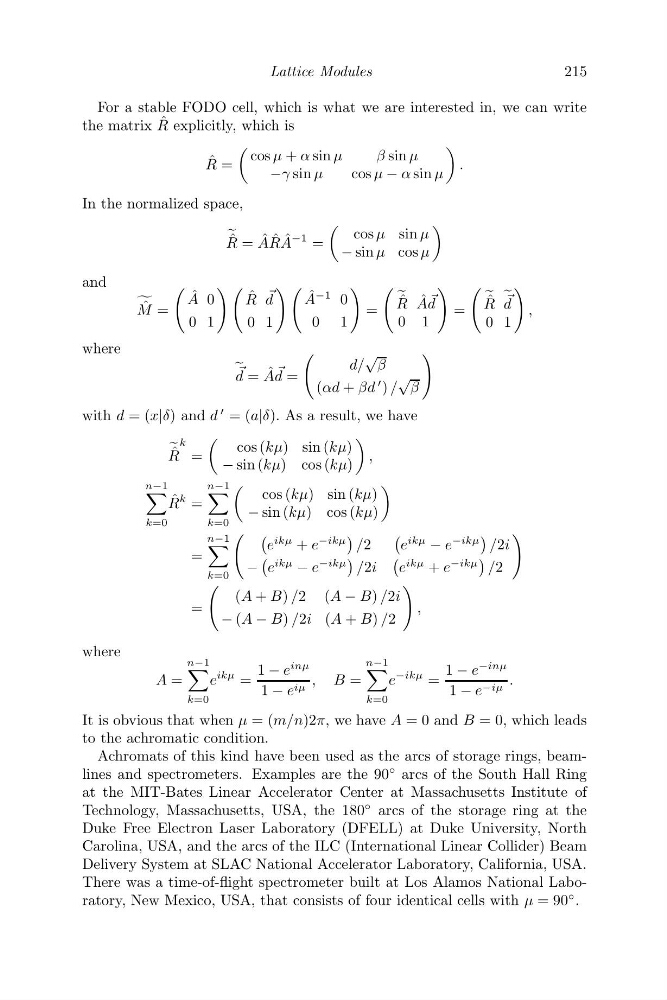
It is obvious that when μ = (m/n)2π, we have A = 0 and B = 0, which leads
to the achromatic condition.
Achromats of this kind have been used as the arcs of storage rings, beamlines and spectrometers. Examples are the 90
◦ arcs of the South Hall Ring
at the MIT-Bates Linear Accelerator Center at Massachusetts Institute of
Technology, Massachusetts, USA, the 180
◦ arcs of the storage ring at the
Duke Free Electron Laser Laboratory (DFELL) at Duke University, North
Carolina, USA, and the arcs of the ILC (International Linear Collider) Beam
Delivery System at SLAC National Accelerator Laboratory, California, USA.
There was a time-of-flight spectrometer built at Los Alamos National Laboratory, New Mexico, USA, that consists of four identical cells with μ = 90
◦ .
215
For a stable FODO cell, which is what we are interested in, we can write
the matrix ˆ
R explicitly, which is
ˆ
R =
cos μ + α sin μ
βsin μ
−γ sin μ
cos μ − α sin μ
.
In the normalized space,
ˆ
R = ˆ
A ˆ
R ˆ
A
−1 =
cos μ sin μ
− sin μ cos μ
and
ˆ
M =
ˆ
A 0
0 1
ˆ
R
d
0 1
ˆ
A
−1 0
0 1
=
ˆ
R ˆ
A
d
0 1
=
ˆ
R
d
0 1
,
where
d = ˆ
A
d =
d/
√
β
(αd + βd
) /
√
β
with d = (x|δ) and d
= (a|δ). As a result, we have
ˆ
R
k
=
cos (kμ) sin (kμ)
− sin (kμ) cos(kμ)
,
n−1
k=0
ˆ
R
k =
n−1
k=0
cos (kμ) sin (kμ)
− sin (kμ) cos(kμ)
=
n−1
k=0
e
ikμ + e
−ikμ
/2
e
ikμ
− e
−ikμ
/2i
−
e
ikμ
− e
−ikμ
/2i
e
ikμ + e
−ikμ
/2
=
(A + B) /2 (A − B) /2i
− (A − B) /2i (A + B) /2
,
where
A =
n−1
k=0
e
ikμ =
1 − e
inμ
1 − e iμ , B =
n−1
k=0
e
−ikμ =
1 − e
−inμ
1 − e −iμ .
It is obvious that when μ = (m/n)2π, we have A = 0 and B = 0, which leads
to the achromatic condition.
Achromats of this kind have been used as the arcs of storage rings, beamlines and spectrometers. Examples are the 90
◦ arcs of the South Hall Ring
at the MIT-Bates Linear Accelerator Center at Massachusetts Institute of
Technology, Massachusetts, USA, the 180
◦ arcs of the storage ring at the
Duke Free Electron Laser Laboratory (DFELL) at Duke University, North
Carolina, USA, and the arcs of the ILC (International Linear Collider) Beam
Delivery System at SLAC National Accelerator Laboratory, California, USA.
There was a time-of-flight spectrometer built at Los Alamos National Laboratory, New Mexico, USA, that consists of four identical cells with μ = 90
◦ .