

214
An Introduction to Beam Physics
focusing and defocusing quadrupoles, respectively. When
k sF =
1
f D max
=
sin (μ/2)
2f 2 θ [1 + sin(μ/2)/2]
,
k sF = −
1
f D min
= −
sin (μ/2)
2f 2 θ [1 − sin(μ/2)/2]
,
the chromaticities are corrected. Note that the relation l = 2f sin (μ/2) is
used to obtain the above expressions.
9.1.1 The FODO Cell Based Achromat
Achromats are needed because dispersion free straight sections are needed
in both circular accelerators and beam transport lines. Achromatic sections
are also required in circular machines, where, for example, straight sections
that house injection and extraction kickers are dispersion free to make the
beam small. The straight section where RF cavities are located is also dispersion free. Passing a RF cavity with x-δ correlation produces coupling
between transverse and longitudinal motion, which is usually undesirable.
In the case of beam transport lines, achromatic conditions have to be met
when the matching requirement is such that the line is imaging or the line is
isochronous.
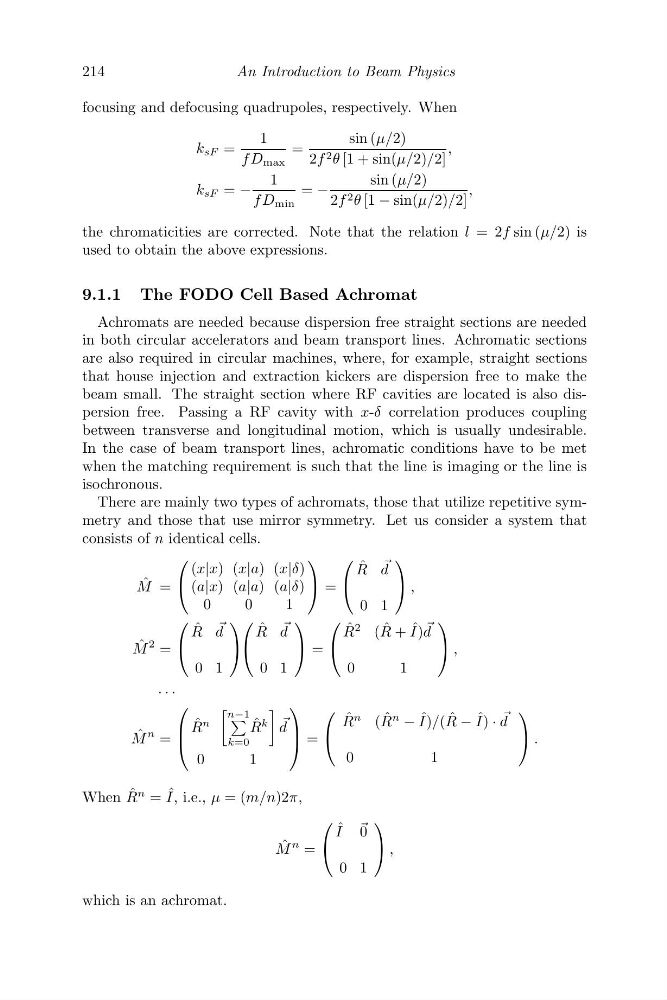
There are mainly two types of achromats, those that utilize repetitive symmetry and those that use mirror symmetry. Let us consider a system that
consists of n identical cells.
ˆ
M =
⎛
⎝
(x|x) (x|a) (x|δ)
(a|x) (a|a) (a|δ)
0
0
1
⎞
⎠ =
⎛
⎝
ˆ
R
d
0 1
⎞
⎠ ,
ˆ
M
2 =
⎛
⎝
ˆ
R
d
0 1
⎞
⎠
⎛
⎝
ˆ
R
d
0 1
⎞
⎠ =
⎛
⎝
ˆ
R
2 ( ˆ
R + ˆ
I)
d
0
1
⎞
⎠ ,
· · ·
ˆ
M
n =
⎛
⎜
⎝
ˆ
R
n
n−1
k=0
ˆ
R
k
d
0
1
⎞
⎟
⎠ =
⎛
⎝
ˆ
R
n ( ˆ
R
n
− ˆ
I)/( ˆ
R − ˆ
I) ·
d
0
1
⎞
⎠ .
When ˆ
R
n = ˆ
I, i.e., μ = (m/n)2π,
ˆ
M
n =
⎛
⎝
ˆ
I 0
0 1
⎞
⎠ ,
which is an achromat.
An Introduction to Beam Physics
focusing and defocusing quadrupoles, respectively. When
k sF =
1
f D max
=
sin (μ/2)
2f 2 θ [1 + sin(μ/2)/2]
,
k sF = −
1
f D min
= −
sin (μ/2)
2f 2 θ [1 − sin(μ/2)/2]
,
the chromaticities are corrected. Note that the relation l = 2f sin (μ/2) is
used to obtain the above expressions.
9.1.1 The FODO Cell Based Achromat
Achromats are needed because dispersion free straight sections are needed
in both circular accelerators and beam transport lines. Achromatic sections
are also required in circular machines, where, for example, straight sections
that house injection and extraction kickers are dispersion free to make the
beam small. The straight section where RF cavities are located is also dispersion free. Passing a RF cavity with x-δ correlation produces coupling
between transverse and longitudinal motion, which is usually undesirable.
In the case of beam transport lines, achromatic conditions have to be met
when the matching requirement is such that the line is imaging or the line is
isochronous.
There are mainly two types of achromats, those that utilize repetitive symmetry and those that use mirror symmetry. Let us consider a system that
consists of n identical cells.
ˆ
M =
⎛
⎝
(x|x) (x|a) (x|δ)
(a|x) (a|a) (a|δ)
0
0
1
⎞
⎠ =
⎛
⎝
ˆ
R
d
0 1
⎞
⎠ ,
ˆ
M
2 =
⎛
⎝
ˆ
R
d
0 1
⎞
⎠
⎛
⎝
ˆ
R
d
0 1
⎞
⎠ =
⎛
⎝
ˆ
R
2 ( ˆ
R + ˆ
I)
d
0
1
⎞
⎠ ,
· · ·
ˆ
M
n =
⎛
⎜
⎝
ˆ
R
n
n−1
k=0
ˆ
R
k
d
0
1
⎞
⎟
⎠ =
⎛
⎝
ˆ
R
n ( ˆ
R
n
− ˆ
I)/( ˆ
R − ˆ
I) ·
d
0
1
⎞
⎠ .
When ˆ
R
n = ˆ
I, i.e., μ = (m/n)2π,
ˆ
M
n =
⎛
⎝
ˆ
I 0
0 1
⎞
⎠ ,
which is an achromat.