

152
An Introduction to Beam Physics
x
a
x
a
drift
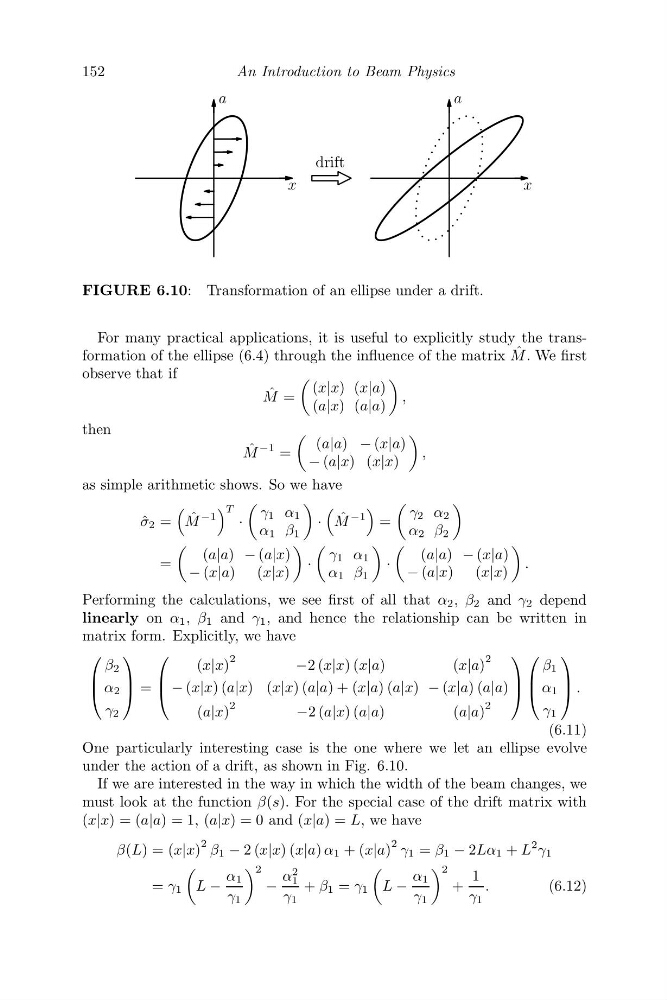
FIGURE 6.10: Transformation of an ellipse under a drift.
For many practical applications, it is useful to explicitly study the transformation of the ellipse (6.4) through the influence of the matrix ˆ
M . We first
observe that if
ˆ
M =
(x|x) (x|a)
(a|x) (a|a)
,
then
ˆ
M
−1 =
(a|a) − (x|a)
− (a|x) (x|x)
,
as simple arithmetic shows. So we have
ˆ
σ 2 =
ˆ
M
−1
T ·
γ 1 α 1
α 1 β 1
·
ˆ
M
−1
=
γ 2 α 2
α 2 β 2
=
(a|a) − (a|x)
− (x|a) (x|x)
·
γ 1 α 1
α 1 β 1
·
(a|a) − (x|a)
− (a|x) (x|x)
.
Performing the calculations, we see first of all that α 2 , β 2 and γ 2 depend
linearly on α 1 , β 1 and γ 1 , and hence the relationship can be written in
matrix form. Explicitly, we have
⎛
⎜
⎝
β 2
α 2
γ 2
⎞
⎟
⎠ =
⎛
⎜
⎝
(x|x)
2
−2 (x|x) (x|a)
( x|a)
2
− (x|x) (a|x) (x|x) (a|a) + (x|a) (a|x) − (x|a) (a|a)
(a|x)
2
−2 (a|x) (a|a)
( a|a)
2
⎞
⎟
⎠
⎛
⎜
⎝
β 1
α 1
γ 1
⎞
⎟
⎠ .
(6.11)
One particularly interesting case is the one where we let an ellipse evolve
under the action of a drift, as shown in Fig. 6.10.
If we are interested in the way in which the width of the beam changes, we
must look at the function β(s). For the special case of the drift matrix with
(x|x) = (a|a) = 1, (a|x) = 0 and (x|a) = L, we have
β(L) = (x|x)
2 β 1 − 2 (x|x) (x|a) α 1 + (x|a)
2 γ 1 = β 1 − 2Lα 1 + L
2 γ 1
= γ 1
L −
α 1
γ 1
2
−
α
2
1
γ 1
+ β 1 = γ 1
L −
α 1
γ 1
2
+
1
γ 1
.
(6.12)
An Introduction to Beam Physics
x
a
x
a
drift
FIGURE 6.10: Transformation of an ellipse under a drift.
For many practical applications, it is useful to explicitly study the transformation of the ellipse (6.4) through the influence of the matrix ˆ
M . We first
observe that if
ˆ
M =
(x|x) (x|a)
(a|x) (a|a)
,
then
ˆ
M
−1 =
(a|a) − (x|a)
− (a|x) (x|x)
,
as simple arithmetic shows. So we have
ˆ
σ 2 =
ˆ
M
−1
T ·
γ 1 α 1
α 1 β 1
·
ˆ
M
−1
=
γ 2 α 2
α 2 β 2
=
(a|a) − (a|x)
− (x|a) (x|x)
·
γ 1 α 1
α 1 β 1
·
(a|a) − (x|a)
− (a|x) (x|x)
.
Performing the calculations, we see first of all that α 2 , β 2 and γ 2 depend
linearly on α 1 , β 1 and γ 1 , and hence the relationship can be written in
matrix form. Explicitly, we have
⎛
⎜
⎝
β 2
α 2
γ 2
⎞
⎟
⎠ =
⎛
⎜
⎝
(x|x)
2
−2 (x|x) (x|a)
( x|a)
2
− (x|x) (a|x) (x|x) (a|a) + (x|a) (a|x) − (x|a) (a|a)
(a|x)
2
−2 (a|x) (a|a)
( a|a)
2
⎞
⎟
⎠
⎛
⎜
⎝
β 1
α 1
γ 1
⎞
⎟
⎠ .
(6.11)
One particularly interesting case is the one where we let an ellipse evolve
under the action of a drift, as shown in Fig. 6.10.
If we are interested in the way in which the width of the beam changes, we
must look at the function β(s). For the special case of the drift matrix with
(x|x) = (a|a) = 1, (a|x) = 0 and (x|a) = L, we have
β(L) = (x|x)
2 β 1 − 2 (x|x) (x|a) α 1 + (x|a)
2 γ 1 = β 1 − 2Lα 1 + L
2 γ 1
= γ 1
L −
α 1
γ 1
2
−
α
2
1
γ 1
+ β 1 = γ 1
L −
α 1
γ 1
2
+
1
γ 1
.
(6.12)