

Linear Phase Space Motion
151
Plugging them into the equation
R 11 (s)R 22 (s) − R 12 (s)R 21 (s) = 1,
we obtain
R
2
11 (s) + R
2
12 (s) = 1.
Therefore, the matrix elements can be expressed as trigonometric functions
of a single variable φ(s) and the matrix ˆ
R(s) takes the form
ˆ
R(s) =
cos φ(s) sinφ(s)
− sin φ(s) cos φ(s)
.
(6.8)
Since ˆ
R(0) = ˆ
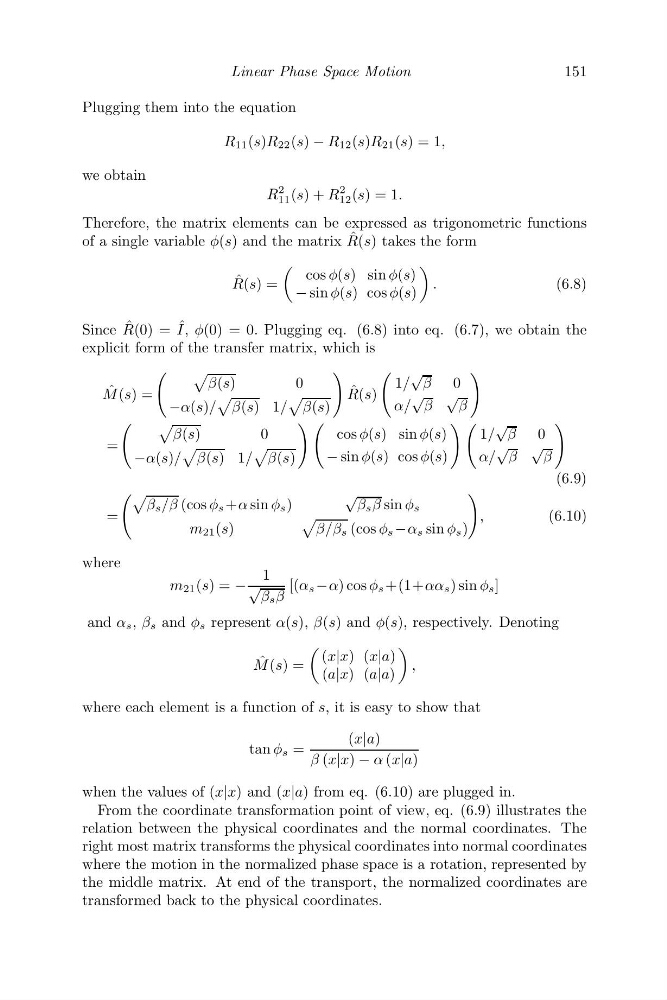
I, φ(0) = 0. Plugging eq. (6.8) into eq. (6.7), we obtain the
explicit form of the transfer matrix, which is
ˆ
M (s) =
β(s)
0
−α(s)/
β(s) 1/
β(s)
ˆ
R(s)
1/
√
β 0
α/
√
β
√
β
=
β(s)
0
−α(s)/
β(s) 1/
β(s)
cos φ(s) sinφ(s)
− sin φ(s) cos φ(s)
1/
√
β 0
α/
√
β
√
β
(6.9)
=
β s /β (cos φ s +α sin φ s )
√
β s β sin φ s
m 21 (s)
β/β s (cos φ s −α s sin φ s )
,
(6.10)
where
m 21 (s) = −
1
√
β s β
[(α s −α) cos φ s +(1+αα s ) sin φ s ]
and α s , β s and φ s represent α(s), β(s) and φ(s), respectively. Denoting
ˆ
M (s) =
(x|x) (x|a)
(a|x) (a|a)
,
where each element is a function of s, it is easy to show that
tan φ s =
(x|a)
β (x|x) − α (x|a)
when the values of (x|x) and (x|a) from eq. (6.10) are plugged in.
From the coordinate transformation point of view, eq. (6.9) illustrates the
relation between the physical coordinates and the normal coordinates. The
right most matrix transforms the physical coordinates into normal coordinates
where the motion in the normalized phase space is a rotation, represented by
the middle matrix. At end of the transport, the normalized coordinates are
transformed back to the physical coordinates.
151
Plugging them into the equation
R 11 (s)R 22 (s) − R 12 (s)R 21 (s) = 1,
we obtain
R
2
11 (s) + R
2
12 (s) = 1.
Therefore, the matrix elements can be expressed as trigonometric functions
of a single variable φ(s) and the matrix ˆ
R(s) takes the form
ˆ
R(s) =
cos φ(s) sinφ(s)
− sin φ(s) cos φ(s)
.
(6.8)
Since ˆ
R(0) = ˆ
I, φ(0) = 0. Plugging eq. (6.8) into eq. (6.7), we obtain the
explicit form of the transfer matrix, which is
ˆ
M (s) =
β(s)
0
−α(s)/
β(s) 1/
β(s)
ˆ
R(s)
1/
√
β 0
α/
√
β
√
β
=
β(s)
0
−α(s)/
β(s) 1/
β(s)
cos φ(s) sinφ(s)
− sin φ(s) cos φ(s)
1/
√
β 0
α/
√
β
√
β
(6.9)
=
β s /β (cos φ s +α sin φ s )
√
β s β sin φ s
m 21 (s)
β/β s (cos φ s −α s sin φ s )
,
(6.10)
where
m 21 (s) = −
1
√
β s β
[(α s −α) cos φ s +(1+αα s ) sin φ s ]
and α s , β s and φ s represent α(s), β(s) and φ(s), respectively. Denoting
ˆ
M (s) =
(x|x) (x|a)
(a|x) (a|a)
,
where each element is a function of s, it is easy to show that
tan φ s =
(x|a)
β (x|x) − α (x|a)
when the values of (x|x) and (x|a) from eq. (6.10) are plugged in.
From the coordinate transformation point of view, eq. (6.9) illustrates the
relation between the physical coordinates and the normal coordinates. The
right most matrix transforms the physical coordinates into normal coordinates
where the motion in the normalized phase space is a rotation, represented by
the middle matrix. At end of the transport, the normalized coordinates are
transformed back to the physical coordinates.