

Linear Phase Space Motion
143
x
a
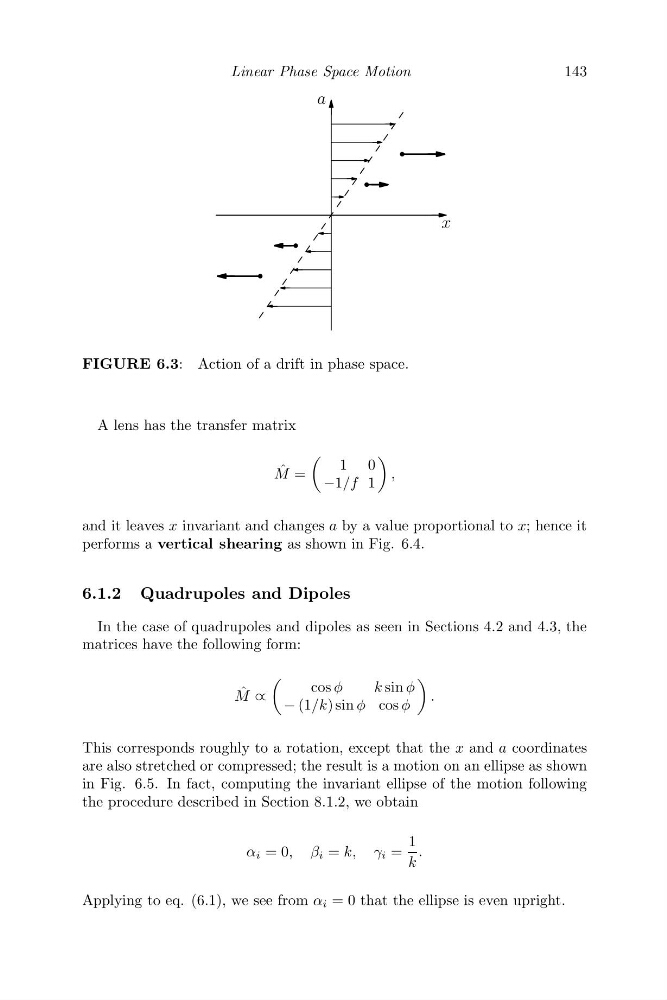
FIGURE 6.3: Action of a drift in phase space.
A lens has the transfer matrix
ˆ
M =
1 0
−1/f 1
,
and it leaves x invariant and changes a by a value proportional to x; hence it
performs a vertical shearing as shown in Fig. 6.4.
6.1.2 Quadrupoles and Dipoles
In the case of quadrupoles and dipoles as seen in Sections 4.2 and 4.3, the
matrices have the following form:
ˆ
M ∝
cos φ
ksin φ
− (1/k) sin φ cos φ
.
This corresponds roughly to a rotation, except that the x and a coordinates
are also stretched or compressed; the result is a motion on an ellipse as shown
in Fig. 6.5. In fact, computing the invariant ellipse of the motion following
the procedure described in Section 8.1.2, we obtain
α i = 0, β i = k, γ i =
1
k
.
Applying to eq. (6.1), we see from α i = 0 that the ellipse is even upright.
143
x
a
FIGURE 6.3: Action of a drift in phase space.
A lens has the transfer matrix
ˆ
M =
1 0
−1/f 1
,
and it leaves x invariant and changes a by a value proportional to x; hence it
performs a vertical shearing as shown in Fig. 6.4.
6.1.2 Quadrupoles and Dipoles
In the case of quadrupoles and dipoles as seen in Sections 4.2 and 4.3, the
matrices have the following form:
ˆ
M ∝
cos φ
ksin φ
− (1/k) sin φ cos φ
.
This corresponds roughly to a rotation, except that the x and a coordinates
are also stretched or compressed; the result is a motion on an ellipse as shown
in Fig. 6.5. In fact, computing the invariant ellipse of the motion following
the procedure described in Section 8.1.2, we obtain
α i = 0, β i = k, γ i =
1
k
.
Applying to eq. (6.1), we see from α i = 0 that the ellipse is even upright.