

142
An Introduction to Beam Physics
x 2
a 2
x 1
a 1
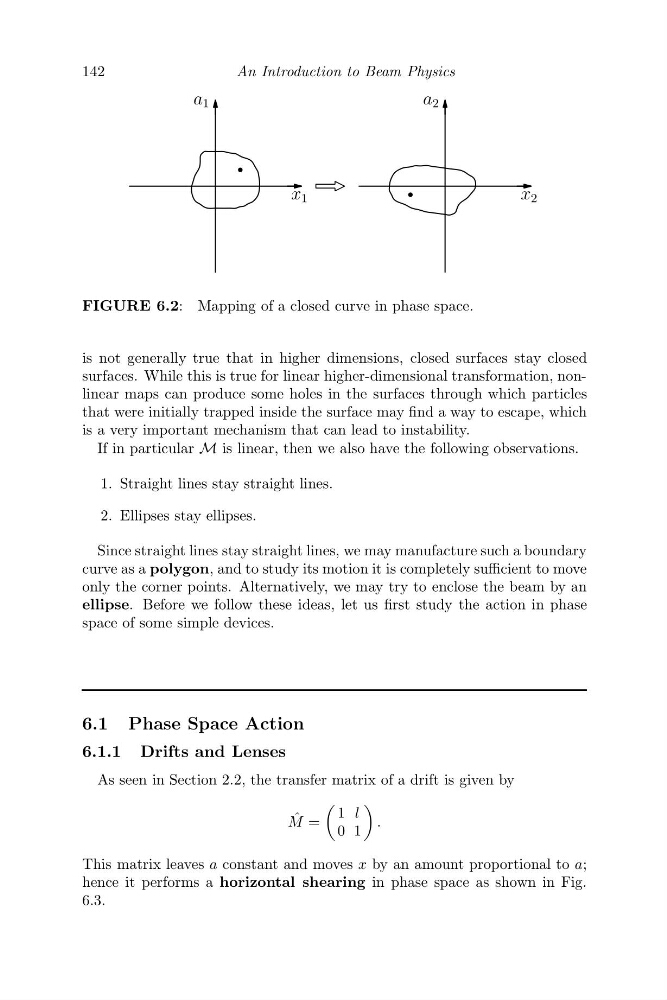
FIGURE 6.2: Mapping of a closed curve in phase space.
is not generally true that in higher dimensions, closed surfaces stay closed
surfaces. While this is true for linear higher-dimensional transformation, nonlinear maps can produce some holes in the surfaces through which particles
that were initially trapped inside the surface may find a way to escape, which
is a very important mechanism that can lead to instability.
If in particular M is linear, then we also have the following observations.
1. Straight lines stay straight lines.
2. Ellipses stay ellipses.
Since straight lines stay straight lines, we may manufacture such a boundary
curve as a polygon, and to study its motion it is completely sufficient to move
only the corner points. Alternatively, we may try to enclose the beam by an
ellipse. Before we follow these ideas, let us first study the action in phase
space of some simple devices.
6.1 Phase Space Action
6.1.1 Drifts and Lenses
As seen in Section 2.2, the transfer matrix of a drift is given by
ˆ
M =
1 l
0 1
.
This matrix leaves a constant and moves x by an amount proportional to a;
hence it performs a horizontal shearing in phase space as shown in Fig.
6.3.
An Introduction to Beam Physics
x 2
a 2
x 1
a 1
FIGURE 6.2: Mapping of a closed curve in phase space.
is not generally true that in higher dimensions, closed surfaces stay closed
surfaces. While this is true for linear higher-dimensional transformation, nonlinear maps can produce some holes in the surfaces through which particles
that were initially trapped inside the surface may find a way to escape, which
is a very important mechanism that can lead to instability.
If in particular M is linear, then we also have the following observations.
1. Straight lines stay straight lines.
2. Ellipses stay ellipses.
Since straight lines stay straight lines, we may manufacture such a boundary
curve as a polygon, and to study its motion it is completely sufficient to move
only the corner points. Alternatively, we may try to enclose the beam by an
ellipse. Before we follow these ideas, let us first study the action in phase
space of some simple devices.
6.1 Phase Space Action
6.1.1 Drifts and Lenses
As seen in Section 2.2, the transfer matrix of a drift is given by
ˆ
M =
1 l
0 1
.
This matrix leaves a constant and moves x by an amount proportional to a;
hence it performs a horizontal shearing in phase space as shown in Fig.
6.3.