

106
An Introduction to Beam Physics
We observe ( ˆ
M
out )
−1 = ˆ
M
in , and both of the matrices have determinant 1.
We discussed the behavior of the edges in Section 4.4.2.2, and we can now
determine the change in the longitudinal angular momentum across the edges.
At the entrance edge, using eqs. (4.22),
z f × c f = z i × ( c i − ω ˆ
JJ z i ) = z i × c i − ωω z i × ( ˆ
JJ z i )
= z i × c i − ω
x i
y i
×
y i
−x i
= z i × c i + ω
x
2
i + y
2
i
e s = z i × c i + ωr
2
i e s ,
where e s is the longitudinal unit vector. Thus the amount of angular momentum generated is ωr
2
i at the entrance and −ωr
2
i at the exit.
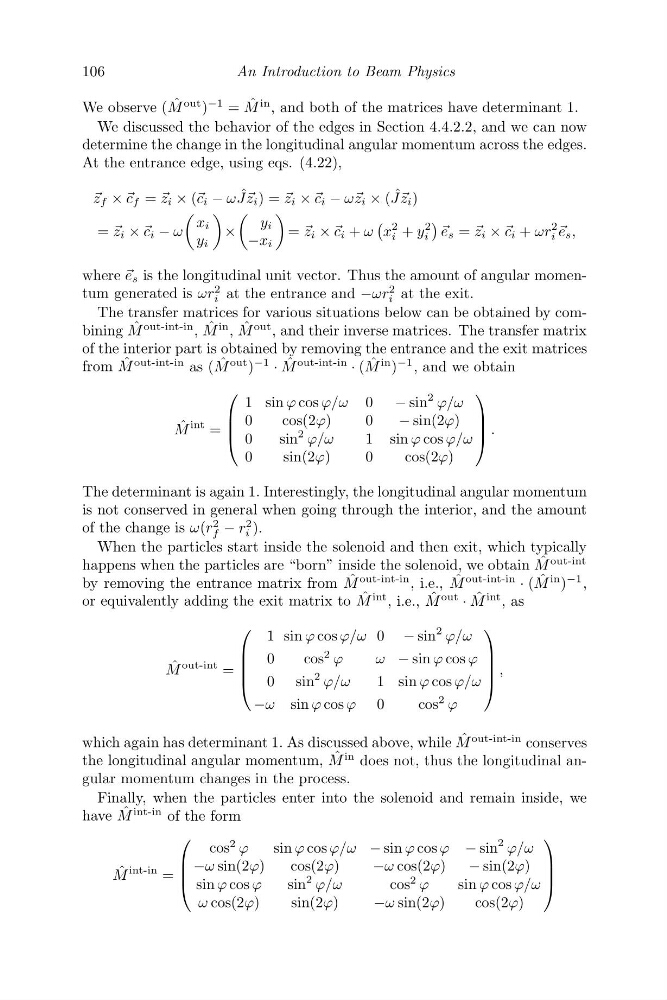
The transfer matrices for various situations below can be obtained by combining ˆ
M
out-int-in , ˆ
M
in , ˆ
M
out , and their inverse matrices. The transfer matrix
of the interior part is obtained by removing the entrance and the exit matrices
from ˆ
M
out-int-in as ( ˆ
M
out )
−1
· ˆ
M
out-int-in
· ( ˆ
M
in )
−1 , and we obtain
ˆ
M
int =
⎛
⎜
⎜
⎝
1 sinϕ cos ϕ/ω 0 − sin
2 ϕ/ω
0
cos(2ϕ)
0
− sin(2ϕ)
0
sin
2 ϕ/ω
1 sinϕ cos ϕ/ω
0
sin(2ϕ)
0
cos(2ϕ)
⎞
⎟
⎟
⎠ .
The determinant is again 1. Interestingly, the longitudinal angular momentum
is not conserved in general when going through the interior, and the amount
of the change is ω(r
2
f − r
2
i ).
When the particles start inside the solenoid and then exit, which typically
happens when the particles are “born” inside the solenoid, we obtain ˆ
M
out-int
by removing the entrance matrix from ˆ
M
out-int-in , i.e., ˆ
M
out-int-in
· ( ˆ
M
in )
−1 ,
or equivalently adding the exit matrix to ˆ
M
int , i.e., ˆ
M
out
· ˆ
M
int , as
ˆ
M
out-int =
⎛
⎜
⎜
⎜
⎝
1 sin ϕ cos ϕ/ω 0 − sin
2 ϕ/ω
0
cos
2 ϕ
ω − sin ϕ cos ϕ
0 sin
2 ϕ/ω
1 sinϕ cos ϕ/ω
−ω sin ϕ cos ϕ 0
cos
2 ϕ
⎞
⎟
⎟
⎟
⎠
,
which again has determinant 1. As discussed above, while ˆ
M
out-int-in conserves
the longitudinal angular momentum, ˆ
M
in does not, thus the longitudinal angular momentum changes in the process.
Finally, when the particles enter into the solenoid and remain inside, we
have ˆ
M
int-in of the form
ˆ
M
int-in =
⎛
⎜
⎜
⎝
cos
2 ϕ
sin ϕ cos ϕ/ω − sin ϕ cos ϕ − sin
2 ϕ/ω
−ω sin(2ϕ)
cos(2ϕ)
−ω cos(2ϕ)
− sin(2ϕ)
sin ϕ cos ϕ
sin
2 ϕ/ω
cos
2 ϕ
sin ϕ cos ϕ/ω
ω cos(2ϕ)
sin(2ϕ)
−ω sin(2ϕ)
cos(2ϕ)
⎞
⎟
⎟
⎠
An Introduction to Beam Physics
We observe ( ˆ
M
out )
−1 = ˆ
M
in , and both of the matrices have determinant 1.
We discussed the behavior of the edges in Section 4.4.2.2, and we can now
determine the change in the longitudinal angular momentum across the edges.
At the entrance edge, using eqs. (4.22),
z f × c f = z i × ( c i − ω ˆ
JJ z i ) = z i × c i − ωω z i × ( ˆ
JJ z i )
= z i × c i − ω
x i
y i
×
y i
−x i
= z i × c i + ω
x
2
i + y
2
i
e s = z i × c i + ωr
2
i e s ,
where e s is the longitudinal unit vector. Thus the amount of angular momentum generated is ωr
2
i at the entrance and −ωr
2
i at the exit.
The transfer matrices for various situations below can be obtained by combining ˆ
M
out-int-in , ˆ
M
in , ˆ
M
out , and their inverse matrices. The transfer matrix
of the interior part is obtained by removing the entrance and the exit matrices
from ˆ
M
out-int-in as ( ˆ
M
out )
−1
· ˆ
M
out-int-in
· ( ˆ
M
in )
−1 , and we obtain
ˆ
M
int =
⎛
⎜
⎜
⎝
1 sinϕ cos ϕ/ω 0 − sin
2 ϕ/ω
0
cos(2ϕ)
0
− sin(2ϕ)
0
sin
2 ϕ/ω
1 sinϕ cos ϕ/ω
0
sin(2ϕ)
0
cos(2ϕ)
⎞
⎟
⎟
⎠ .
The determinant is again 1. Interestingly, the longitudinal angular momentum
is not conserved in general when going through the interior, and the amount
of the change is ω(r
2
f − r
2
i ).
When the particles start inside the solenoid and then exit, which typically
happens when the particles are “born” inside the solenoid, we obtain ˆ
M
out-int
by removing the entrance matrix from ˆ
M
out-int-in , i.e., ˆ
M
out-int-in
· ( ˆ
M
in )
−1 ,
or equivalently adding the exit matrix to ˆ
M
int , i.e., ˆ
M
out
· ˆ
M
int , as
ˆ
M
out-int =
⎛
⎜
⎜
⎜
⎝
1 sin ϕ cos ϕ/ω 0 − sin
2 ϕ/ω
0
cos
2 ϕ
ω − sin ϕ cos ϕ
0 sin
2 ϕ/ω
1 sinϕ cos ϕ/ω
−ω sin ϕ cos ϕ 0
cos
2 ϕ
⎞
⎟
⎟
⎟
⎠
,
which again has determinant 1. As discussed above, while ˆ
M
out-int-in conserves
the longitudinal angular momentum, ˆ
M
in does not, thus the longitudinal angular momentum changes in the process.
Finally, when the particles enter into the solenoid and remain inside, we
have ˆ
M
int-in of the form
ˆ
M
int-in =
⎛
⎜
⎜
⎝
cos
2 ϕ
sin ϕ cos ϕ/ω − sin ϕ cos ϕ − sin
2 ϕ/ω
−ω sin(2ϕ)
cos(2ϕ)
−ω cos(2ϕ)
− sin(2ϕ)
sin ϕ cos ϕ
sin
2 ϕ/ω
cos
2 ϕ
sin ϕ cos ϕ/ω
ω cos(2ϕ)
sin(2ϕ)
−ω sin(2ϕ)
cos(2ϕ)
⎞
⎟
⎟
⎠