

100
An Introduction to Beam Physics
x
y
x 1 x 2
x 3
r 1
r 2
r 3
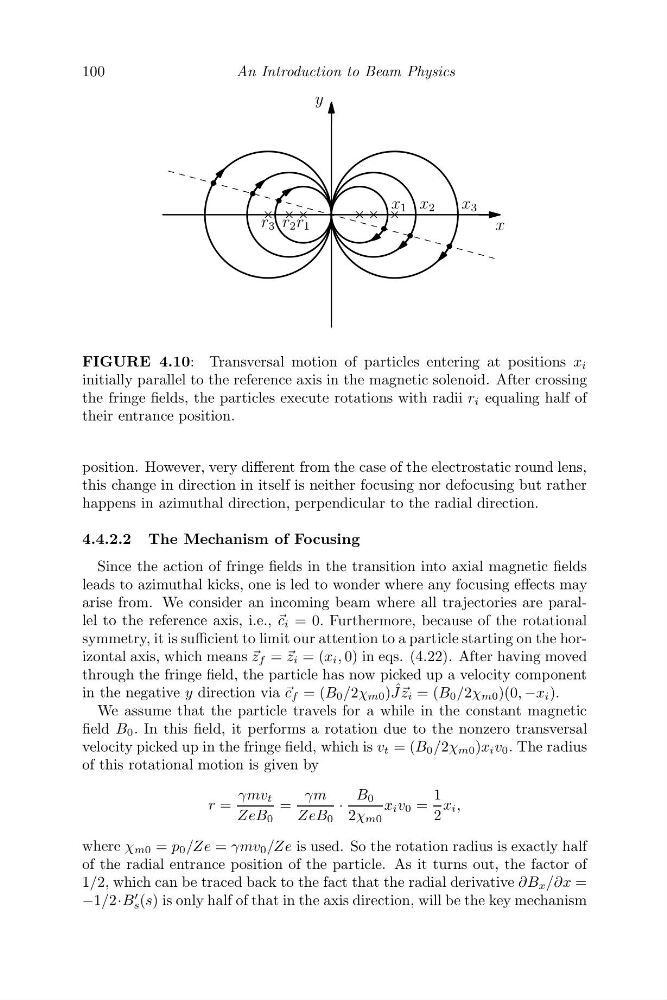
FIGURE 4.10: Transversal motion of particles entering at positions x i
initially parallel to the reference axis in the magnetic solenoid. After crossing
the fringe fields, the particles execute rotations with radii r i equaling half of
their entrance position.
position. However, very different from the case of the electrostatic round lens,
this change in direction in itself is neither focusing nor defocusing but rather
happens in azimuthal direction, perpendicular to the radial direction.
4.4.2.2 The Mechanism of Focusing
Since the action of fringe fields in the transition into axial magnetic fields
leads to azimuthal kicks, one is led to wonder where any focusing effects may
arise from. We consider an incoming beam where all trajectories are parallel to the reference axis, i.e., c i = 0. Furthermore, because of the rotational
symmetry, it is sufficient to limit our attention to a particle starting on the horizontal axis, which means z f = z i = (x i , 0) in eqs. (4.22). After having moved
through the fringe field, the particle has now picked up a velocity component
in the negative y direction via c f = (B 0 /2χ m0 ) ˆ
JJ z i = (B 0 /2χ m0 )(0, −x i ).
We assume that the particle travels for a while in the constant magnetic
field B 0 . In this field, it performs a rotation due to the nonzero transversal
velocity picked up in the fringe field, which is v t = (B 0 /2χ m0 )x i v 0 . The radius
of this rotational motion is given by
r =
γmv t
ZeB 0
=
γm
ZeB 0
·
B 0
2χ m0
x i v 0 =
1
2
x i ,
where χ m0 = p 0 /Ze = γmv 0 /Ze is used. So the rotation radius is exactly half
of the radial entrance position of the particle. As it turns out, the factor of
1/2, which can be traced back to the fact that the radial derivative ∂B x /∂x =
−1/2·B
s (s) is only half of that in the axis direction, will be the key mechanism
An Introduction to Beam Physics
x
y
x 1 x 2
x 3
r 1
r 2
r 3
FIGURE 4.10: Transversal motion of particles entering at positions x i
initially parallel to the reference axis in the magnetic solenoid. After crossing
the fringe fields, the particles execute rotations with radii r i equaling half of
their entrance position.
position. However, very different from the case of the electrostatic round lens,
this change in direction in itself is neither focusing nor defocusing but rather
happens in azimuthal direction, perpendicular to the radial direction.
4.4.2.2 The Mechanism of Focusing
Since the action of fringe fields in the transition into axial magnetic fields
leads to azimuthal kicks, one is led to wonder where any focusing effects may
arise from. We consider an incoming beam where all trajectories are parallel to the reference axis, i.e., c i = 0. Furthermore, because of the rotational
symmetry, it is sufficient to limit our attention to a particle starting on the horizontal axis, which means z f = z i = (x i , 0) in eqs. (4.22). After having moved
through the fringe field, the particle has now picked up a velocity component
in the negative y direction via c f = (B 0 /2χ m0 ) ˆ
JJ z i = (B 0 /2χ m0 )(0, −x i ).
We assume that the particle travels for a while in the constant magnetic
field B 0 . In this field, it performs a rotation due to the nonzero transversal
velocity picked up in the fringe field, which is v t = (B 0 /2χ m0 )x i v 0 . The radius
of this rotational motion is given by
r =
γmv t
ZeB 0
=
γm
ZeB 0
·
B 0
2χ m0
x i v 0 =
1
2
x i ,
where χ m0 = p 0 /Ze = γmv 0 /Ze is used. So the rotation radius is exactly half
of the radial entrance position of the particle. As it turns out, the factor of
1/2, which can be traced back to the fact that the radial derivative ∂B x /∂x =
−1/2·B
s (s) is only half of that in the axis direction, will be the key mechanism