

The Linearization of the Equations of Motion
99
For a particle moving parallel to the s-axis without transversal momentum,
i.e., c i = 0, the second term in the c
equation, B
s /(2χ m0 )· ˆ
JJ z, acts to produce
a nonzero transversal momentum. Typically, the situation of B
s = 0 happens
in the fringe field regions near the entrance and the exit, and it is the main
reason why particles entering parallel to the s-axis will follow a transversely
rotating motion inside the magnetic round lens.
In the following, we will employ a dual approach in understanding the
motion of particles in the magnetic round lens. The quantitative approach
will be based on studying the equations of motion and solving them for certain
specific cases. But equally important is the qualitative understanding of where
the focusing effects of a magnetic round lens really come from.
4.4.2.1 Hard Edge Fringe Fields
We first discuss the fringe field effects appearing in an abrupt transition into
a region of axial field from a field-free region. In practice this situation arises
at the edge of a solenoid of very small radial aperture. We use the impulsive
kick approximation in a similar manner as applied to the dipole edge focusing
in Section 4.3.2. When entering into the solenoid of the constant field strength
B 0 at the idealized hard edge at s = 0, B s and B
s are expressed in terms of
the Heaviside step function H and the Dirac delta function δ defined in eqs.
(4.5) via
B s (s) = B 0 H(s),
B
s (s) = B 0 δ(s),
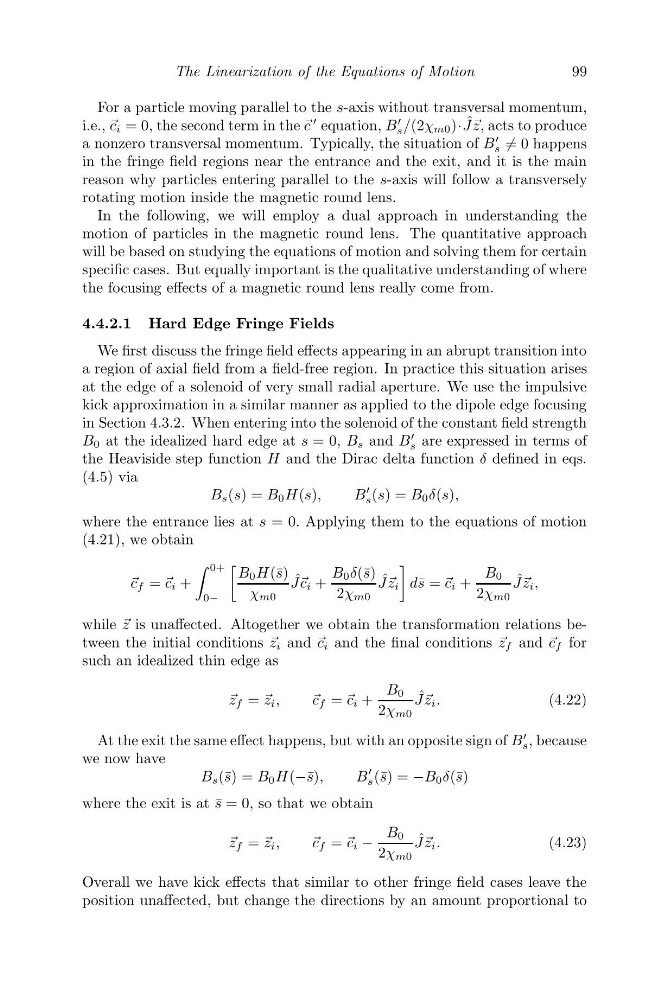
where the entrance lies at s = 0. Applying them to the equations of motion
(4.21), we obtain
c f = c i +
0+
0−
B 0 H(¯ s)
χ m0
ˆ
JJ c i +
B 0 δ(¯ s)
2χ m0
ˆ
JJ z i
d¯ s = c i +
B 0
2χ m0
ˆ
JJ z i ,
while z is unaffected. Altogether we obtain the transformation relations between the initial conditions z i and c i and the final conditions z f and c f for
such an idealized thin edge as
z f = z i ,
, c f = c i +
B 0
2χ m0
ˆ
JJ z i .
(4.22)
At the exit the same effect happens, but with an opposite sign of B
s , because
we now have
B s (¯ s) = B 0 H(−¯ s),
B
s (¯ s) = −B 0 δ(¯ s)
where the exit is at ¯
s = 0, so that we obtain
z f = z i ,
, c f = c i −
B 0
2χ m0
ˆ
JJ z i .
(4.23)
Overall we have kick effects that similar to other fringe field cases leave the
position unaffected, but change the directions by an amount proportional to
99
For a particle moving parallel to the s-axis without transversal momentum,
i.e., c i = 0, the second term in the c
equation, B
s /(2χ m0 )· ˆ
JJ z, acts to produce
a nonzero transversal momentum. Typically, the situation of B
s = 0 happens
in the fringe field regions near the entrance and the exit, and it is the main
reason why particles entering parallel to the s-axis will follow a transversely
rotating motion inside the magnetic round lens.
In the following, we will employ a dual approach in understanding the
motion of particles in the magnetic round lens. The quantitative approach
will be based on studying the equations of motion and solving them for certain
specific cases. But equally important is the qualitative understanding of where
the focusing effects of a magnetic round lens really come from.
4.4.2.1 Hard Edge Fringe Fields
We first discuss the fringe field effects appearing in an abrupt transition into
a region of axial field from a field-free region. In practice this situation arises
at the edge of a solenoid of very small radial aperture. We use the impulsive
kick approximation in a similar manner as applied to the dipole edge focusing
in Section 4.3.2. When entering into the solenoid of the constant field strength
B 0 at the idealized hard edge at s = 0, B s and B
s are expressed in terms of
the Heaviside step function H and the Dirac delta function δ defined in eqs.
(4.5) via
B s (s) = B 0 H(s),
B
s (s) = B 0 δ(s),
where the entrance lies at s = 0. Applying them to the equations of motion
(4.21), we obtain
c f = c i +
0+
0−
B 0 H(¯ s)
χ m0
ˆ
JJ c i +
B 0 δ(¯ s)
2χ m0
ˆ
JJ z i
d¯ s = c i +
B 0
2χ m0
ˆ
JJ z i ,
while z is unaffected. Altogether we obtain the transformation relations between the initial conditions z i and c i and the final conditions z f and c f for
such an idealized thin edge as
z f = z i ,
, c f = c i +
B 0
2χ m0
ˆ
JJ z i .
(4.22)
At the exit the same effect happens, but with an opposite sign of B
s , because
we now have
B s (¯ s) = B 0 H(−¯ s),
B
s (¯ s) = −B 0 δ(¯ s)
where the exit is at ¯
s = 0, so that we obtain
z f = z i ,
, c f = c i −
B 0
2χ m0
ˆ
JJ z i .
(4.23)
Overall we have kick effects that similar to other fringe field cases leave the
position unaffected, but change the directions by an amount proportional to