

The Linearization of the Equations of Motion
97
where
α = −
E 0
2χ e0
,
L S = S ·
2p 0
p m + p 0
.
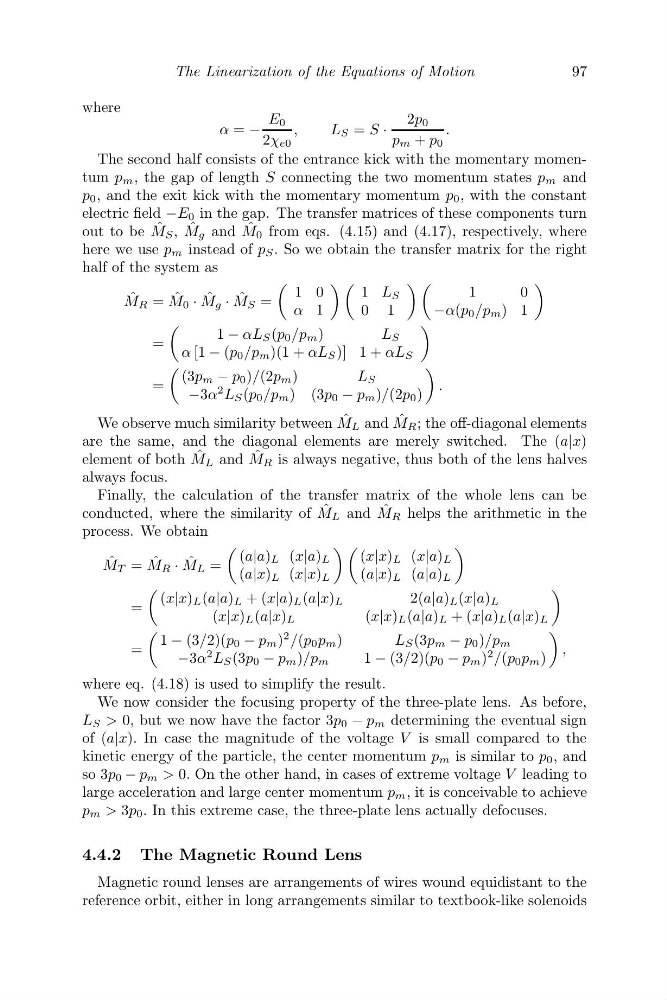
The second half consists of the entrance kick with the momentary momentum p m , the gap of length S connecting the two momentum states p m and
p 0 , and the exit kick with the momentary momentum p 0 , with the constant
electric field −E 0 in the gap. The transfer matrices of these components turn
out to be ˆ
M S , ˆ
M g and ˆ
M 0 from eqs. (4.15) and (4.17), respectively, where
here we use p m instead of p S . So we obtain the transfer matrix for the right
half of the system as
ˆ
M R = ˆ
M 0 · ˆ
M g · ˆ
M S =
1 0
α 1
1 L S
0 1
1
0
−α(p 0 /p m ) 1
=
1 − αL S (p 0 /p m )
L S
α [1 − (p 0 /p m )(1 + αL S )] 1 + αL S
=
(3p m − p 0 )/(2p m )
L S
−3α
2 L S (p 0 /p m ) (3p 0 − p m )/(2p 0 )
.
We observe much similarity between ˆ
M L and ˆ
M R ; the off-diagonal elements
are the same, and the diagonal elements are merely switched. The (a|x)
element of both ˆ
M L and ˆ
M R is always negative, thus both of the lens halves
always focus.
Finally, the calculation of the transfer matrix of the whole lens can be
conducted, where the similarity of ˆ
M L and ˆ
M R helps the arithmetic in the
process. We obtain
ˆ
M T = ˆ
M R · ˆ
M L =
(a|a) L (x|a) L
(a|x) L (x|x) L
(x|x) L (x|a) L
(a|x) L (a|a) L
=
(x|x) L (a|a) L + (x|a) L (a|x) L
2(a|a) L (x|a) L
(x|x) L (a|x) L
(x|x) L (a|a) L + (x|a) L (a|x) L
=
1 − (3/2)(p 0 − p m )
2 /(p 0 p m )
L S (3p m − p 0 )/p m
−3α
2 L S (3p 0 − p m )/p m
1 − (3/2)(p 0 − p m )
2 /(p 0 p m )
,
where eq. (4.18) is used to simplify the result.
We now consider the focusing property of the three-plate lens. As before,
L S > 0, but we now have the factor 3p 0 − p m determining the eventual sign
of (a|x). In case the magnitude of the voltage V is small compared to the
kinetic energy of the particle, the center momentum p m is similar to p 0 , and
so 3p 0 − p m > 0. On the other hand, in cases of extreme voltage V leading to
large acceleration and large center momentum p m , it is conceivable to achieve
p m > 3p 0 . In this extreme case, the three-plate lens actually defocuses.
4.4.2 The Magnetic Round Lens
Magnetic round lenses are arrangements of wires wound equidistant to the
reference orbit, either in long arrangements similar to textbook-like solenoids
97
where
α = −
E 0
2χ e0
,
L S = S ·
2p 0
p m + p 0
.
The second half consists of the entrance kick with the momentary momentum p m , the gap of length S connecting the two momentum states p m and
p 0 , and the exit kick with the momentary momentum p 0 , with the constant
electric field −E 0 in the gap. The transfer matrices of these components turn
out to be ˆ
M S , ˆ
M g and ˆ
M 0 from eqs. (4.15) and (4.17), respectively, where
here we use p m instead of p S . So we obtain the transfer matrix for the right
half of the system as
ˆ
M R = ˆ
M 0 · ˆ
M g · ˆ
M S =
1 0
α 1
1 L S
0 1
1
0
−α(p 0 /p m ) 1
=
1 − αL S (p 0 /p m )
L S
α [1 − (p 0 /p m )(1 + αL S )] 1 + αL S
=
(3p m − p 0 )/(2p m )
L S
−3α
2 L S (p 0 /p m ) (3p 0 − p m )/(2p 0 )
.
We observe much similarity between ˆ
M L and ˆ
M R ; the off-diagonal elements
are the same, and the diagonal elements are merely switched. The (a|x)
element of both ˆ
M L and ˆ
M R is always negative, thus both of the lens halves
always focus.
Finally, the calculation of the transfer matrix of the whole lens can be
conducted, where the similarity of ˆ
M L and ˆ
M R helps the arithmetic in the
process. We obtain
ˆ
M T = ˆ
M R · ˆ
M L =
(a|a) L (x|a) L
(a|x) L (x|x) L
(x|x) L (x|a) L
(a|x) L (a|a) L
=
(x|x) L (a|a) L + (x|a) L (a|x) L
2(a|a) L (x|a) L
(x|x) L (a|x) L
(x|x) L (a|a) L + (x|a) L (a|x) L
=
1 − (3/2)(p 0 − p m )
2 /(p 0 p m )
L S (3p m − p 0 )/p m
−3α
2 L S (3p 0 − p m )/p m
1 − (3/2)(p 0 − p m )
2 /(p 0 p m )
,
where eq. (4.18) is used to simplify the result.
We now consider the focusing property of the three-plate lens. As before,
L S > 0, but we now have the factor 3p 0 − p m determining the eventual sign
of (a|x). In case the magnitude of the voltage V is small compared to the
kinetic energy of the particle, the center momentum p m is similar to p 0 , and
so 3p 0 − p m > 0. On the other hand, in cases of extreme voltage V leading to
large acceleration and large center momentum p m , it is conceivable to achieve
p m > 3p 0 . In this extreme case, the three-plate lens actually defocuses.
4.4.2 The Magnetic Round Lens
Magnetic round lenses are arrangements of wires wound equidistant to the
reference orbit, either in long arrangements similar to textbook-like solenoids