

88
An Introduction to Beam Physics
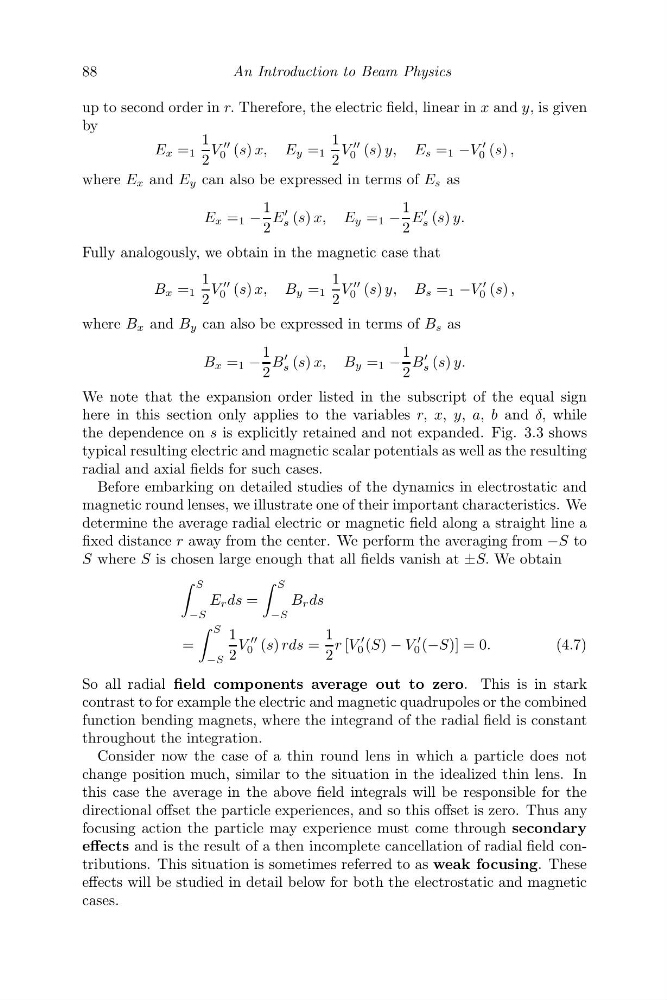
up to second order in r. Therefore, the electric field, linear in x and y, is given
by
E x = 1
1
2
V
0 (s) x, E y = 1
1
2
V
0 (s) y, E s = 1 −V
0 (s) ,
where E x and E y can also be expressed in terms of E s as
E x = 1 −
1
2
E
s (s) x, E y = 1 −
1
2
E
s (s) y.
Fully analogously, we obtain in the magnetic case that
B x = 1
1
2
V
0 (s) x, B y = 1
1
2
V
0 (s) y, B s = 1 −V
0 (s) ,
where B x and B y can also be expressed in terms of B s as
B x = 1 −
1
2
B
s (s) x, B y = 1 −
1
2
B
s (s) y.
We note that the expansion order listed in the subscript of the equal sign
here in this section only applies to the variables r, x, y, a, b and δ, while
the dependence on s is explicitly retained and not expanded. Fig. 3.3 shows
typical resulting electric and magnetic scalar potentials as well as the resulting
radial and axial fields for such cases.
Before embarking on detailed studies of the dynamics in electrostatic and
magnetic round lenses, we illustrate one of their important characteristics. We
determine the average radial electric or magnetic field along a straight line a
fixed distance r away from the center. We perform the averaging from −S to
S where S is chosen large enough that all fields vanish at ±S. We obtain
S
−S
E r ds =
S
−S
B r ds
=
S
−S
1
2
V
0 (s) rds =
1
2
r [V
0 (S) − V
0 (−S)] = 0.
(4.7)
So all radial field components average out to zero. This is in stark
contrast to for example the electric and magnetic quadrupoles or the combined
function bending magnets, where the integrand of the radial field is constant
throughout the integration.
Consider now the case of a thin round lens in which a particle does not
change position much, similar to the situation in the idealized thin lens. In
this case the average in the above field integrals will be responsible for the
directional offset the particle experiences, and so this offset is zero. Thus any
focusing action the particle may experience must come through secondary
effects and is the result of a then incomplete cancellation of radial field contributions. This situation is sometimes referred to as weak focusing. These
effects will be studied in detail below for both the electrostatic and magnetic
cases.
An Introduction to Beam Physics
up to second order in r. Therefore, the electric field, linear in x and y, is given
by
E x = 1
1
2
V
0 (s) x, E y = 1
1
2
V
0 (s) y, E s = 1 −V
0 (s) ,
where E x and E y can also be expressed in terms of E s as
E x = 1 −
1
2
E
s (s) x, E y = 1 −
1
2
E
s (s) y.
Fully analogously, we obtain in the magnetic case that
B x = 1
1
2
V
0 (s) x, B y = 1
1
2
V
0 (s) y, B s = 1 −V
0 (s) ,
where B x and B y can also be expressed in terms of B s as
B x = 1 −
1
2
B
s (s) x, B y = 1 −
1
2
B
s (s) y.
We note that the expansion order listed in the subscript of the equal sign
here in this section only applies to the variables r, x, y, a, b and δ, while
the dependence on s is explicitly retained and not expanded. Fig. 3.3 shows
typical resulting electric and magnetic scalar potentials as well as the resulting
radial and axial fields for such cases.
Before embarking on detailed studies of the dynamics in electrostatic and
magnetic round lenses, we illustrate one of their important characteristics. We
determine the average radial electric or magnetic field along a straight line a
fixed distance r away from the center. We perform the averaging from −S to
S where S is chosen large enough that all fields vanish at ±S. We obtain
S
−S
E r ds =
S
−S
B r ds
=
S
−S
1
2
V
0 (s) rds =
1
2
r [V
0 (S) − V
0 (−S)] = 0.
(4.7)
So all radial field components average out to zero. This is in stark
contrast to for example the electric and magnetic quadrupoles or the combined
function bending magnets, where the integrand of the radial field is constant
throughout the integration.
Consider now the case of a thin round lens in which a particle does not
change position much, similar to the situation in the idealized thin lens. In
this case the average in the above field integrals will be responsible for the
directional offset the particle experiences, and so this offset is zero. Thus any
focusing action the particle may experience must come through secondary
effects and is the result of a then incomplete cancellation of radial field contributions. This situation is sometimes referred to as weak focusing. These
effects will be studied in detail below for both the electrostatic and magnetic
cases.