

The Linearization of the Equations of Motion
87
For φ = π/
√
2 = 127.28
◦ , the deflector is imaging in the horizontal plane,
which has been used as energy spectrometers.
In the spherical case, we have E ∝ 1/R
2 and thus
E x = −E x0
R 0
R 0 + x
2
= 1 −E x0
1 − 2
x
R 0
,
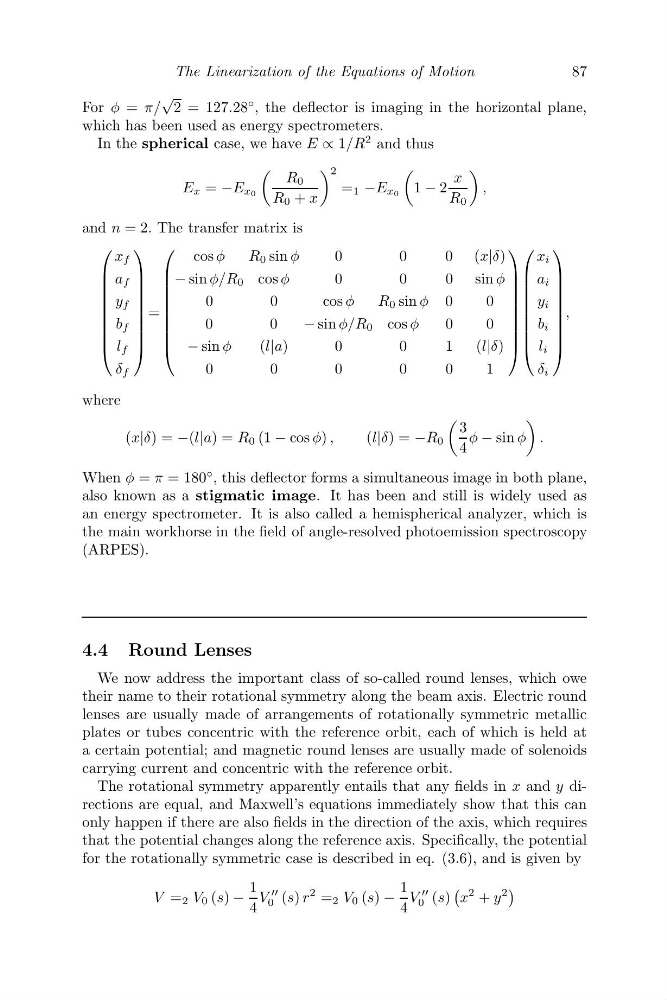
and n = 2. The transfer matrix is
⎛
⎜
⎜
⎜
⎜
⎜
⎜
⎜
⎜
⎝
x f
a f
y f
b f
l f
δ f
⎞
⎟
⎟
⎟
⎟
⎟
⎟
⎟
⎟
⎠
=
⎛
⎜
⎜
⎜
⎜
⎜
⎜
⎜
⎜
⎝
cos φ
R 0 sin φ
0
0
0 ( x|δ)
− sin φ/R 0 cos φ
0
0
0 s i nφ
0
0
c o sφ
R 0 sin φ 0
0
0
0
− sin φ/R 0 cos φ
0
0
− sin φ
(l|a)
0
0
1
( l|δ)
0
0
0
0
0
1
⎞
⎟
⎟
⎟
⎟
⎟
⎟
⎟
⎟
⎠
⎛
⎜
⎜
⎜
⎜
⎜
⎜
⎜
⎜
⎝
x i
a i
y i
b i
l i
δ i
⎞
⎟
⎟
⎟
⎟
⎟
⎟
⎟
⎟
⎠
,
where
(x|δ) = −(l|a) = R 0 (1 − cos φ) ,
(l|δ) = −R 0
3
4
φ − sin φ
.
When φ = π = 180
◦ , this deflector forms a simultaneous image in both plane,
also known as a stigmatic image. It has been and still is widely used as
an energy spectrometer. It is also called a hemispherical analyzer, which is
the main workhorse in the field of angle-resolved photoemission spectroscopy
(ARPES).
4.4 Round Lenses
We now address the important class of so-called round lenses, which owe
their name to their rotational symmetry along the beam axis. Electric round
lenses are usually made of arrangements of rotationally symmetric metallic
plates or tubes concentric with the reference orbit, each of which is held at
a certain potential; and magnetic round lenses are usually made of solenoids
carrying current and concentric with the reference orbit.
The rotational symmetry apparently entails that any fields in x and y directions are equal, and Maxwell’s equations immediately show that this can
only happen if there are also fields in the direction of the axis, which requires
that the potential changes along the reference axis. Specifically, the potential
for the rotationally symmetric case is described in eq. (3.6), and is given by
V = 2 V 0 (s) −
1
4
V
0 (s) r
2 = 2 V 0 (s) −
1
4
V
0 (s)
x
2 + y
2
87
For φ = π/
√
2 = 127.28
◦ , the deflector is imaging in the horizontal plane,
which has been used as energy spectrometers.
In the spherical case, we have E ∝ 1/R
2 and thus
E x = −E x0
R 0
R 0 + x
2
= 1 −E x0
1 − 2
x
R 0
,
and n = 2. The transfer matrix is
⎛
⎜
⎜
⎜
⎜
⎜
⎜
⎜
⎜
⎝
x f
a f
y f
b f
l f
δ f
⎞
⎟
⎟
⎟
⎟
⎟
⎟
⎟
⎟
⎠
=
⎛
⎜
⎜
⎜
⎜
⎜
⎜
⎜
⎜
⎝
cos φ
R 0 sin φ
0
0
0 ( x|δ)
− sin φ/R 0 cos φ
0
0
0 s i nφ
0
0
c o sφ
R 0 sin φ 0
0
0
0
− sin φ/R 0 cos φ
0
0
− sin φ
(l|a)
0
0
1
( l|δ)
0
0
0
0
0
1
⎞
⎟
⎟
⎟
⎟
⎟
⎟
⎟
⎟
⎠
⎛
⎜
⎜
⎜
⎜
⎜
⎜
⎜
⎜
⎝
x i
a i
y i
b i
l i
δ i
⎞
⎟
⎟
⎟
⎟
⎟
⎟
⎟
⎟
⎠
,
where
(x|δ) = −(l|a) = R 0 (1 − cos φ) ,
(l|δ) = −R 0
3
4
φ − sin φ
.
When φ = π = 180
◦ , this deflector forms a simultaneous image in both plane,
also known as a stigmatic image. It has been and still is widely used as
an energy spectrometer. It is also called a hemispherical analyzer, which is
the main workhorse in the field of angle-resolved photoemission spectroscopy
(ARPES).
4.4 Round Lenses
We now address the important class of so-called round lenses, which owe
their name to their rotational symmetry along the beam axis. Electric round
lenses are usually made of arrangements of rotationally symmetric metallic
plates or tubes concentric with the reference orbit, each of which is held at
a certain potential; and magnetic round lenses are usually made of solenoids
carrying current and concentric with the reference orbit.
The rotational symmetry apparently entails that any fields in x and y directions are equal, and Maxwell’s equations immediately show that this can
only happen if there are also fields in the direction of the axis, which requires
that the potential changes along the reference axis. Specifically, the potential
for the rotationally symmetric case is described in eq. (3.6), and is given by
V = 2 V 0 (s) −
1
4
V
0 (s) r
2 = 2 V 0 (s) −
1
4
V
0 (s)
x
2 + y
2