

78 Damage to concrete structures
shrinkage can amount to up to 60% of the drying shrinkage, depending on
the degree of hydration at the onset of drying. Carbonation during drying
can also increase the irreversible drying shrinkage.
4.3.2 Influencing parameters
4.3.2.1 Parameters related to the concrete composition
Drying shrinkage of concrete is largely dependent on the paste volume, or
alternatively, on the aggregate content. As the paste is the actively shrinking component, a reduction in paste content will reduce the overall shrinkage values. Furthermore, drying shrinkage of the cement paste is partly
restrained by the non-shrinking aggregates (Bisschop 2002). Based on
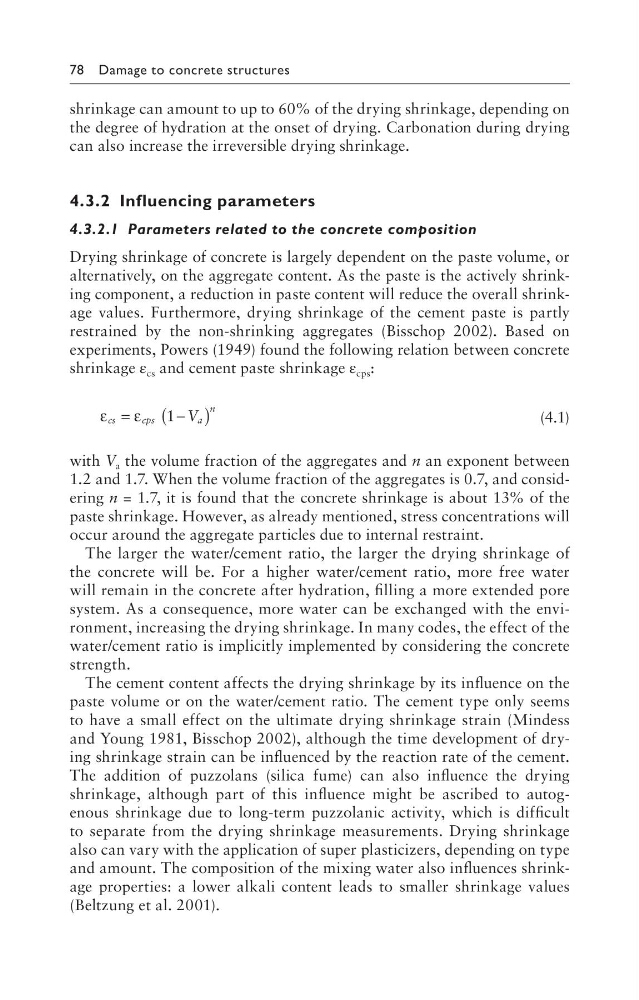
experiments, Powers (1949) found the following relation between concrete
shrinkage ε cs and cement paste shrinkage ε cps :
V
1
cs
cps
a
n
)
(
ε = ε
−
(4.1)
with V a the volume fraction of the aggregates and n an exponent between
1.2 and 1.7. When the volume fraction of the aggregates is 0.7, and considering n = 1.7, it is found that the concrete shrinkage is about 13% of the
paste shrinkage. However, as already mentioned, stress concentrations will
occur around the aggregate particles due to internal restraint.
The larger the water/cement ratio, the larger the drying shrinkage of
the concrete will be. For a higher water/cement ratio, more free water
will remain in the concrete after hydration, filling a more extended pore
system. As a consequence, more water can be exchanged with the environment, increasing the drying shrinkage. In many codes, the effect of the
water/cement ratio is implicitly implemented by considering the concrete
strength.
The cement content affects the drying shrinkage by its influence on the
paste volume or on the water/cement ratio. The cement type only seems
to have a small effect on the ultimate drying shrinkage strain (Mindess
and Young 1981, Bisschop 2002), although the time development of drying shrinkage strain can be influenced by the reaction rate of the cement.
The addition of puzzolans (silica fume) can also influence the drying
shrinkage, although part of this influence might be ascribed to autogenous shrinkage due to long-term puzzolanic activity, which is difficult
to separate from the drying shrinkage measurements. Drying shrinkage
also can vary with the application of super plasticizers, depending on type
and amount. The composition of the mixing water also influences shrinkage properties: a lower alkali content leads to smaller shrinkage values
(Beltzung et al. 2001).
shrinkage can amount to up to 60% of the drying shrinkage, depending on
the degree of hydration at the onset of drying. Carbonation during drying
can also increase the irreversible drying shrinkage.
4.3.2 Influencing parameters
4.3.2.1 Parameters related to the concrete composition
Drying shrinkage of concrete is largely dependent on the paste volume, or
alternatively, on the aggregate content. As the paste is the actively shrinking component, a reduction in paste content will reduce the overall shrinkage values. Furthermore, drying shrinkage of the cement paste is partly
restrained by the non-shrinking aggregates (Bisschop 2002). Based on
experiments, Powers (1949) found the following relation between concrete
shrinkage ε cs and cement paste shrinkage ε cps :
V
1
cs
cps
a
n
)
(
ε = ε
−
(4.1)
with V a the volume fraction of the aggregates and n an exponent between
1.2 and 1.7. When the volume fraction of the aggregates is 0.7, and considering n = 1.7, it is found that the concrete shrinkage is about 13% of the
paste shrinkage. However, as already mentioned, stress concentrations will
occur around the aggregate particles due to internal restraint.
The larger the water/cement ratio, the larger the drying shrinkage of
the concrete will be. For a higher water/cement ratio, more free water
will remain in the concrete after hydration, filling a more extended pore
system. As a consequence, more water can be exchanged with the environment, increasing the drying shrinkage. In many codes, the effect of the
water/cement ratio is implicitly implemented by considering the concrete
strength.
The cement content affects the drying shrinkage by its influence on the
paste volume or on the water/cement ratio. The cement type only seems
to have a small effect on the ultimate drying shrinkage strain (Mindess
and Young 1981, Bisschop 2002), although the time development of drying shrinkage strain can be influenced by the reaction rate of the cement.
The addition of puzzolans (silica fume) can also influence the drying
shrinkage, although part of this influence might be ascribed to autogenous shrinkage due to long-term puzzolanic activity, which is difficult
to separate from the drying shrinkage measurements. Drying shrinkage
also can vary with the application of super plasticizers, depending on type
and amount. The composition of the mixing water also influences shrinkage properties: a lower alkali content leads to smaller shrinkage values
(Beltzung et al. 2001).