

Actions during hardening 79
4.3.2.2 Geometrical parameters
The time development of drying shrinkage is significantly influenced by the
geometry of the element, due to the key role of the exposed surfaces. This
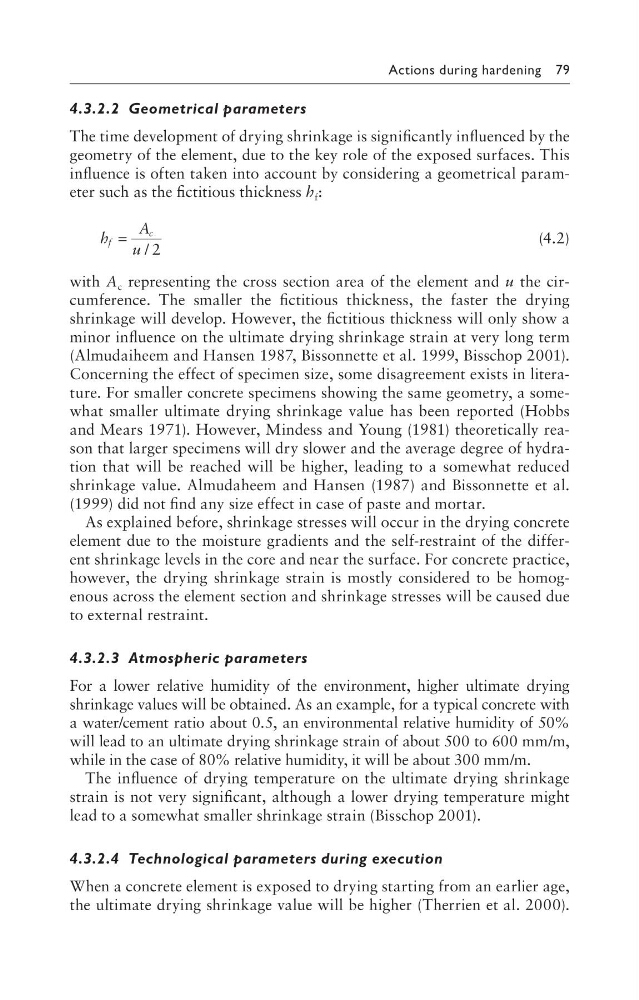
influence is often taken into account by considering a geometrical parameter such as the fictitious thickness h f :
h
A
u
f
c
= / 2
(4.2)
with A c representing the cross section area of the element and u the circumference. The smaller the fictitious thickness, the faster the drying
shrinkage will develop. However, the fictitious thickness will only show a
minor influence on the ultimate drying shrinkage strain at very long term
(Almudaiheem and Hansen 1987, Bissonnette et al. 1999, Bisschop 2001).
Concerning the effect of specimen size, some disagreement exists in literature. For smaller concrete specimens showing the same geometry, a somewhat smaller ultimate drying shrinkage value has been reported (Hobbs
and Mears 1971). However, Mindess and Young (1981) theoretically reason that larger specimens will dry slower and the average degree of hydration that will be reached will be higher, leading to a somewhat reduced
shrinkage value. Almudaheem and Hansen (1987) and Bissonnette et al.
(1999) did not find any size effect in case of paste and mortar.
As explained before, shrinkage stresses will occur in the drying concrete
element due to the moisture gradients and the self-restraint of the different shrinkage levels in the core and near the surface. For concrete practice,
however, the drying shrinkage strain is mostly considered to be homogenous across the element section and shrinkage stresses will be caused due
to external restraint.
4.3.2.3 Atmospheric parameters
For a lower relative humidity of the environment, higher ultimate drying
shrinkage values will be obtained. As an example, for a typical concrete with
a water/cement ratio about 0.5, an environmental relative humidity of 50%
will lead to an ultimate drying shrinkage strain of about 500 to 600 mm/m,
while in the case of 80% relative humidity, it will be about 300 mm/m.
The influence of drying temperature on the ultimate drying shrinkage
strain is not very significant, although a lower drying temperature might
lead to a somewhat smaller shrinkage strain (Bisschop 2001).
4.3.2.4 Technological parameters during execution
When a concrete element is exposed to drying starting from an earlier age,
the ultimate drying shrinkage value will be higher (Therrien et al. 2000).
4.3.2.2 Geometrical parameters
The time development of drying shrinkage is significantly influenced by the
geometry of the element, due to the key role of the exposed surfaces. This
influence is often taken into account by considering a geometrical parameter such as the fictitious thickness h f :
h
A
u
f
c
= / 2
(4.2)
with A c representing the cross section area of the element and u the circumference. The smaller the fictitious thickness, the faster the drying
shrinkage will develop. However, the fictitious thickness will only show a
minor influence on the ultimate drying shrinkage strain at very long term
(Almudaiheem and Hansen 1987, Bissonnette et al. 1999, Bisschop 2001).
Concerning the effect of specimen size, some disagreement exists in literature. For smaller concrete specimens showing the same geometry, a somewhat smaller ultimate drying shrinkage value has been reported (Hobbs
and Mears 1971). However, Mindess and Young (1981) theoretically reason that larger specimens will dry slower and the average degree of hydration that will be reached will be higher, leading to a somewhat reduced
shrinkage value. Almudaheem and Hansen (1987) and Bissonnette et al.
(1999) did not find any size effect in case of paste and mortar.
As explained before, shrinkage stresses will occur in the drying concrete
element due to the moisture gradients and the self-restraint of the different shrinkage levels in the core and near the surface. For concrete practice,
however, the drying shrinkage strain is mostly considered to be homogenous across the element section and shrinkage stresses will be caused due
to external restraint.
4.3.2.3 Atmospheric parameters
For a lower relative humidity of the environment, higher ultimate drying
shrinkage values will be obtained. As an example, for a typical concrete with
a water/cement ratio about 0.5, an environmental relative humidity of 50%
will lead to an ultimate drying shrinkage strain of about 500 to 600 mm/m,
while in the case of 80% relative humidity, it will be about 300 mm/m.
The influence of drying temperature on the ultimate drying shrinkage
strain is not very significant, although a lower drying temperature might
lead to a somewhat smaller shrinkage strain (Bisschop 2001).
4.3.2.4 Technological parameters during execution
When a concrete element is exposed to drying starting from an earlier age,
the ultimate drying shrinkage value will be higher (Therrien et al. 2000).