

58 Damage to concrete structures
of air bubbles escaping from the surface of the concrete. Moreover, the
compaction of fresh concrete on site is a complicated and laborious operation, leading to many problems. This is nicely illustrated by De Schutter
et al. (2008): ‘Compaction of fresh concrete of traditional consistence is
often claimed to be the most unpleasant and tiring job on a typical construction site. In some countries it has become difficult to find workers
prepared to carry this out. Supervision of the compaction process is also
inherently difficult and it is therefore not surprising that a substantial proportion of concrete placed world-wide is, in reality, not adequately compacted’. As a matter of fact, this conclusion was a driving force for the
introduction of self-compacting concrete in the 1980s.
Defects caused by inappropriate compaction of the fresh concrete are
often hidden, but can nevertheless significantly reduce the performance.
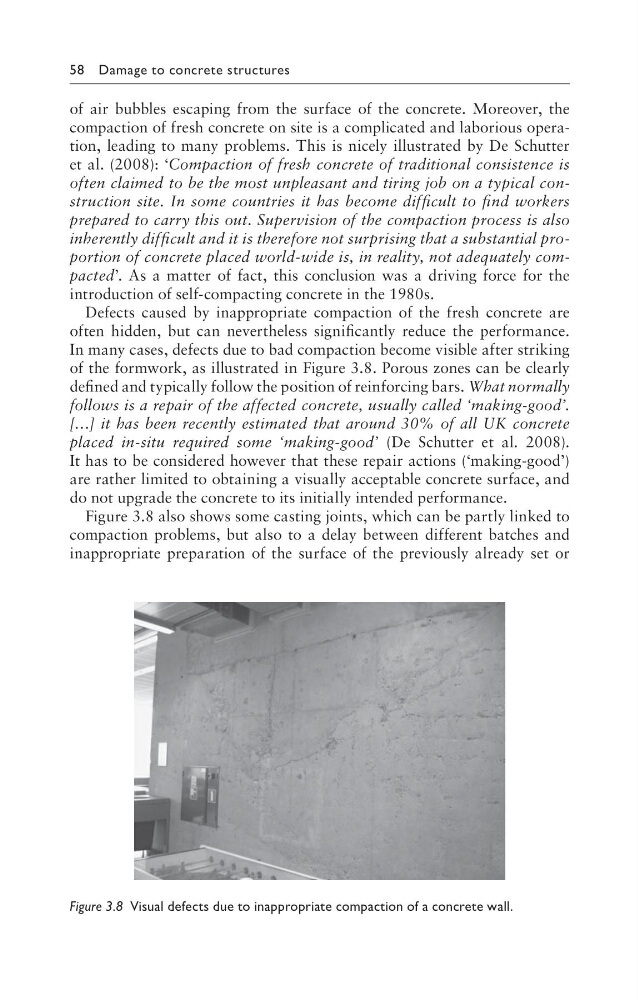
In many cases, defects due to bad compaction become visible after striking
of the formwork, as illustrated in Figure 3.8. Porous zones can be clearly
defined and typically follow the position of reinforcing bars. What normally
follows is a repair of the affected concrete, usually called ‘making-good’.
[…] it has been recently estimated that around 30% of all UK concrete
placed in-situ required some ‘making-good’ (De Schutter et al. 2008).
It has to be considered however that these repair actions (‘making-good’)
are rather limited to obtaining a visually acceptable concrete surface, and
do not upgrade the concrete to its initially intended performance.
Figure 3.8 also shows some casting joints, which can be partly linked to
compaction problems, but also to a delay between different batches and
inappropriate preparation of the surface of the previously already set or
Figure 3.8 Visual defects due to inappropriate compaction of a concrete wall.
of air bubbles escaping from the surface of the concrete. Moreover, the
compaction of fresh concrete on site is a complicated and laborious operation, leading to many problems. This is nicely illustrated by De Schutter
et al. (2008): ‘Compaction of fresh concrete of traditional consistence is
often claimed to be the most unpleasant and tiring job on a typical construction site. In some countries it has become difficult to find workers
prepared to carry this out. Supervision of the compaction process is also
inherently difficult and it is therefore not surprising that a substantial proportion of concrete placed world-wide is, in reality, not adequately compacted’. As a matter of fact, this conclusion was a driving force for the
introduction of self-compacting concrete in the 1980s.
Defects caused by inappropriate compaction of the fresh concrete are
often hidden, but can nevertheless significantly reduce the performance.
In many cases, defects due to bad compaction become visible after striking
of the formwork, as illustrated in Figure 3.8. Porous zones can be clearly
defined and typically follow the position of reinforcing bars. What normally
follows is a repair of the affected concrete, usually called ‘making-good’.
[…] it has been recently estimated that around 30% of all UK concrete
placed in-situ required some ‘making-good’ (De Schutter et al. 2008).
It has to be considered however that these repair actions (‘making-good’)
are rather limited to obtaining a visually acceptable concrete surface, and
do not upgrade the concrete to its initially intended performance.
Figure 3.8 also shows some casting joints, which can be partly linked to
compaction problems, but also to a delay between different batches and
inappropriate preparation of the surface of the previously already set or
Figure 3.8 Visual defects due to inappropriate compaction of a concrete wall.