

Errors during casting 57
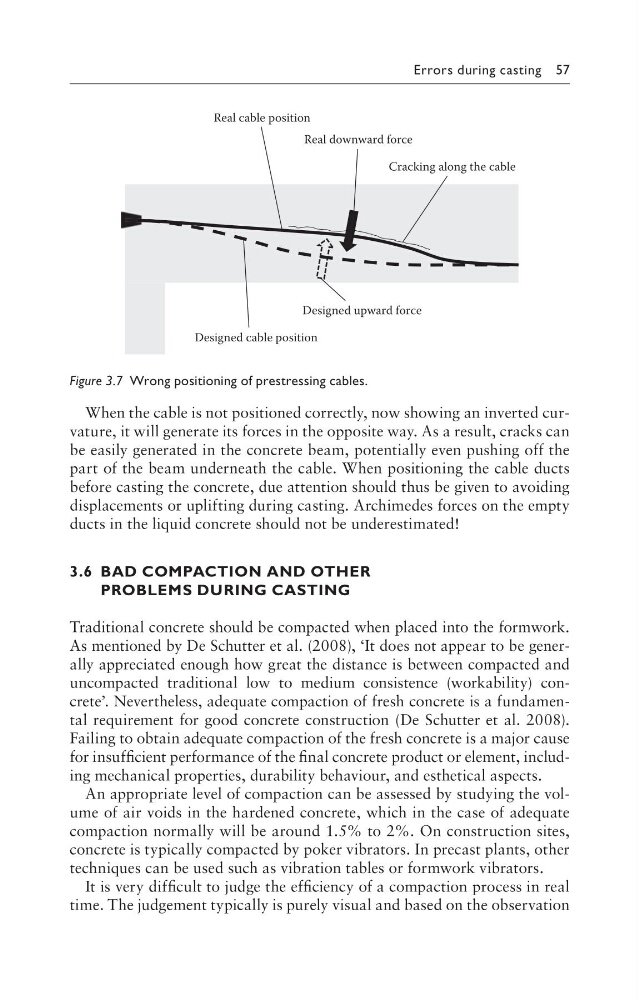
When the cable is not positioned correctly, now showing an inverted curvature, it will generate its forces in the opposite way. As a result, cracks can
be easily generated in the concrete beam, potentially even pushing off the
part of the beam underneath the cable. When positioning the cable ducts
before casting the concrete, due attention should thus be given to avoiding
displacements or uplifting during casting. Archimedes forces on the empty
ducts in the liquid concrete should not be underestimated!
3.6 baD coMPactIon anD other
ProbleMs DurIng castIng
Traditional concrete should be compacted when placed into the formwork.
As mentioned by De Schutter et al. (2008), ‘It does not appear to be generally appreciated enough how great the distance is between compacted and
uncompacted traditional low to medium consistence (workability) concrete’. Nevertheless, adequate compaction of fresh concrete is a fundamental requirement for good concrete construction (De Schutter et al. 2008).
Failing to obtain adequate compaction of the fresh concrete is a major cause
for insufficient performance of the final concrete product or element, including mechanical properties, durability behaviour, and esthetical aspects.
An appropriate level of compaction can be assessed by studying the volume of air voids in the hardened concrete, which in the case of adequate
compaction normally will be around 1.5% to 2%. On construction sites,
concrete is typically compacted by poker vibrators. In precast plants, other
techniques can be used such as vibration tables or formwork vibrators.
It is very difficult to judge the efficiency of a compaction process in real
time. The judgement typically is purely visual and based on the observation
Real cable position
Real downward force
Cracking along the cable
Designed upward force
Designed cable position
Figure 3.7 Wrong positioning of prestressing cables.
When the cable is not positioned correctly, now showing an inverted curvature, it will generate its forces in the opposite way. As a result, cracks can
be easily generated in the concrete beam, potentially even pushing off the
part of the beam underneath the cable. When positioning the cable ducts
before casting the concrete, due attention should thus be given to avoiding
displacements or uplifting during casting. Archimedes forces on the empty
ducts in the liquid concrete should not be underestimated!
3.6 baD coMPactIon anD other
ProbleMs DurIng castIng
Traditional concrete should be compacted when placed into the formwork.
As mentioned by De Schutter et al. (2008), ‘It does not appear to be generally appreciated enough how great the distance is between compacted and
uncompacted traditional low to medium consistence (workability) concrete’. Nevertheless, adequate compaction of fresh concrete is a fundamental requirement for good concrete construction (De Schutter et al. 2008).
Failing to obtain adequate compaction of the fresh concrete is a major cause
for insufficient performance of the final concrete product or element, including mechanical properties, durability behaviour, and esthetical aspects.
An appropriate level of compaction can be assessed by studying the volume of air voids in the hardened concrete, which in the case of adequate
compaction normally will be around 1.5% to 2%. On construction sites,
concrete is typically compacted by poker vibrators. In precast plants, other
techniques can be used such as vibration tables or formwork vibrators.
It is very difficult to judge the efficiency of a compaction process in real
time. The judgement typically is purely visual and based on the observation
Real cable position
Real downward force
Cracking along the cable
Designed upward force
Designed cable position
Figure 3.7 Wrong positioning of prestressing cables.