

Errors during casting 55
3.5.4 Insufficient cover thickness
In Chapter 1, the importance of respecting the cover thickness was explained
in detail, showing that reducing the cover thickness by half can lead to a
reduction of the service life (based on reinforcement corrosion) to 15% of the
target service life. Thus, it is worthwhile to carefully control the real cover
thickness provided during construction. Prescribed cover thickness values
should be considered as minimum values and not as average values.
Due attention should then be given to a correct positioning of the reinforcement cage, avoiding shifting of the cage towards the formwork during
casting as illustrated in Figure 3.5. This can be easily done by providing
spacers with the right size and insufficient quantities and by inspecting over
spacing before concrete placement. Failing to do so can lead to accelerated
corrosion of the reinforcing bars which are too close to the surface, clearly
making them visible due to expansive corrosion and subsequent concrete
spalling as seen in Figure 3.6.
3.5.5 Wrong position of prestressing cables
In the case of prestressed concrete, the prestressing cables have to be accurately positioned. It should be kept in mind that the geometrical position of
the cables, especially the curvature, is directly linked to the forces the prestressed cables will generate on the structural element. A detailed explanation of prestressed concrete is beyond the scope of this textbook; however,
potential problems related to wrong positioning of a prestressing cable are
illustrated in Figure 3.7 as an example.
Badly compacted
congested area
Concrete
flow
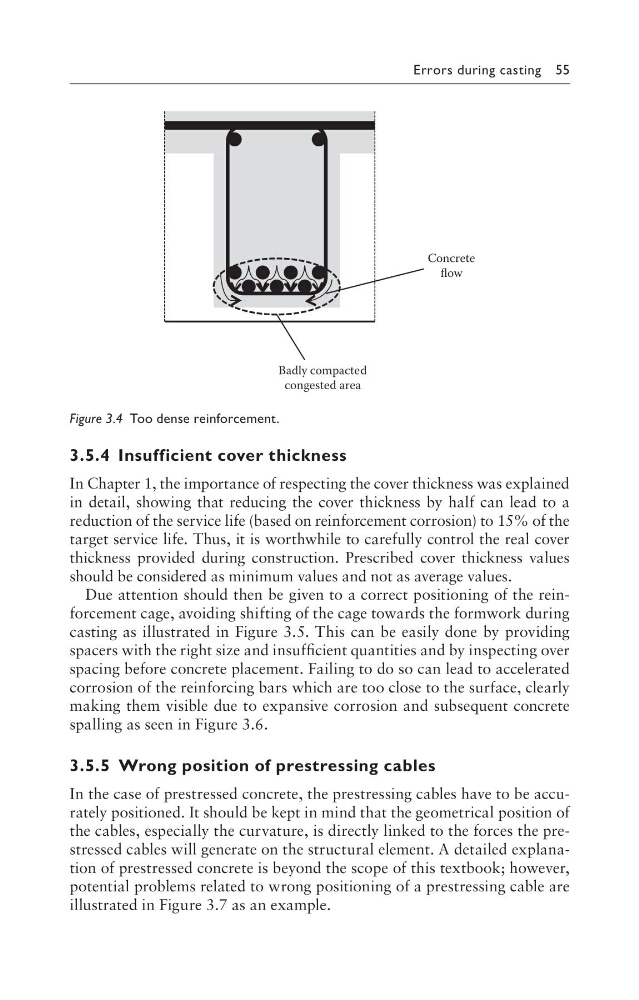
Figure 3.4 Too dense reinforcement.
3.5.4 Insufficient cover thickness
In Chapter 1, the importance of respecting the cover thickness was explained
in detail, showing that reducing the cover thickness by half can lead to a
reduction of the service life (based on reinforcement corrosion) to 15% of the
target service life. Thus, it is worthwhile to carefully control the real cover
thickness provided during construction. Prescribed cover thickness values
should be considered as minimum values and not as average values.
Due attention should then be given to a correct positioning of the reinforcement cage, avoiding shifting of the cage towards the formwork during
casting as illustrated in Figure 3.5. This can be easily done by providing
spacers with the right size and insufficient quantities and by inspecting over
spacing before concrete placement. Failing to do so can lead to accelerated
corrosion of the reinforcing bars which are too close to the surface, clearly
making them visible due to expansive corrosion and subsequent concrete
spalling as seen in Figure 3.6.
3.5.5 Wrong position of prestressing cables
In the case of prestressed concrete, the prestressing cables have to be accurately positioned. It should be kept in mind that the geometrical position of
the cables, especially the curvature, is directly linked to the forces the prestressed cables will generate on the structural element. A detailed explanation of prestressed concrete is beyond the scope of this textbook; however,
potential problems related to wrong positioning of a prestressing cable are
illustrated in Figure 3.7 as an example.
Badly compacted
congested area
Concrete
flow
Figure 3.4 Too dense reinforcement.