

54 Damage to concrete structures
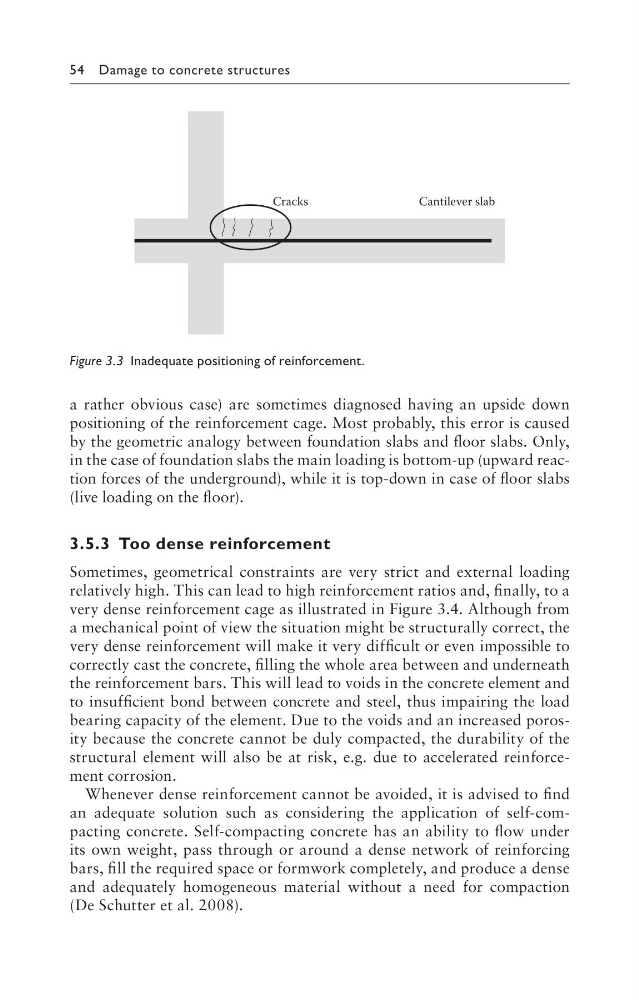
a rather obvious case) are sometimes diagnosed having an upside down
positioning of the reinforcement cage. Most probably, this error is caused
by the geometric analogy between foundation slabs and floor slabs. Only,
in the case of foundation slabs the main loading is bottom-up (upward reaction forces of the underground), while it is top-down in case of floor slabs
(live loading on the floor).
3.5.3 too dense reinforcement
Sometimes, geometrical constraints are very strict and external loading
relatively high. This can lead to high reinforcement ratios and, finally, to a
very dense reinforcement cage as illustrated in Figure 3.4. Although from
a mechanical point of view the situation might be structurally correct, the
very dense reinforcement will make it very difficult or even impossible to
correctly cast the concrete, filling the whole area between and underneath
the reinforcement bars. This will lead to voids in the concrete element and
to insufficient bond between concrete and steel, thus impairing the load
bearing capacity of the element. Due to the voids and an increased porosity because the concrete cannot be duly compacted, the durability of the
structural element will also be at risk, e.g. due to accelerated reinforcement corrosion.
Whenever dense reinforcement cannot be avoided, it is advised to find
an adequate solution such as considering the application of self-compacting concrete. Self-compacting concrete has an ability to flow under
its own weight, pass through or around a dense network of reinforcing
bars, fill the required space or formwork completely, and produce a dense
and adequately homogeneous material without a need for compaction
(De Schutter et al. 2008).
Cracks
Cantilever slab
Figure 3.3 Inadequate positioning of reinforcement.
a rather obvious case) are sometimes diagnosed having an upside down
positioning of the reinforcement cage. Most probably, this error is caused
by the geometric analogy between foundation slabs and floor slabs. Only,
in the case of foundation slabs the main loading is bottom-up (upward reaction forces of the underground), while it is top-down in case of floor slabs
(live loading on the floor).
3.5.3 too dense reinforcement
Sometimes, geometrical constraints are very strict and external loading
relatively high. This can lead to high reinforcement ratios and, finally, to a
very dense reinforcement cage as illustrated in Figure 3.4. Although from
a mechanical point of view the situation might be structurally correct, the
very dense reinforcement will make it very difficult or even impossible to
correctly cast the concrete, filling the whole area between and underneath
the reinforcement bars. This will lead to voids in the concrete element and
to insufficient bond between concrete and steel, thus impairing the load
bearing capacity of the element. Due to the voids and an increased porosity because the concrete cannot be duly compacted, the durability of the
structural element will also be at risk, e.g. due to accelerated reinforcement corrosion.
Whenever dense reinforcement cannot be avoided, it is advised to find
an adequate solution such as considering the application of self-compacting concrete. Self-compacting concrete has an ability to flow under
its own weight, pass through or around a dense network of reinforcing
bars, fill the required space or formwork completely, and produce a dense
and adequately homogeneous material without a need for compaction
(De Schutter et al. 2008).
Cracks
Cantilever slab
Figure 3.3 Inadequate positioning of reinforcement.