

52 Damage to concrete structures
A typical example is the case of aggregates containing pyrites. These minerals can undergo some expansive corrosion processes, leading to pop-outs as
previously described in the case of free lime particles, however, now with
some brown corrosion products at the location of the aggregate particle.
Care should also be taken when using by-products or waste-products as
aggregates in concrete. It should be verified whether the alternative aggregate particles are stable enough so that expansive reactions and consequent
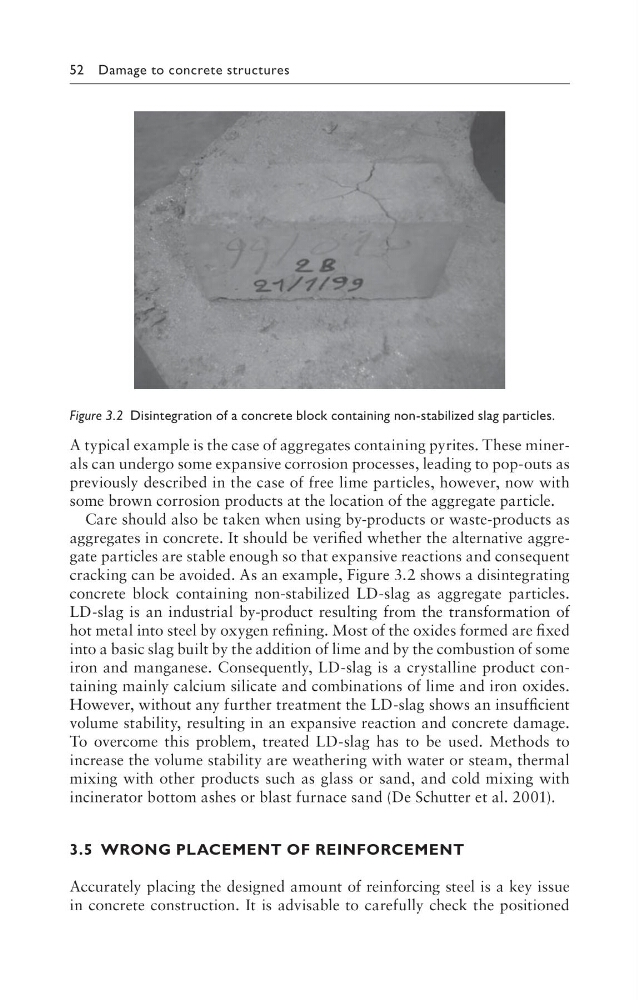
cracking can be avoided. As an example, Figure 3.2 shows a disintegrating
concrete block containing non-stabilized LD-slag as aggregate particles.
LD-slag is an industrial by-product resulting from the transformation of
hot metal into steel by oxygen refining. Most of the oxides formed are fixed
into a basic slag built by the addition of lime and by the combustion of some
iron and manganese. Consequently, LD-slag is a crystalline product containing mainly calcium silicate and combinations of lime and iron oxides.
However, without any further treatment the LD-slag shows an insufficient
volume stability, resulting in an expansive reaction and concrete damage.
To overcome this problem, treated LD-slag has to be used. Methods to
increase the volume stability are weathering with water or steam, thermal
mixing with other products such as glass or sand, and cold mixing with
incinerator bottom ashes or blast furnace sand (De Schutter et al. 2001).
3.5 Wrong PlaceMent of reInforceMent
Accurately placing the designed amount of reinforcing steel is a key issue
in concrete construction. It is advisable to carefully check the positioned
Figure 3.2 Disintegration of a concrete block containing non-stabilized slag particles.
A typical example is the case of aggregates containing pyrites. These minerals can undergo some expansive corrosion processes, leading to pop-outs as
previously described in the case of free lime particles, however, now with
some brown corrosion products at the location of the aggregate particle.
Care should also be taken when using by-products or waste-products as
aggregates in concrete. It should be verified whether the alternative aggregate particles are stable enough so that expansive reactions and consequent
cracking can be avoided. As an example, Figure 3.2 shows a disintegrating
concrete block containing non-stabilized LD-slag as aggregate particles.
LD-slag is an industrial by-product resulting from the transformation of
hot metal into steel by oxygen refining. Most of the oxides formed are fixed
into a basic slag built by the addition of lime and by the combustion of some
iron and manganese. Consequently, LD-slag is a crystalline product containing mainly calcium silicate and combinations of lime and iron oxides.
However, without any further treatment the LD-slag shows an insufficient
volume stability, resulting in an expansive reaction and concrete damage.
To overcome this problem, treated LD-slag has to be used. Methods to
increase the volume stability are weathering with water or steam, thermal
mixing with other products such as glass or sand, and cold mixing with
incinerator bottom ashes or blast furnace sand (De Schutter et al. 2001).
3.5 Wrong PlaceMent of reInforceMent
Accurately placing the designed amount of reinforcing steel is a key issue
in concrete construction. It is advisable to carefully check the positioned
Figure 3.2 Disintegration of a concrete block containing non-stabilized slag particles.