

Errors during casting 51
lead to cracking when the concrete cannot resist the generated stresses. For
this reason, the free lime content in cement is well monitored and limited by
provisions given in cement standards. As a consequence, contamination of
the concrete by free lime present in cement rarely occurs in actual practice.
However, free lime can accidentally also be added to concrete due to
a contamination of aggregates. In Belgium, this happened in May 2010,
when a silo of limestone aggregates accidentally was contaminated with
free lime particles (Moerman 2010, Marinus 2011). In total, about 100 tons
of free lime were blended within 35,000 tons of limestone aggregate. The
contaminated aggregates were delivered to large construction sites as well
as to precast factories and concrete plants. In total, about 100 concrete
structures have been affected by this contamination.
The free lime particles, which had a size ranging from 2 mm to 20 mm,
expansively hydrated to calcium hydroxide after the addition of the mixing water. As this hydration process takes some time, at least part of the
hydration took place after the concrete had already hardened. After some
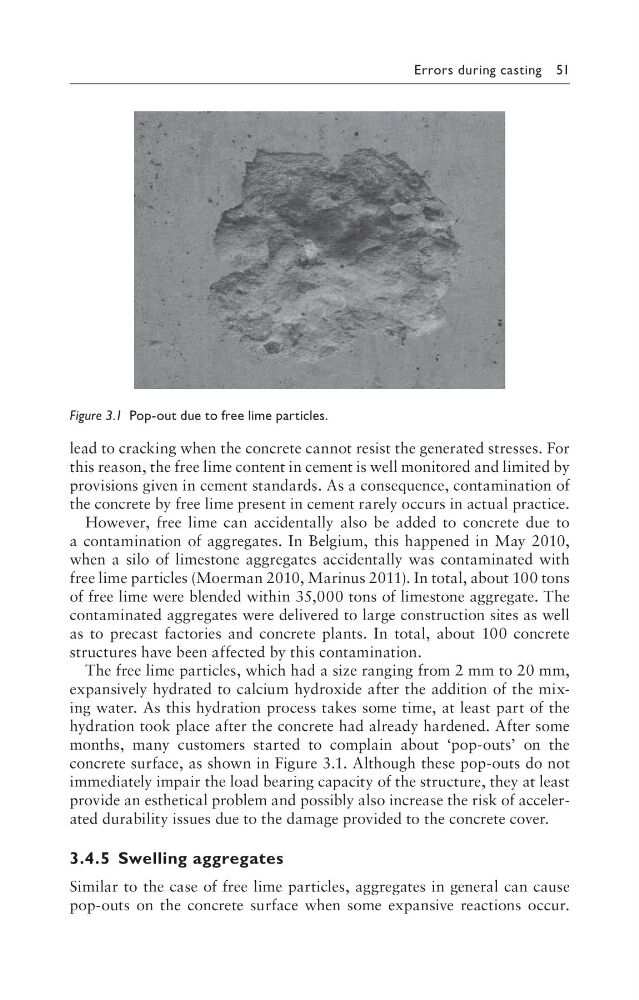
months, many customers started to complain about ‘pop-outs’ on the
concrete surface, as shown in Figure 3.1. Although these pop-outs do not
immediately impair the load bearing capacity of the structure, they at least
provide an esthetical problem and possibly also increase the risk of accelerated durability issues due to the damage provided to the concrete cover.
3.4.5 swelling aggregates
Similar to the case of free lime particles, aggregates in general can cause
pop-outs on the concrete surface when some expansive reactions occur.
Figure 3.1 Pop-out due to free lime particles.
lead to cracking when the concrete cannot resist the generated stresses. For
this reason, the free lime content in cement is well monitored and limited by
provisions given in cement standards. As a consequence, contamination of
the concrete by free lime present in cement rarely occurs in actual practice.
However, free lime can accidentally also be added to concrete due to
a contamination of aggregates. In Belgium, this happened in May 2010,
when a silo of limestone aggregates accidentally was contaminated with
free lime particles (Moerman 2010, Marinus 2011). In total, about 100 tons
of free lime were blended within 35,000 tons of limestone aggregate. The
contaminated aggregates were delivered to large construction sites as well
as to precast factories and concrete plants. In total, about 100 concrete
structures have been affected by this contamination.
The free lime particles, which had a size ranging from 2 mm to 20 mm,
expansively hydrated to calcium hydroxide after the addition of the mixing water. As this hydration process takes some time, at least part of the
hydration took place after the concrete had already hardened. After some
months, many customers started to complain about ‘pop-outs’ on the
concrete surface, as shown in Figure 3.1. Although these pop-outs do not
immediately impair the load bearing capacity of the structure, they at least
provide an esthetical problem and possibly also increase the risk of accelerated durability issues due to the damage provided to the concrete cover.
3.4.5 swelling aggregates
Similar to the case of free lime particles, aggregates in general can cause
pop-outs on the concrete surface when some expansive reactions occur.
Figure 3.1 Pop-out due to free lime particles.