

42 Damage to concrete structures
Quite often it is considered that no particular requirements have to be
defined for the concrete type applied for the construction of swimming
pools, reasoning that the concrete will be protected by a water-tight membrane protecting it from the chloride containing pool water. Apart from
the significant impact of leaks in the membrane, this approach does not
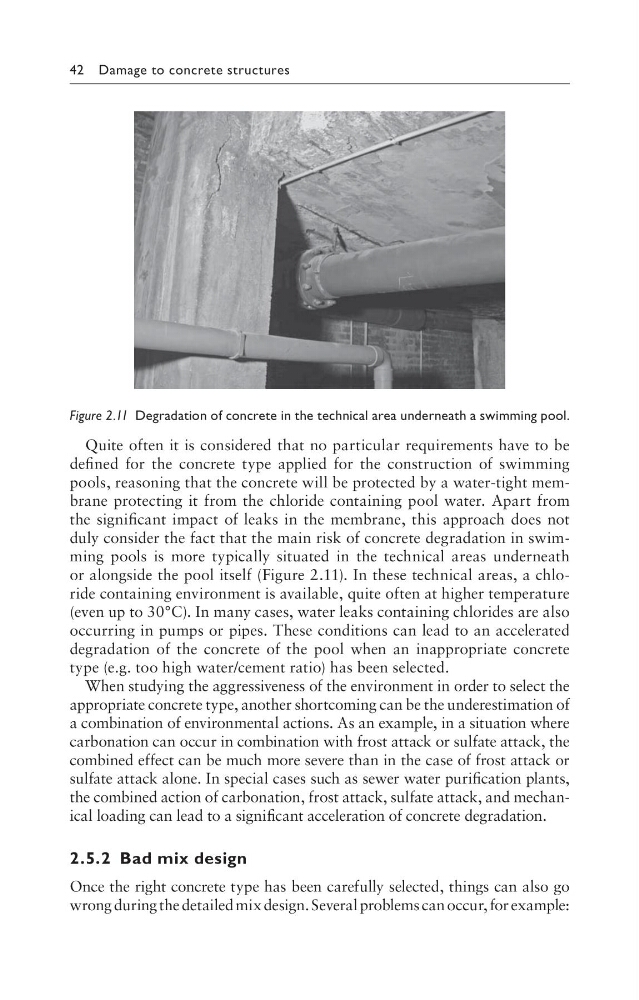
duly consider the fact that the main risk of concrete degradation in swimming pools is more typically situated in the technical areas underneath
or alongside the pool itself (Figure 2.11). In these technical areas, a chloride containing environment is available, quite often at higher temperature
(even up to 30°C). In many cases, water leaks containing chlorides are also
occurring in pumps or pipes. These conditions can lead to an accelerated
degradation of the concrete of the pool when an inappropriate concrete
type (e.g. too high water/cement ratio) has been selected.
When studying the aggressiveness of the environment in order to select the
appropriate concrete type, another shortcoming can be the underestimation of
a combination of environmental actions. As an example, in a situation where
carbonation can occur in combination with frost attack or sulfate attack, the
combined effect can be much more severe than in the case of frost attack or
sulfate attack alone. In special cases such as sewer water purification plants,
the combined action of carbonation, frost attack, sulfate attack, and mechanical loading can lead to a significant acceleration of concrete degradation.
2.5.2 bad mix design
Once the right concrete type has been carefully selected, things can also go
wrong during the detailed mix design. Several problems can occur, for example:
Figure 2.11 Degradation of concrete in the technical area underneath a swimming pool.
Quite often it is considered that no particular requirements have to be
defined for the concrete type applied for the construction of swimming
pools, reasoning that the concrete will be protected by a water-tight membrane protecting it from the chloride containing pool water. Apart from
the significant impact of leaks in the membrane, this approach does not
duly consider the fact that the main risk of concrete degradation in swimming pools is more typically situated in the technical areas underneath
or alongside the pool itself (Figure 2.11). In these technical areas, a chloride containing environment is available, quite often at higher temperature
(even up to 30°C). In many cases, water leaks containing chlorides are also
occurring in pumps or pipes. These conditions can lead to an accelerated
degradation of the concrete of the pool when an inappropriate concrete
type (e.g. too high water/cement ratio) has been selected.
When studying the aggressiveness of the environment in order to select the
appropriate concrete type, another shortcoming can be the underestimation of
a combination of environmental actions. As an example, in a situation where
carbonation can occur in combination with frost attack or sulfate attack, the
combined effect can be much more severe than in the case of frost attack or
sulfate attack alone. In special cases such as sewer water purification plants,
the combined action of carbonation, frost attack, sulfate attack, and mechanical loading can lead to a significant acceleration of concrete degradation.
2.5.2 bad mix design
Once the right concrete type has been carefully selected, things can also go
wrong during the detailed mix design. Several problems can occur, for example:
Figure 2.11 Degradation of concrete in the technical area underneath a swimming pool.