

Durability and service life 23
The approach based on durability indicators seems to offer more freedom to achieve a required durability performance. Further developments,
however, are needed in order to come to a generally accepted method which
can be easily applied.
1.6 More aDvanceD DurabIlIty DesIgn
A more advanced durability design can be based on reliability theory, as
applied to mechanical or structural design. Degradation mechanisms can
be introduced into the reliability analysis by explicitly considering time,
yielding a time-dependent failure probability.
In a simplified approach, a load-action S and a resistance R can be considered, which can be any stochastic variable expressed in arbitrary units.
The only requirement is that S and R can be directly compared. Failure
will occur when the resistance R becomes smaller than the load-action S,
or R < S. For a time-independent situation, the probability of failure is then
defined as the probability that R < S:
P f = P [R < S]
(1.1)
Considering degradation mechanisms, it is clear that both the resistance R
and the load-action S can be time-dependent stochastic variables, as illustrated in Figure 1.14a. This will lead to a time-dependent failure probability:
P f (t) = P [R(τ) < S(τ)]
for all τ ≤ t
(1.2)
Potential Durability
Very Low
Low
Medium
10000
1000
100
10
Apparent Gas Permeability (10
–18
m
2
)
High
Very High
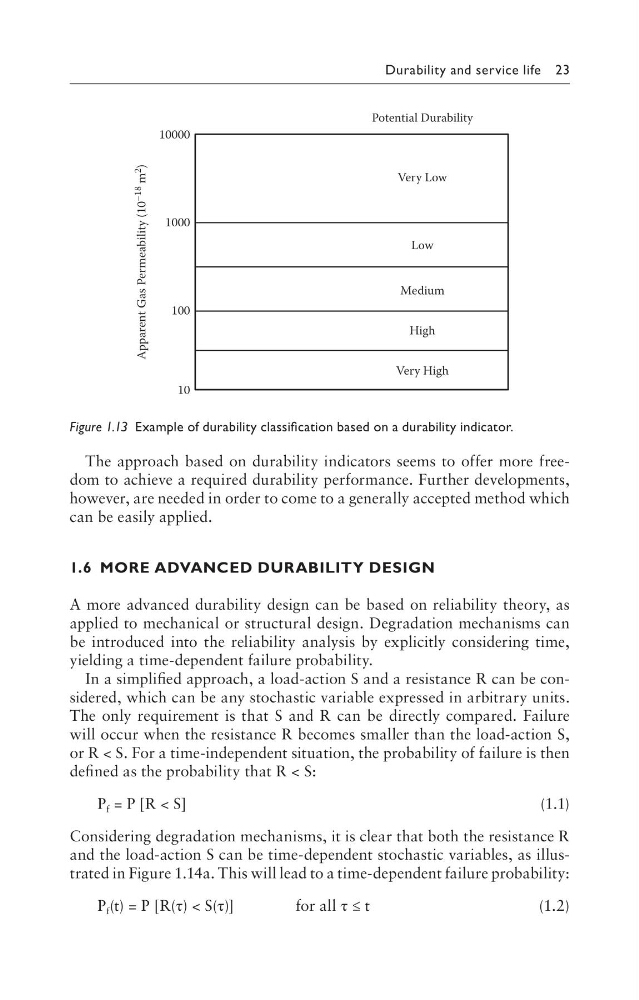
Figure 1.13 Example of durability classification based on a durability indicator.
The approach based on durability indicators seems to offer more freedom to achieve a required durability performance. Further developments,
however, are needed in order to come to a generally accepted method which
can be easily applied.
1.6 More aDvanceD DurabIlIty DesIgn
A more advanced durability design can be based on reliability theory, as
applied to mechanical or structural design. Degradation mechanisms can
be introduced into the reliability analysis by explicitly considering time,
yielding a time-dependent failure probability.
In a simplified approach, a load-action S and a resistance R can be considered, which can be any stochastic variable expressed in arbitrary units.
The only requirement is that S and R can be directly compared. Failure
will occur when the resistance R becomes smaller than the load-action S,
or R < S. For a time-independent situation, the probability of failure is then
defined as the probability that R < S:
P f = P [R < S]
(1.1)
Considering degradation mechanisms, it is clear that both the resistance R
and the load-action S can be time-dependent stochastic variables, as illustrated in Figure 1.14a. This will lead to a time-dependent failure probability:
P f (t) = P [R(τ) < S(τ)]
for all τ ≤ t
(1.2)
Potential Durability
Very Low
Low
Medium
10000
1000
100
10
Apparent Gas Permeability (10
–18
m
2
)
High
Very High
Figure 1.13 Example of durability classification based on a durability indicator.