

178 Damage to concrete structures
hydrogen (H 2 ), causing high internal pressures in the steel and possibly
crack initiation. The role of chlorides in this process is twofold, as pit corrosion on the one hand leads to hydrogen formation and, on the other
hand, leads to stress concentrations in the mechanically loaded steel.
In order to prevent chloride-induced corrosion of steel reinforcement,
the same basic measures have to be taken as for carbonation-induced corrosion: a good quality concrete has to protect the reinforcement from the
aggressive environment, and an adequate concrete cover thickness must be
considered. Appropriate curing of the freshly cast concrete is important in
order to reach the required concrete quality in the cover zone. However,
when considering the effect of binder type, a different situation is to be
noticed in comparison with carbonation. As the chloride-binding capacity
is higher in the case of blast furnace slag cement, this cement type might
be preferred in case of chloride attack instead of Portland cement; whereas
in the case of carbonation-induced corrosion, a Portland cement will typically perform better. However, a good curing of the freshly cast concrete
is stressed again because lack of curing will increase the carbonation rate
in the case of blast furnace slag cement, which will further increase the
chloride penetration.
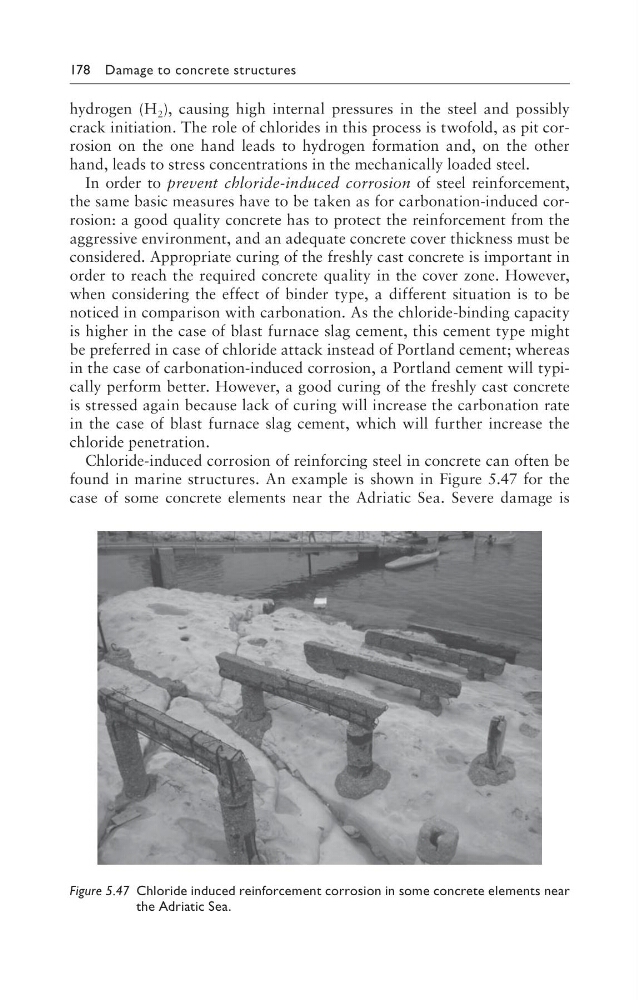
Chloride-induced corrosion of reinforcing steel in concrete can often be
found in marine structures. An example is shown in Figure 5.47 for the
case of some concrete elements near the Adriatic Sea. Severe damage is
Figure 5.47 Chloride induced reinforcement corrosion in some concrete elements near
the Adriatic Sea.
hydrogen (H 2 ), causing high internal pressures in the steel and possibly
crack initiation. The role of chlorides in this process is twofold, as pit corrosion on the one hand leads to hydrogen formation and, on the other
hand, leads to stress concentrations in the mechanically loaded steel.
In order to prevent chloride-induced corrosion of steel reinforcement,
the same basic measures have to be taken as for carbonation-induced corrosion: a good quality concrete has to protect the reinforcement from the
aggressive environment, and an adequate concrete cover thickness must be
considered. Appropriate curing of the freshly cast concrete is important in
order to reach the required concrete quality in the cover zone. However,
when considering the effect of binder type, a different situation is to be
noticed in comparison with carbonation. As the chloride-binding capacity
is higher in the case of blast furnace slag cement, this cement type might
be preferred in case of chloride attack instead of Portland cement; whereas
in the case of carbonation-induced corrosion, a Portland cement will typically perform better. However, a good curing of the freshly cast concrete
is stressed again because lack of curing will increase the carbonation rate
in the case of blast furnace slag cement, which will further increase the
chloride penetration.
Chloride-induced corrosion of reinforcing steel in concrete can often be
found in marine structures. An example is shown in Figure 5.47 for the
case of some concrete elements near the Adriatic Sea. Severe damage is
Figure 5.47 Chloride induced reinforcement corrosion in some concrete elements near
the Adriatic Sea.