

158 Damage to concrete structures
formed around the undamaged core of the sample. After 21 days, the outer
part showed cracks and was partially released. The front of the attack is
clearly visible in the sample after 21 days of exposure.
One typical case of severe attack is caused by sulfuric acid, H 2 SO 4 ,
which, in fact, is a combination of acid attack and sulfate attack (Skalny
et al. 2002). In the case of exposure to sulfuric acid, calcium hydroxide will
react with the acid, forming gypsum (calcium sulfate). A similar reaction
occurs, degrading the C-S-H phase. Furthermore, because of the reduced
pH value due to the presence of the acid, monosulfate and ettringite will
become unstable and form gypsum and aluminium sulfate. In the case of
running fluid near the exposed concrete surface, the degrading concrete
surface can be eroded very easily.
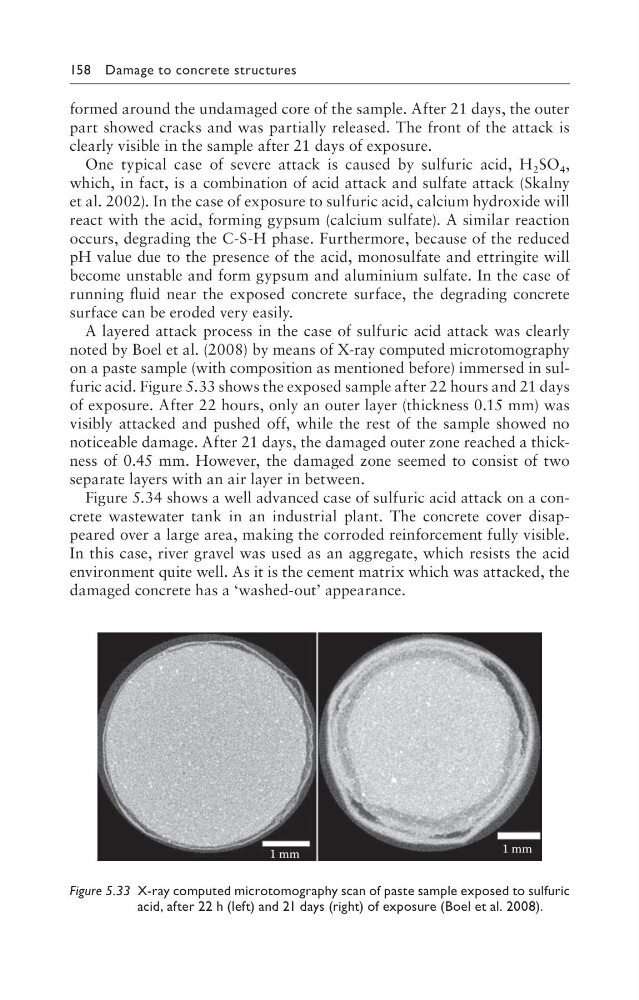
A layered attack process in the case of sulfuric acid attack was clearly
noted by Boel et al. (2008) by means of X-ray computed microtomography
on a paste sample (with composition as mentioned before) immersed in sulfuric acid. Figure 5.33 shows the exposed sample after 22 hours and 21 days
of exposure. After 22 hours, only an outer layer (thickness 0.15 mm) was
visibly attacked and pushed off, while the rest of the sample showed no
noticeable damage. After 21 days, the damaged outer zone reached a thickness of 0.45 mm. However, the damaged zone seemed to consist of two
separate layers with an air layer in between.
Figure 5.34 shows a well advanced case of sulfuric acid attack on a concrete wastewater tank in an industrial plant. The concrete cover disappeared over a large area, making the corroded reinforcement fully visible.
In this case, river gravel was used as an aggregate, which resists the acid
environment quite well. As it is the cement matrix which was attacked, the
damaged concrete has a ‘washed-out’ appearance.
1 mm
1 mm
Figure 5.33 X-ray computed microtomography scan of paste sample exposed to sulfuric
acid, after 22 h (left) and 21 days (right) of exposure (Boel et al. 2008).
formed around the undamaged core of the sample. After 21 days, the outer
part showed cracks and was partially released. The front of the attack is
clearly visible in the sample after 21 days of exposure.
One typical case of severe attack is caused by sulfuric acid, H 2 SO 4 ,
which, in fact, is a combination of acid attack and sulfate attack (Skalny
et al. 2002). In the case of exposure to sulfuric acid, calcium hydroxide will
react with the acid, forming gypsum (calcium sulfate). A similar reaction
occurs, degrading the C-S-H phase. Furthermore, because of the reduced
pH value due to the presence of the acid, monosulfate and ettringite will
become unstable and form gypsum and aluminium sulfate. In the case of
running fluid near the exposed concrete surface, the degrading concrete
surface can be eroded very easily.
A layered attack process in the case of sulfuric acid attack was clearly
noted by Boel et al. (2008) by means of X-ray computed microtomography
on a paste sample (with composition as mentioned before) immersed in sulfuric acid. Figure 5.33 shows the exposed sample after 22 hours and 21 days
of exposure. After 22 hours, only an outer layer (thickness 0.15 mm) was
visibly attacked and pushed off, while the rest of the sample showed no
noticeable damage. After 21 days, the damaged outer zone reached a thickness of 0.45 mm. However, the damaged zone seemed to consist of two
separate layers with an air layer in between.
Figure 5.34 shows a well advanced case of sulfuric acid attack on a concrete wastewater tank in an industrial plant. The concrete cover disappeared over a large area, making the corroded reinforcement fully visible.
In this case, river gravel was used as an aggregate, which resists the acid
environment quite well. As it is the cement matrix which was attacked, the
damaged concrete has a ‘washed-out’ appearance.
1 mm
1 mm
Figure 5.33 X-ray computed microtomography scan of paste sample exposed to sulfuric
acid, after 22 h (left) and 21 days (right) of exposure (Boel et al. 2008).