

128 Damage to concrete structures
of the fibres, leading to an increase in permeability (Liu et al. 2008). An
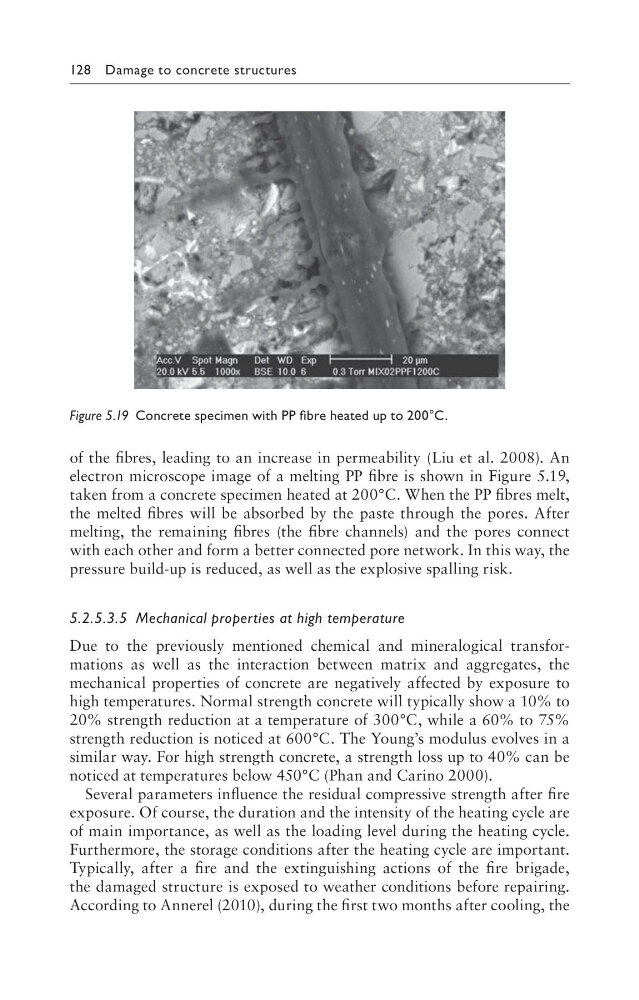
electron microscope image of a melting PP fibre is shown in Figure 5.19,
taken from a concrete specimen heated at 200°C. When the PP fibres melt,
the melted fibres will be absorbed by the paste through the pores. After
melting, the remaining fibres (the fibre channels) and the pores connect
with each other and form a better connected pore network. In this way, the
pressure build-up is reduced, as well as the explosive spalling risk.
5.2.5.3.5 Mechanical properties at high temperature
Due to the previously mentioned chemical and mineralogical transformations as well as the interaction between matrix and aggregates, the
mechanical properties of concrete are negatively affected by exposure to
high temperatures. Normal strength concrete will typically show a 10% to
20% strength reduction at a temperature of 300°C, while a 60% to 75%
strength reduction is noticed at 600°C. The Young’s modulus evolves in a
similar way. For high strength concrete, a strength loss up to 40% can be
noticed at temperatures below 450°C (Phan and Carino 2000).
Several parameters influence the residual compressive strength after fire
exposure. Of course, the duration and the intensity of the heating cycle are
of main importance, as well as the loading level during the heating cycle.
Furthermore, the storage conditions after the heating cycle are important.
Typically, after a fire and the extinguishing actions of the fire brigade,
the damaged structure is exposed to weather conditions before repairing.
According to Annerel (2010), during the first two months after cooling, the
Figure 5.19 Concrete specimen with PP fibre heated up to 200°C.
of the fibres, leading to an increase in permeability (Liu et al. 2008). An
electron microscope image of a melting PP fibre is shown in Figure 5.19,
taken from a concrete specimen heated at 200°C. When the PP fibres melt,
the melted fibres will be absorbed by the paste through the pores. After
melting, the remaining fibres (the fibre channels) and the pores connect
with each other and form a better connected pore network. In this way, the
pressure build-up is reduced, as well as the explosive spalling risk.
5.2.5.3.5 Mechanical properties at high temperature
Due to the previously mentioned chemical and mineralogical transformations as well as the interaction between matrix and aggregates, the
mechanical properties of concrete are negatively affected by exposure to
high temperatures. Normal strength concrete will typically show a 10% to
20% strength reduction at a temperature of 300°C, while a 60% to 75%
strength reduction is noticed at 600°C. The Young’s modulus evolves in a
similar way. For high strength concrete, a strength loss up to 40% can be
noticed at temperatures below 450°C (Phan and Carino 2000).
Several parameters influence the residual compressive strength after fire
exposure. Of course, the duration and the intensity of the heating cycle are
of main importance, as well as the loading level during the heating cycle.
Furthermore, the storage conditions after the heating cycle are important.
Typically, after a fire and the extinguishing actions of the fire brigade,
the damaged structure is exposed to weather conditions before repairing.
According to Annerel (2010), during the first two months after cooling, the
Figure 5.19 Concrete specimen with PP fibre heated up to 200°C.