

Actions during service 127
In laboratory conditions, unreinforced cementitious specimens can totally
disintegrate due to explosive spalling while rapidly heating in a furnace
(Liu 2006).
Many parameters have an influence on the spalling risk of concrete elements exposed to fire (Boström and Jansson 2007). Major influence is
noticed by the pore structure and the moisture content of the concrete.
However, further parameters are linked to element size and geometry, heating rate, and pre-loading conditions.
Normal strength concrete does not typically show spalling behaviour when
exposed to rapid heating. Although the spalling risk is more pronounced for
high-strength concrete, it can also occur in the case of self-compacting concrete (Ye et al. 2007, Boström and Jansson 2007, Fares et at. 2011) or, in
general, in any type of concrete with a more dense pore structure.
The addition of polypropylene fibres (PP) is widely used as an effective
method to prevent explosive spalling. Upon the melting of the PP fibres,
no significant increase in total pore volume is obtained, as is sometimes
thought. However, the connectivity of the pores increases due to melting
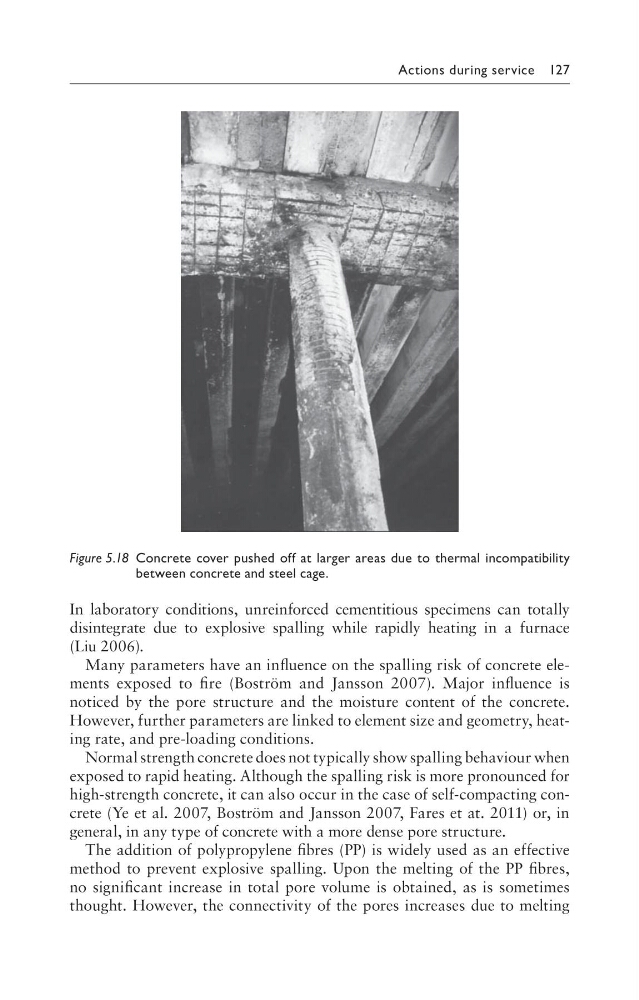
Figure 5.18 Concrete cover pushed off at larger areas due to thermal incompatibility
between concrete and steel cage.
In laboratory conditions, unreinforced cementitious specimens can totally
disintegrate due to explosive spalling while rapidly heating in a furnace
(Liu 2006).
Many parameters have an influence on the spalling risk of concrete elements exposed to fire (Boström and Jansson 2007). Major influence is
noticed by the pore structure and the moisture content of the concrete.
However, further parameters are linked to element size and geometry, heating rate, and pre-loading conditions.
Normal strength concrete does not typically show spalling behaviour when
exposed to rapid heating. Although the spalling risk is more pronounced for
high-strength concrete, it can also occur in the case of self-compacting concrete (Ye et al. 2007, Boström and Jansson 2007, Fares et at. 2011) or, in
general, in any type of concrete with a more dense pore structure.
The addition of polypropylene fibres (PP) is widely used as an effective
method to prevent explosive spalling. Upon the melting of the PP fibres,
no significant increase in total pore volume is obtained, as is sometimes
thought. However, the connectivity of the pores increases due to melting
Figure 5.18 Concrete cover pushed off at larger areas due to thermal incompatibility
between concrete and steel cage.