

84 Damage to concrete structures
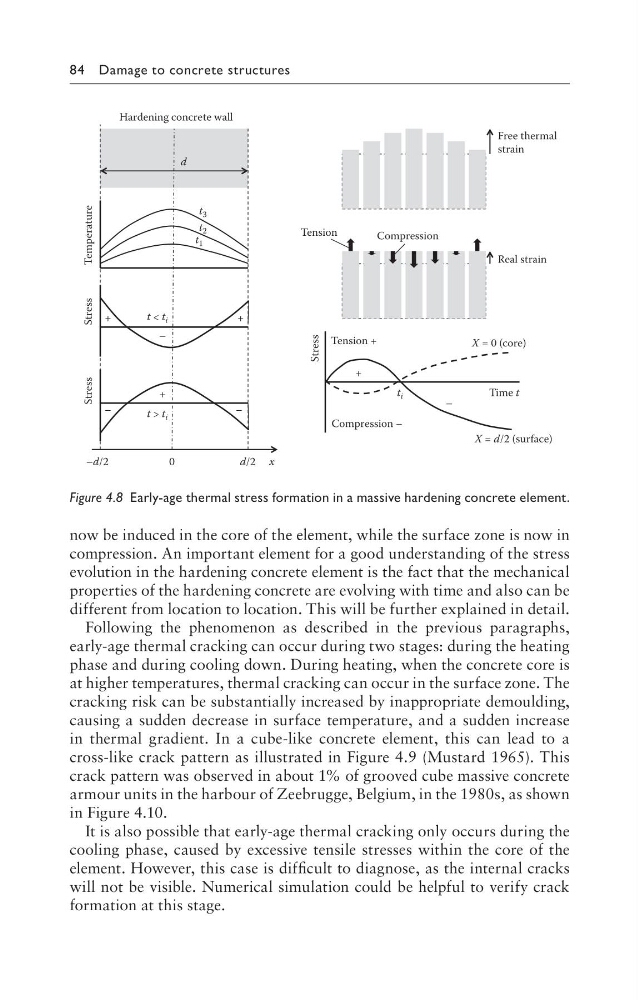
now be induced in the core of the element, while the surface zone is now in
compression. An important element for a good understanding of the stress
evolution in the hardening concrete element is the fact that the mechanical
properties of the hardening concrete are evolving with time and also can be
different from location to location. This will be further explained in detail.
Following the phenomenon as described in the previous paragraphs,
early-age thermal cracking can occur during two stages: during the heating
phase and during cooling down. During heating, when the concrete core is
at higher temperatures, thermal cracking can occur in the surface zone. The
cracking risk can be substantially increased by inappropriate demoulding,
causing a sudden decrease in surface temperature, and a sudden increase
in thermal gradient. In a cube-like concrete element, this can lead to a
cross-like crack pattern as illustrated in Figure 4.9 (Mustard 1965). This
crack pattern was observed in about 1% of grooved cube massive concrete
armour units in the harbour of Zeebrugge, Belgium, in the 1980s, as shown
in Figure 4.10.
It is also possible that early-age thermal cracking only occurs during the
cooling phase, caused by excessive tensile stresses within the core of the
element. However, this case is difficult to diagnose, as the internal cracks
will not be visible. Numerical simulation could be helpful to verify crack
formation at this stage.
Free thermal
strain
Hardening concrete wall
Temperature
Stress
Stress
d
Real strain
X = d/2 (surface)
Compression –
d/2
–
+
+
–
+
–
–d/2
t > t i
t < t i
t 1
t 2
t 3
0
x
Tension +
Tension
Compression
Stress
+
–
t i
X = 0 (core)
Time t
Figure 4.8 Early-age thermal stress formation in a massive hardening concrete element.
now be induced in the core of the element, while the surface zone is now in
compression. An important element for a good understanding of the stress
evolution in the hardening concrete element is the fact that the mechanical
properties of the hardening concrete are evolving with time and also can be
different from location to location. This will be further explained in detail.
Following the phenomenon as described in the previous paragraphs,
early-age thermal cracking can occur during two stages: during the heating
phase and during cooling down. During heating, when the concrete core is
at higher temperatures, thermal cracking can occur in the surface zone. The
cracking risk can be substantially increased by inappropriate demoulding,
causing a sudden decrease in surface temperature, and a sudden increase
in thermal gradient. In a cube-like concrete element, this can lead to a
cross-like crack pattern as illustrated in Figure 4.9 (Mustard 1965). This
crack pattern was observed in about 1% of grooved cube massive concrete
armour units in the harbour of Zeebrugge, Belgium, in the 1980s, as shown
in Figure 4.10.
It is also possible that early-age thermal cracking only occurs during the
cooling phase, caused by excessive tensile stresses within the core of the
element. However, this case is difficult to diagnose, as the internal cracks
will not be visible. Numerical simulation could be helpful to verify crack
formation at this stage.
Free thermal
strain
Hardening concrete wall
Temperature
Stress
Stress
d
Real strain
X = d/2 (surface)
Compression –
d/2
–
+
+
–
+
–
–d/2
t > t i
t < t i
t 1
t 2
t 3
0
x
Tension +
Tension
Compression
Stress
+
–
t i
X = 0 (core)
Time t
Figure 4.8 Early-age thermal stress formation in a massive hardening concrete element.