

666
I. S. Rampasso et al.
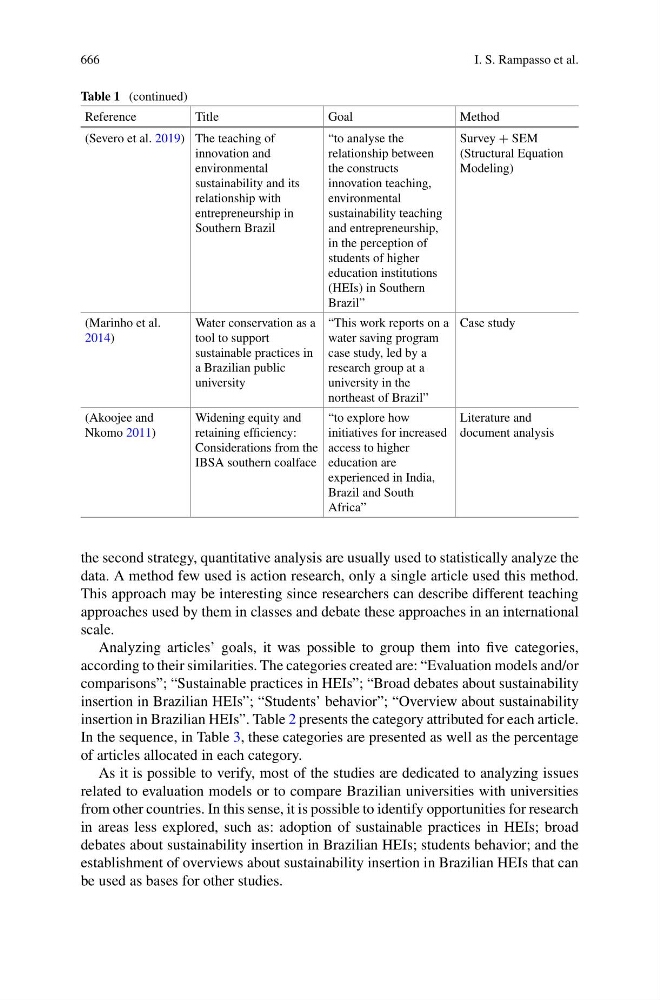
Table 1 (continued)
Reference
Title
Goal
Method
(Severo et al. 2019) The teaching of
innovation and
environmental
sustainability and its
relationship with
entrepreneurship in
Southern Brazil
“to analyse the
relationship between
the constructs
innovation teaching,
environmental
sustainability teaching
and entrepreneurship,
in the perception of
students of higher
education institutions
(HEIs) in Southern
Brazil”
Survey + SEM
(Structural Equation
Modeling)
(Marinho et al.
2014)
Water conservation as a
tool to support
sustainable practices in
a Brazilian public
university
“This work reports on a
water saving program
case study, led by a
research group at a
university in the
northeast of Brazil”
Case study
(Akoojee and
Nkomo 2011)
Widening equity and
retaining efficiency:
Considerations from the
IBSA southern coalface
“to explore how
initiatives for increased
access to higher
education are
experienced in India,
Brazil and South
Africa”
Literature and
document analysis
the second strategy, quantitative analysis are usually used to statistically analyze the
data. A method few used is action research, only a single article used this method.
This approach may be interesting since researchers can describe different teaching
approaches used by them in classes and debate these approaches in an international
scale.
Analyzing articles’ goals, it was possible to group them into five categories,
according to their similarities. The categories created are: “Evaluation models and/or
comparisons”; “Sustainable practices in HEIs”; “Broad debates about sustainability
insertion in Brazilian HEIs”; “Students’ behavior”; “Overview about sustainability
insertion in Brazilian HEIs”. Table 2 presents the category attributed for each article.
In the sequence, in Table 3, these categories are presented as well as the percentage
of articles allocated in each category.
As it is possible to verify, most of the studies are dedicated to analyzing issues
related to evaluation models or to compare Brazilian universities with universities
from other countries. In this sense, it is possible to identify opportunities for research
in areas less explored, such as: adoption of sustainable practices in HEIs; broad
debates about sustainability insertion in Brazilian HEIs; students behavior; and the
establishment of overviews about sustainability insertion in Brazilian HEIs that can
be used as bases for other studies.