

Macroergonomics as a Way for Social Responsibility…
611
Nowadays, social responsibility is an issue considered by organizations for
achieving a sustainable work system, which suggests an interrelation between
sustainability and work organization. Social responsibility is the legal and moral
commitment that a company has towards the society. In promoting the well-being,
quality of life and health of its stakeholders, whether internal (employees of the organization) or external (customers, suppliers, etc.) as well as the benefits of investing
in social responsibility, it goes beyond profits, favoring the society as a whole (Salaiz
et al. 2019; Moraes et al. 2017). The relationship between social responsibility
and ergonomics is the promotion of the well-being and health of an organization’s
stakeholders.
Hendrick proposed the sociotechnical system evaluation as a way to achieve
ergonomics goals and Macroergonomics, an approach using the sociotechnical model
and participatory ergonomics (which considers the active involvement/participation
of the stakeholders during the entire process of an ergonomic analysis or interventions) to improve system’s performance and human well-being in the organization,
what is being proved to be true by empirical studies (e.g. Derenevich 2017).
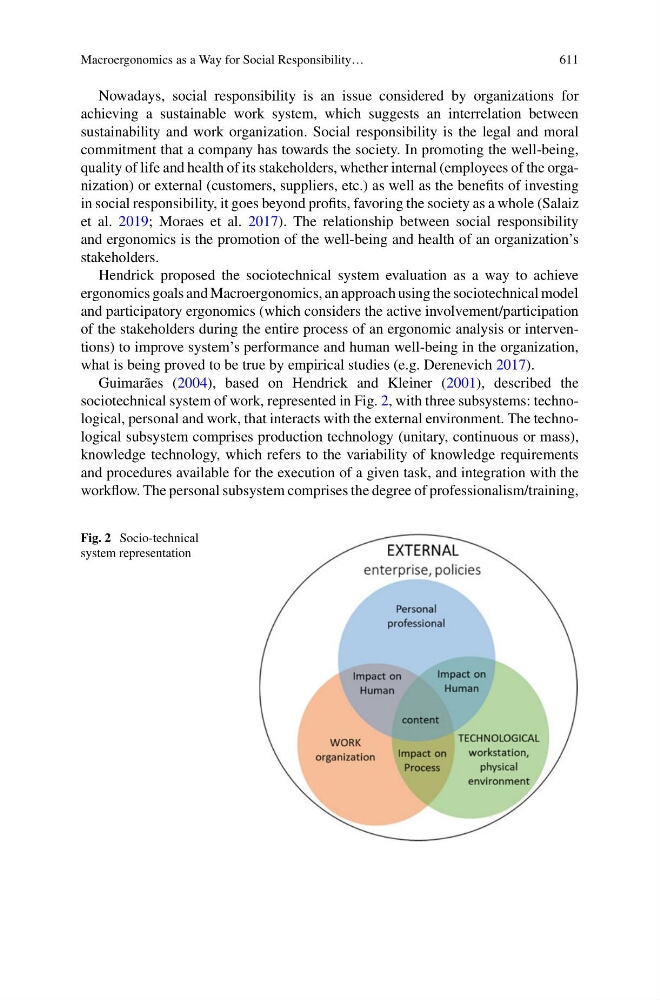
Guimarães (2004), based on Hendrick and Kleiner (2001), described the
sociotechnical system of work, represented in Fig. 2, with three subsystems: technological, personal and work, that interacts with the external environment. The technological subsystem comprises production technology (unitary, continuous or mass),
knowledge technology, which refers to the variability of knowledge requirements
and procedures available for the execution of a given task, and integration with the
workflow. The personal subsystem comprises the degree of professionalism/training,
Fig. 2 Socio-technical
system representation
611
Nowadays, social responsibility is an issue considered by organizations for
achieving a sustainable work system, which suggests an interrelation between
sustainability and work organization. Social responsibility is the legal and moral
commitment that a company has towards the society. In promoting the well-being,
quality of life and health of its stakeholders, whether internal (employees of the organization) or external (customers, suppliers, etc.) as well as the benefits of investing
in social responsibility, it goes beyond profits, favoring the society as a whole (Salaiz
et al. 2019; Moraes et al. 2017). The relationship between social responsibility
and ergonomics is the promotion of the well-being and health of an organization’s
stakeholders.
Hendrick proposed the sociotechnical system evaluation as a way to achieve
ergonomics goals and Macroergonomics, an approach using the sociotechnical model
and participatory ergonomics (which considers the active involvement/participation
of the stakeholders during the entire process of an ergonomic analysis or interventions) to improve system’s performance and human well-being in the organization,
what is being proved to be true by empirical studies (e.g. Derenevich 2017).
Guimarães (2004), based on Hendrick and Kleiner (2001), described the
sociotechnical system of work, represented in Fig. 2, with three subsystems: technological, personal and work, that interacts with the external environment. The technological subsystem comprises production technology (unitary, continuous or mass),
knowledge technology, which refers to the variability of knowledge requirements
and procedures available for the execution of a given task, and integration with the
workflow. The personal subsystem comprises the degree of professionalism/training,
Fig. 2 Socio-technical
system representation