

610
M. G. Derenevich et al.
seen as an endless resource (Oliveira 2013). Ergonomics is the science that studies
the interactions between the human and other elements of a system, and it aims to
improve well-being and systems performance (International Ergonomics Association
2020).
The second industrial revolution brought reflections about how the development
of organizations impacts on nature and humans, which started to be discussed in the
third industrial revolution. Local movements in favour of the environment became
common and were organized in NGOs, and economic development started to be seen
as the opposite of environmental preservation. Physical ergonomics, that mainly
deals with biomechanical issues related to the workplace, begins to be discussed,
and the term Social Responsibility was evoked. In 1972, the UN Stockholm Conference took place and sustainability, expressed as eco-development, was defined by
Sachs (1986, p. 113) as “the socially desirable, economically viable and ecologically
prudent development”. A year later, in what is now known as the Brundtland Report,
Sustainable Development was conceptualized as “the use of resources to meet the
needs of the present without compromising the ability of future generations to meet
their own needs” (CMMAD 1991, p. 46), bringing into play the social and environmental interdependence. At this point, ergonomics was in its third evolutionary
phase, known as cognitive, incorporating the cognitive aspects that influence work
performance, as a result of the evolution in computers and demand for attention. More
recently, in Agenda 21, the human being was allocated in the centre of sustainable
development: it is necessary to consider people and their social, economic and environmental conditions. For corporations, based on the study by Bolis et al. (2014), the
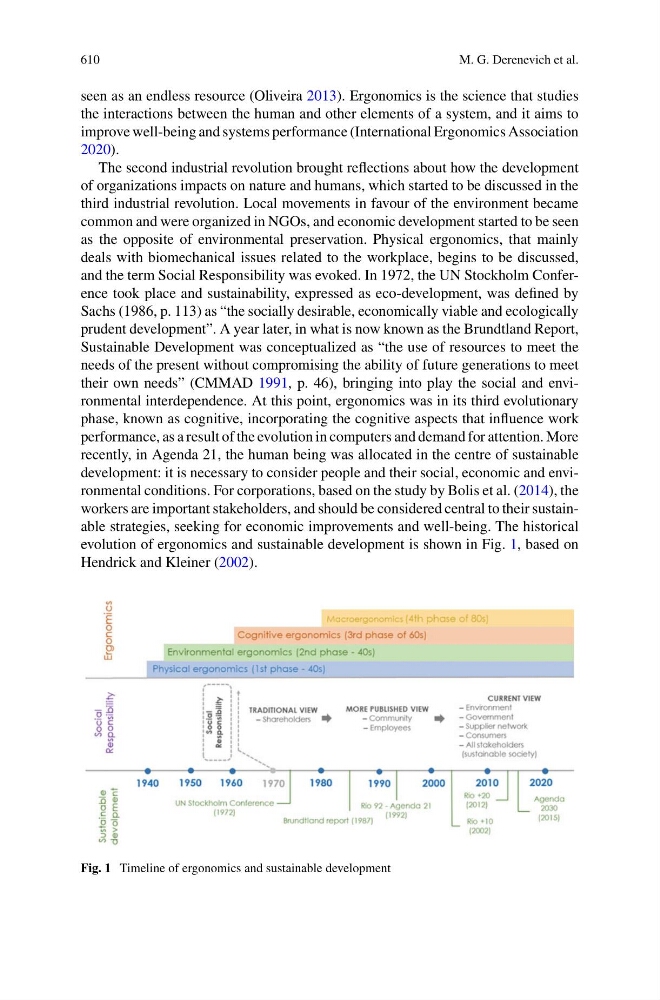
workers are important stakeholders, and should be considered central to their sustainable strategies, seeking for economic improvements and well-being. The historical
evolution of ergonomics and sustainable development is shown in Fig. 1, based on
Hendrick and Kleiner (2002).
Fig. 1 Timeline of ergonomics and sustainable development
M. G. Derenevich et al.
seen as an endless resource (Oliveira 2013). Ergonomics is the science that studies
the interactions between the human and other elements of a system, and it aims to
improve well-being and systems performance (International Ergonomics Association
2020).
The second industrial revolution brought reflections about how the development
of organizations impacts on nature and humans, which started to be discussed in the
third industrial revolution. Local movements in favour of the environment became
common and were organized in NGOs, and economic development started to be seen
as the opposite of environmental preservation. Physical ergonomics, that mainly
deals with biomechanical issues related to the workplace, begins to be discussed,
and the term Social Responsibility was evoked. In 1972, the UN Stockholm Conference took place and sustainability, expressed as eco-development, was defined by
Sachs (1986, p. 113) as “the socially desirable, economically viable and ecologically
prudent development”. A year later, in what is now known as the Brundtland Report,
Sustainable Development was conceptualized as “the use of resources to meet the
needs of the present without compromising the ability of future generations to meet
their own needs” (CMMAD 1991, p. 46), bringing into play the social and environmental interdependence. At this point, ergonomics was in its third evolutionary
phase, known as cognitive, incorporating the cognitive aspects that influence work
performance, as a result of the evolution in computers and demand for attention. More
recently, in Agenda 21, the human being was allocated in the centre of sustainable
development: it is necessary to consider people and their social, economic and environmental conditions. For corporations, based on the study by Bolis et al. (2014), the
workers are important stakeholders, and should be considered central to their sustainable strategies, seeking for economic improvements and well-being. The historical
evolution of ergonomics and sustainable development is shown in Fig. 1, based on
Hendrick and Kleiner (2002).
Fig. 1 Timeline of ergonomics and sustainable development