

Environmental Bioethics, Sustainable Development and Social …
557
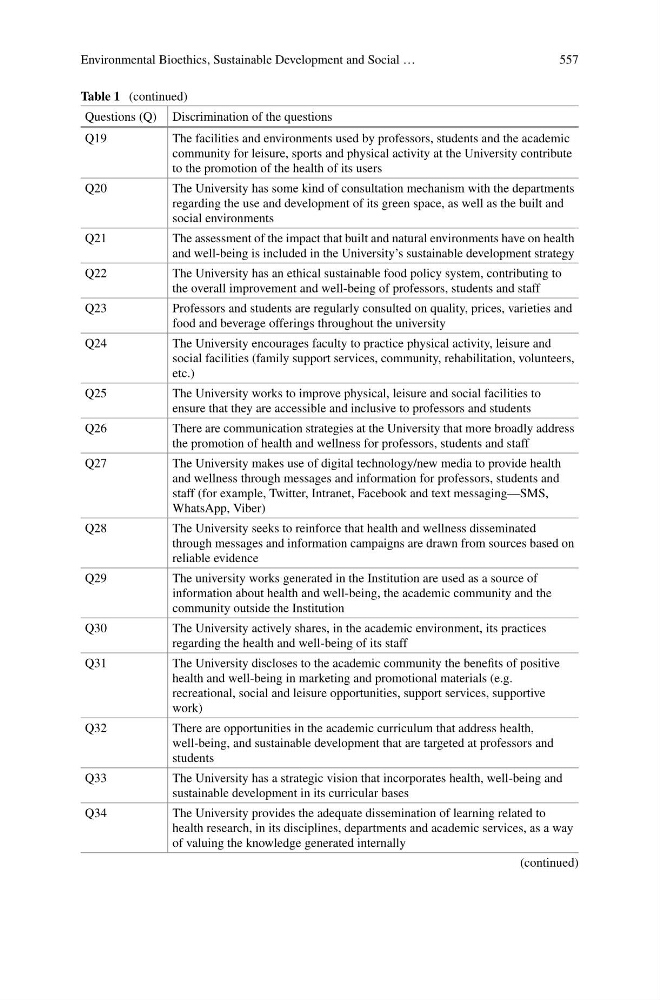
Table 1 (continued)
Questions (Q) Discrimination of the questions
Q19
The facilities and environments used by professors, students and the academic
community for leisure, sports and physical activity at the University contribute
to the promotion of the health of its users
Q20
The University has some kind of consultation mechanism with the departments
regarding the use and development of its green space, as well as the built and
social environments
Q21
The assessment of the impact that built and natural environments have on health
and well-being is included in the University’s sustainable development strategy
Q22
The University has an ethical sustainable food policy system, contributing to
the overall improvement and well-being of professors, students and staff
Q23
Professors and students are regularly consulted on quality, prices, varieties and
food and beverage offerings throughout the university
Q24
The University encourages faculty to practice physical activity, leisure and
social facilities (family support services, community, rehabilitation, volunteers,
etc.)
Q25
The University works to improve physical, leisure and social facilities to
ensure that they are accessible and inclusive to professors and students
Q26
There are communication strategies at the University that more broadly address
the promotion of health and wellness for professors, students and staff
Q27
The University makes use of digital technology/new media to provide health
and wellness through messages and information for professors, students and
staff (for example, Twitter, Intranet, Facebook and text messaging—SMS,
WhatsApp, Viber)
Q28
The University seeks to reinforce that health and wellness disseminated
through messages and information campaigns are drawn from sources based on
reliable evidence
Q29
The university works generated in the Institution are used as a source of
information about health and well-being, the academic community and the
community outside the Institution
Q30
The University actively shares, in the academic environment, its practices
regarding the health and well-being of its staff
Q31
The University discloses to the academic community the benefits of positive
health and well-being in marketing and promotional materials (e.g.
recreational, social and leisure opportunities, support services, supportive
work)
Q32
There are opportunities in the academic curriculum that address health,
well-being, and sustainable development that are targeted at professors and
students
Q33
The University has a strategic vision that incorporates health, well-being and
sustainable development in its curricular bases
Q34
The University provides the adequate dissemination of learning related to
health research, in its disciplines, departments and academic services, as a way
of valuing the knowledge generated internally
(continued)
557
Table 1 (continued)
Questions (Q) Discrimination of the questions
Q19
The facilities and environments used by professors, students and the academic
community for leisure, sports and physical activity at the University contribute
to the promotion of the health of its users
Q20
The University has some kind of consultation mechanism with the departments
regarding the use and development of its green space, as well as the built and
social environments
Q21
The assessment of the impact that built and natural environments have on health
and well-being is included in the University’s sustainable development strategy
Q22
The University has an ethical sustainable food policy system, contributing to
the overall improvement and well-being of professors, students and staff
Q23
Professors and students are regularly consulted on quality, prices, varieties and
food and beverage offerings throughout the university
Q24
The University encourages faculty to practice physical activity, leisure and
social facilities (family support services, community, rehabilitation, volunteers,
etc.)
Q25
The University works to improve physical, leisure and social facilities to
ensure that they are accessible and inclusive to professors and students
Q26
There are communication strategies at the University that more broadly address
the promotion of health and wellness for professors, students and staff
Q27
The University makes use of digital technology/new media to provide health
and wellness through messages and information for professors, students and
staff (for example, Twitter, Intranet, Facebook and text messaging—SMS,
WhatsApp, Viber)
Q28
The University seeks to reinforce that health and wellness disseminated
through messages and information campaigns are drawn from sources based on
reliable evidence
Q29
The university works generated in the Institution are used as a source of
information about health and well-being, the academic community and the
community outside the Institution
Q30
The University actively shares, in the academic environment, its practices
regarding the health and well-being of its staff
Q31
The University discloses to the academic community the benefits of positive
health and well-being in marketing and promotional materials (e.g.
recreational, social and leisure opportunities, support services, supportive
work)
Q32
There are opportunities in the academic curriculum that address health,
well-being, and sustainable development that are targeted at professors and
students
Q33
The University has a strategic vision that incorporates health, well-being and
sustainable development in its curricular bases
Q34
The University provides the adequate dissemination of learning related to
health research, in its disciplines, departments and academic services, as a way
of valuing the knowledge generated internally
(continued)