

506
T. Frozza et al.
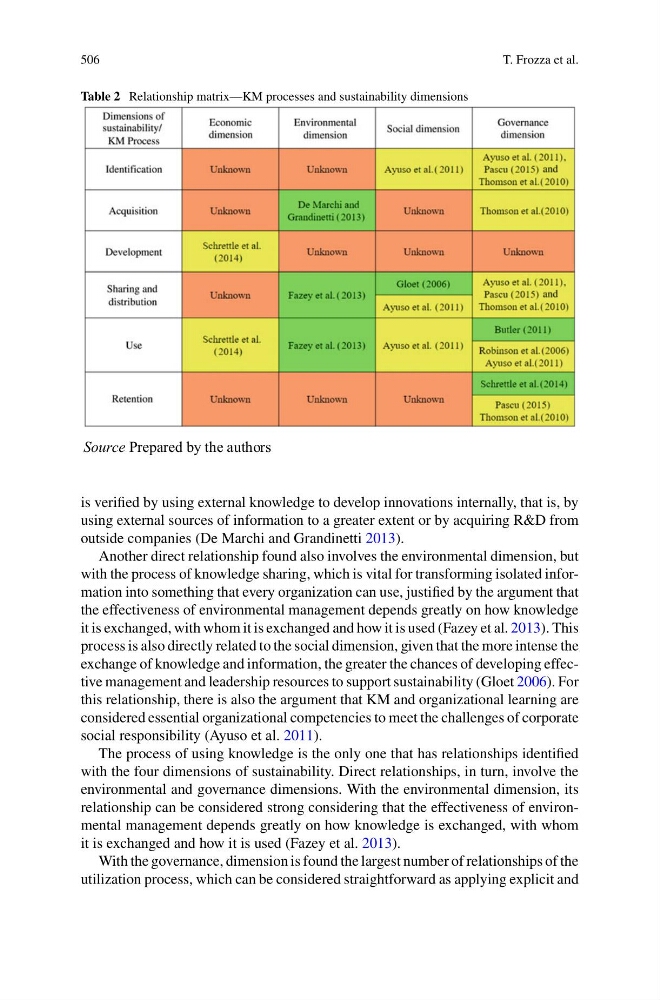
Table 2 Relationship matrix—KM processes and sustainability dimensions
Source Prepared by the authors
is verified by using external knowledge to develop innovations internally, that is, by
using external sources of information to a greater extent or by acquiring R&D from
outside companies (De Marchi and Grandinetti 2013).
Another direct relationship found also involves the environmental dimension, but
with the process of knowledge sharing, which is vital for transforming isolated information into something that every organization can use, justified by the argument that
the effectiveness of environmental management depends greatly on how knowledge
it is exchanged, with whom it is exchanged and how it is used (Fazey et al. 2013). This
process is also directly related to the social dimension, given that the more intense the
exchange of knowledge and information, the greater the chances of developing effective management and leadership resources to support sustainability (Gloet 2006). For
this relationship, there is also the argument that KM and organizational learning are
considered essential organizational competencies to meet the challenges of corporate
social responsibility (Ayuso et al. 2011).
The process of using knowledge is the only one that has relationships identified
with the four dimensions of sustainability. Direct relationships, in turn, involve the
environmental and governance dimensions. With the environmental dimension, its
relationship can be considered strong considering that the effectiveness of environmental management depends greatly on how knowledge is exchanged, with whom
it is exchanged and how it is used (Fazey et al. 2013).
With the governance, dimension is found the largest number of relationships of the
utilization process, which can be considered straightforward as applying explicit and
T. Frozza et al.
Table 2 Relationship matrix—KM processes and sustainability dimensions
Source Prepared by the authors
is verified by using external knowledge to develop innovations internally, that is, by
using external sources of information to a greater extent or by acquiring R&D from
outside companies (De Marchi and Grandinetti 2013).
Another direct relationship found also involves the environmental dimension, but
with the process of knowledge sharing, which is vital for transforming isolated information into something that every organization can use, justified by the argument that
the effectiveness of environmental management depends greatly on how knowledge
it is exchanged, with whom it is exchanged and how it is used (Fazey et al. 2013). This
process is also directly related to the social dimension, given that the more intense the
exchange of knowledge and information, the greater the chances of developing effective management and leadership resources to support sustainability (Gloet 2006). For
this relationship, there is also the argument that KM and organizational learning are
considered essential organizational competencies to meet the challenges of corporate
social responsibility (Ayuso et al. 2011).
The process of using knowledge is the only one that has relationships identified
with the four dimensions of sustainability. Direct relationships, in turn, involve the
environmental and governance dimensions. With the environmental dimension, its
relationship can be considered strong considering that the effectiveness of environmental management depends greatly on how knowledge is exchanged, with whom
it is exchanged and how it is used (Fazey et al. 2013).
With the governance, dimension is found the largest number of relationships of the
utilization process, which can be considered straightforward as applying explicit and