

504
T. Frozza et al.
A fourth study, Nupap (2017) seeks to create a KM system for use by a research
group within a university department. The intent with the creation of this KM system
was to enhance knowledge sharing and learning for sustainable development. Thus,
with the system, it was possible to increase the sharing of tacit knowledge among
group members and turn this tacit knowledge into explicit knowledge by storing it
in a repository.
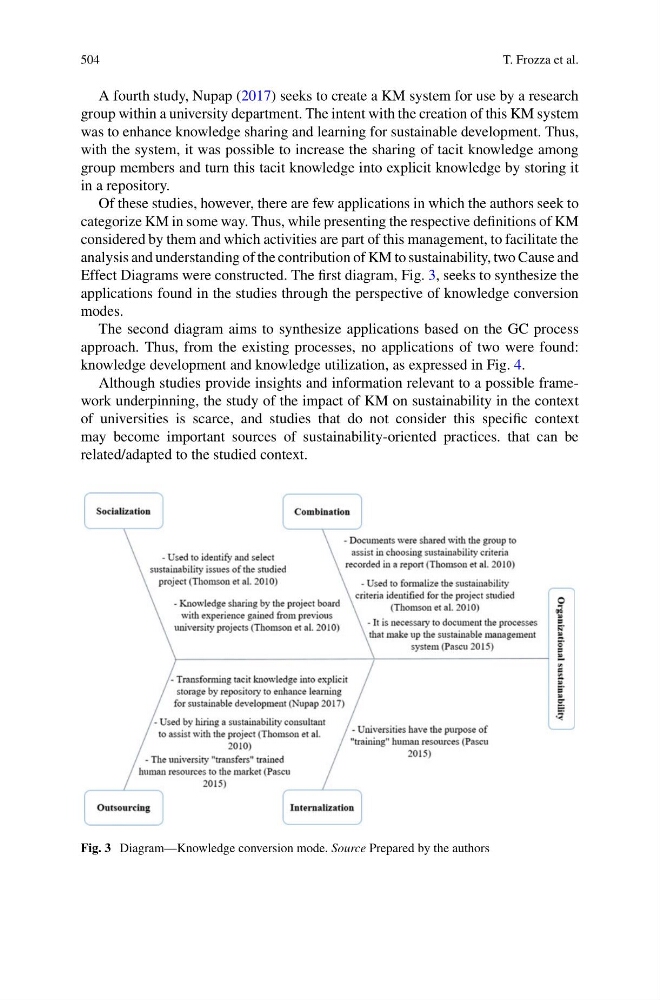
Of these studies, however, there are few applications in which the authors seek to
categorize KM in some way. Thus, while presenting the respective definitions of KM
considered by them and which activities are part of this management, to facilitate the
analysis and understanding of the contribution of KM to sustainability, two Cause and
Effect Diagrams were constructed. The first diagram, Fig. 3, seeks to synthesize the
applications found in the studies through the perspective of knowledge conversion
modes.
The second diagram aims to synthesize applications based on the GC process
approach. Thus, from the existing processes, no applications of two were found:
knowledge development and knowledge utilization, as expressed in Fig. 4.
Although studies provide insights and information relevant to a possible framework underpinning, the study of the impact of KM on sustainability in the context
of universities is scarce, and studies that do not consider this specific context
may become important sources of sustainability-oriented practices. that can be
related/adapted to the studied context.
Fig. 3 Diagram—Knowledge conversion mode. Source Prepared by the authors
T. Frozza et al.
A fourth study, Nupap (2017) seeks to create a KM system for use by a research
group within a university department. The intent with the creation of this KM system
was to enhance knowledge sharing and learning for sustainable development. Thus,
with the system, it was possible to increase the sharing of tacit knowledge among
group members and turn this tacit knowledge into explicit knowledge by storing it
in a repository.
Of these studies, however, there are few applications in which the authors seek to
categorize KM in some way. Thus, while presenting the respective definitions of KM
considered by them and which activities are part of this management, to facilitate the
analysis and understanding of the contribution of KM to sustainability, two Cause and
Effect Diagrams were constructed. The first diagram, Fig. 3, seeks to synthesize the
applications found in the studies through the perspective of knowledge conversion
modes.
The second diagram aims to synthesize applications based on the GC process
approach. Thus, from the existing processes, no applications of two were found:
knowledge development and knowledge utilization, as expressed in Fig. 4.
Although studies provide insights and information relevant to a possible framework underpinning, the study of the impact of KM on sustainability in the context
of universities is scarce, and studies that do not consider this specific context
may become important sources of sustainability-oriented practices. that can be
related/adapted to the studied context.
Fig. 3 Diagram—Knowledge conversion mode. Source Prepared by the authors