

University-Society Integration Through Action Research Projects
487
Table 3 Social innovation elements in the TimeBank project
Drivers for social
innovation
Structural
dimension (social
ties configuration)
Relational
dimension (social
norms, trust)
Cognitive
dimension (codes
and narratives)
TimeBank
project
Leadership,
networking, and,
alignment of needs
Volunteers,
assistants, and
students access
leaders and
teachers through
vertical ties.
Between teacher
and leader, there
are horizontal ties.
Decision making
is centered on the
teacher who
passes the
deference of the
leader who knows
the needs of the
assisted
Among teachers,
students, and
volunteers, the
rules
predominated.
Among volunteers
with the assisted,
the bonds were
reliable, gradually
gained and by
previous
interaction. The
credibility of the
educational
institution lends
confidence to the
project
Between teacher
and students, codes
and languages are
specific and
common only
among them, as
well as between
volunteers and
assistants. The
community leader
has taken
responsibility for
engaging and
building trust, as
well as dealing
with project-related
expectations. There
are codes and
language that
permeate the
boundaries
between groups
that begin to create
a common
language for all
Source Drawn by authors (2019)
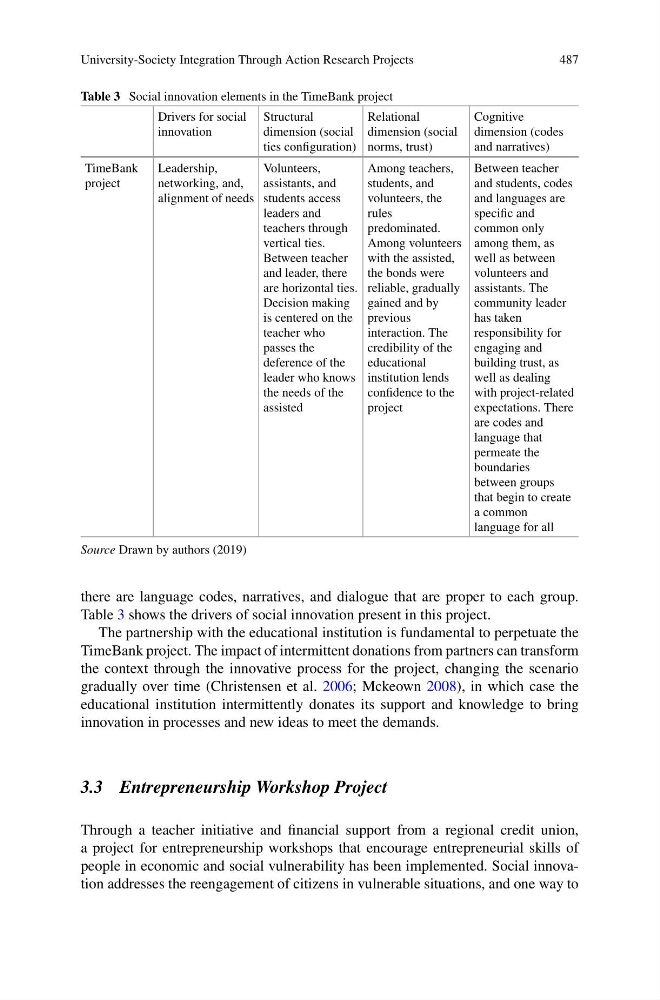
there are language codes, narratives, and dialogue that are proper to each group.
Table 3 shows the drivers of social innovation present in this project.
The partnership with the educational institution is fundamental to perpetuate the
TimeBank project. The impact of intermittent donations from partners can transform
the context through the innovative process for the project, changing the scenario
gradually over time (Christensen et al. 2006; Mckeown 2008), in which case the
educational institution intermittently donates its support and knowledge to bring
innovation in processes and new ideas to meet the demands.
3.3 Entrepreneurship Workshop Project
Through a teacher initiative and financial support from a regional credit union,
a project for entrepreneurship workshops that encourage entrepreneurial skills of
people in economic and social vulnerability has been implemented. Social innovation addresses the reengagement of citizens in vulnerable situations, and one way to
487
Table 3 Social innovation elements in the TimeBank project
Drivers for social
innovation
Structural
dimension (social
ties configuration)
Relational
dimension (social
norms, trust)
Cognitive
dimension (codes
and narratives)
TimeBank
project
Leadership,
networking, and,
alignment of needs
Volunteers,
assistants, and
students access
leaders and
teachers through
vertical ties.
Between teacher
and leader, there
are horizontal ties.
Decision making
is centered on the
teacher who
passes the
deference of the
leader who knows
the needs of the
assisted
Among teachers,
students, and
volunteers, the
rules
predominated.
Among volunteers
with the assisted,
the bonds were
reliable, gradually
gained and by
previous
interaction. The
credibility of the
educational
institution lends
confidence to the
project
Between teacher
and students, codes
and languages are
specific and
common only
among them, as
well as between
volunteers and
assistants. The
community leader
has taken
responsibility for
engaging and
building trust, as
well as dealing
with project-related
expectations. There
are codes and
language that
permeate the
boundaries
between groups
that begin to create
a common
language for all
Source Drawn by authors (2019)
there are language codes, narratives, and dialogue that are proper to each group.
Table 3 shows the drivers of social innovation present in this project.
The partnership with the educational institution is fundamental to perpetuate the
TimeBank project. The impact of intermittent donations from partners can transform
the context through the innovative process for the project, changing the scenario
gradually over time (Christensen et al. 2006; Mckeown 2008), in which case the
educational institution intermittently donates its support and knowledge to bring
innovation in processes and new ideas to meet the demands.
3.3 Entrepreneurship Workshop Project
Through a teacher initiative and financial support from a regional credit union,
a project for entrepreneurship workshops that encourage entrepreneurial skills of
people in economic and social vulnerability has been implemented. Social innovation addresses the reengagement of citizens in vulnerable situations, and one way to