

Assessment Tools and Performance Indicators …
471
• The reputable tools are: STARS, AISHE, GASU, GRI, CSAF, SAQ, STAUNCH,
Green Metric, USAT, AUA, CSRC, ISCN, ISO 14001 and Green Plan;
• The main tools, ie those that have been mentioned 4 or more times are: STARS,
AISHE, GASU, GRI, CSAF, SAQ, STAUNCH, Green Metric and USAT;
• The most mentioned tool is STARS, followed by AISHE.
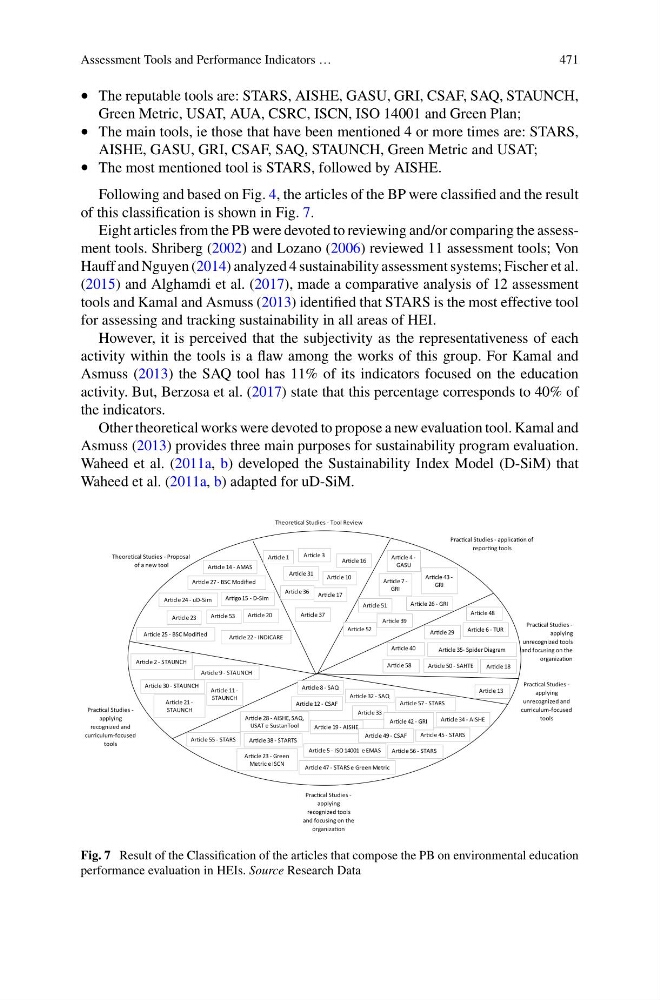
Following and based on Fig. 4, the articles of the BP were classified and the result
of this classification is shown in Fig. 7.
Eight articles from the PB were devoted to reviewing and/or comparing the assessment tools. Shriberg (2002) and Lozano (2006) reviewed 11 assessment tools; Von
Hauff and Nguyen (2014) analyzed 4 sustainability assessment systems; Fischer et al.
(2015) and Alghamdi et al. (2017), made a comparative analysis of 12 assessment
tools and Kamal and Asmuss (2013) identified that STARS is the most effective tool
for assessing and tracking sustainability in all areas of HEI.
However, it is perceived that the subjectivity as the representativeness of each
activity within the tools is a flaw among the works of this group. For Kamal and
Asmuss (2013) the SAQ tool has 11% of its indicators focused on the education
activity. But, Berzosa et al. (2017) state that this percentage corresponds to 40% of
the indicators.
Other theoretical works were devoted to propose a new evaluation tool. Kamal and
Asmuss (2013) provides three main purposes for sustainability program evaluation.
Waheed et al. (2011a, b) developed the Sustainability Index Model (D-SiM) that
Waheed et al. (2011a, b) adapted for uD-SiM.
TheoreƟcal Studies - Tool Review
Estudos
PracƟcal Studies -
applying
unrecognized and
curriculum-focused
tools
PracƟcal Studies -
applying
recognized and
curriculum-focused
tools
PracƟcal Studies -
applying
recognized tools
and focusing on the
organizaƟon
PracƟcal Studies -
applying
unrecognized tools
and focusing on the
organizaƟon
PracƟcal Studies - applicaƟon of
reporƟng tools
TheoreƟcal Studies - Proposal
of a new tool
ArƟcle 1
ArƟcle 3
ArƟcle 31
ArƟcle 10
ArƟcle 36
ArƟcle 16
ArƟcle 17
ArƟcle 37
ArƟcle 14 - AMAS
ArƟgo 15 - D-Sim
ArƟcle 24 - uD-Sim
ArƟcle 25 - BSC Modified
ArƟcle 27 - BSC Modified
ArƟcle 20
ArƟcle 23
ArƟcle 53
ArƟcle 22 - INDICARE
ArƟcle 2 - STAUNCH
ArƟcle 21 -
STAUNCH
ArƟcle 30 - STAUNCH
ArƟcle 11 -
STAUNCH
ArƟcle 9 - STAUNCH
ArƟcle 5 - ISO 14001 e EMAS
ArƟcle 12 - CSAF
ArƟcle 8 - SAQ
ArƟcle 32 - SAQ
ArƟcle 19 - AISHE
ArƟcle 23 - Green
Metric e ISCN
ArƟcle 33
ArƟcle 57 - STARS
ArƟcle 34 - AISHE
ArƟcle 45 - STARS
ArƟcle 56 - STARS
ArƟcle 42 - GRI
ArƟcle 38 - STARTS
ArƟcle 28 - AISHE, SAQ,
USAT e SustanTool
ArƟcle 55 - STARS
ArƟcle 49 - CSAF
ArƟcle 47 - STARS e Green Metric
ArƟcle 13
ArƟcle 50 - SAHTE
ArƟcle 48
ArƟcle 58
ArƟcle 35- Spider Diagram
ArƟcle 40
ArƟcle 29
ArƟcle 18
ArƟcle 6 - TUR
ArƟcle 4 -
GASU
ArƟcle 26 - GRI
ArƟcle 7 -
GRI
ArƟcle 39
ArƟcle 43 -
GRI
ArƟcle 51
ArƟcle 52
Fig. 7 Result of the Classification of the articles that compose the PB on environmental education
performance evaluation in HEIs. Source Research Data
471
• The reputable tools are: STARS, AISHE, GASU, GRI, CSAF, SAQ, STAUNCH,
Green Metric, USAT, AUA, CSRC, ISCN, ISO 14001 and Green Plan;
• The main tools, ie those that have been mentioned 4 or more times are: STARS,
AISHE, GASU, GRI, CSAF, SAQ, STAUNCH, Green Metric and USAT;
• The most mentioned tool is STARS, followed by AISHE.
Following and based on Fig. 4, the articles of the BP were classified and the result
of this classification is shown in Fig. 7.
Eight articles from the PB were devoted to reviewing and/or comparing the assessment tools. Shriberg (2002) and Lozano (2006) reviewed 11 assessment tools; Von
Hauff and Nguyen (2014) analyzed 4 sustainability assessment systems; Fischer et al.
(2015) and Alghamdi et al. (2017), made a comparative analysis of 12 assessment
tools and Kamal and Asmuss (2013) identified that STARS is the most effective tool
for assessing and tracking sustainability in all areas of HEI.
However, it is perceived that the subjectivity as the representativeness of each
activity within the tools is a flaw among the works of this group. For Kamal and
Asmuss (2013) the SAQ tool has 11% of its indicators focused on the education
activity. But, Berzosa et al. (2017) state that this percentage corresponds to 40% of
the indicators.
Other theoretical works were devoted to propose a new evaluation tool. Kamal and
Asmuss (2013) provides three main purposes for sustainability program evaluation.
Waheed et al. (2011a, b) developed the Sustainability Index Model (D-SiM) that
Waheed et al. (2011a, b) adapted for uD-SiM.
TheoreƟcal Studies - Tool Review
Estudos
PracƟcal Studies -
applying
unrecognized and
curriculum-focused
tools
PracƟcal Studies -
applying
recognized and
curriculum-focused
tools
PracƟcal Studies -
applying
recognized tools
and focusing on the
organizaƟon
PracƟcal Studies -
applying
unrecognized tools
and focusing on the
organizaƟon
PracƟcal Studies - applicaƟon of
reporƟng tools
TheoreƟcal Studies - Proposal
of a new tool
ArƟcle 1
ArƟcle 3
ArƟcle 31
ArƟcle 10
ArƟcle 36
ArƟcle 16
ArƟcle 17
ArƟcle 37
ArƟcle 14 - AMAS
ArƟgo 15 - D-Sim
ArƟcle 24 - uD-Sim
ArƟcle 25 - BSC Modified
ArƟcle 27 - BSC Modified
ArƟcle 20
ArƟcle 23
ArƟcle 53
ArƟcle 22 - INDICARE
ArƟcle 2 - STAUNCH
ArƟcle 21 -
STAUNCH
ArƟcle 30 - STAUNCH
ArƟcle 11 -
STAUNCH
ArƟcle 9 - STAUNCH
ArƟcle 5 - ISO 14001 e EMAS
ArƟcle 12 - CSAF
ArƟcle 8 - SAQ
ArƟcle 32 - SAQ
ArƟcle 19 - AISHE
ArƟcle 23 - Green
Metric e ISCN
ArƟcle 33
ArƟcle 57 - STARS
ArƟcle 34 - AISHE
ArƟcle 45 - STARS
ArƟcle 56 - STARS
ArƟcle 42 - GRI
ArƟcle 38 - STARTS
ArƟcle 28 - AISHE, SAQ,
USAT e SustanTool
ArƟcle 55 - STARS
ArƟcle 49 - CSAF
ArƟcle 47 - STARS e Green Metric
ArƟcle 13
ArƟcle 50 - SAHTE
ArƟcle 48
ArƟcle 58
ArƟcle 35- Spider Diagram
ArƟcle 40
ArƟcle 29
ArƟcle 18
ArƟcle 6 - TUR
ArƟcle 4 -
GASU
ArƟcle 26 - GRI
ArƟcle 7 -
GRI
ArƟcle 39
ArƟcle 43 -
GRI
ArƟcle 51
ArƟcle 52
Fig. 7 Result of the Classification of the articles that compose the PB on environmental education
performance evaluation in HEIs. Source Research Data