

Assessment Tools and Performance Indicators …
467
the implementation of sustainability directly through curricular issues, ie, based on
activities related to education and studies, which present more specific questions with
organizational focus (Drahein et al. 2019). This study focuses on curricular issues.
The sustainability of HEIs implies the adoption of measurable and manageable
objectives. Sustainability assessment tools can play a strategic role not only in developing a holistic and systemic approach to sustainability, but also as a vital enabler
for the shift towards sustainability (Aleixo et al. 2018).
These tools vary in scope and purpose. Some focus on environmental aspects and
eco-efficiency; other tools focus on social aspects and community outreach; while
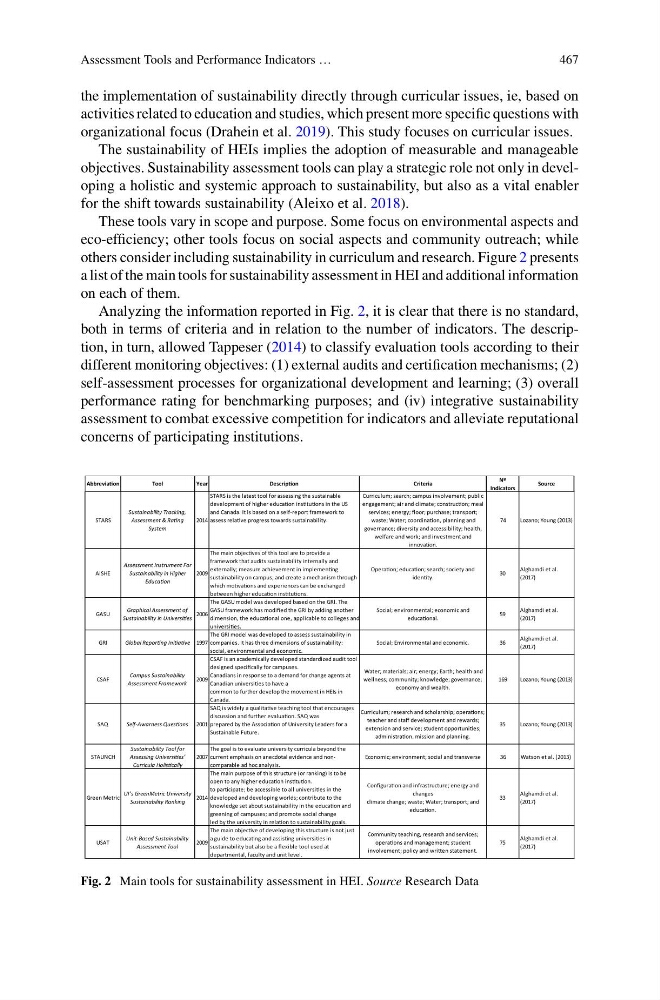
others consider including sustainability in curriculum and research. Figure 2 presents
a list of the main tools for sustainability assessment in HEI and additional information
on each of them.
Analyzing the information reported in Fig. 2, it is clear that there is no standard,
both in terms of criteria and in relation to the number of indicators. The description, in turn, allowed Tappeser (2014) to classify evaluation tools according to their
different monitoring objectives: (1) external audits and certification mechanisms; (2)
self-assessment processes for organizational development and learning; (3) overall
performance rating for benchmarking purposes; and (iv) integrative sustainability
assessment to combat excessive competition for indicators and alleviate reputational
concerns of participating institutions.
STARS
Sustainability Tracking,
Assessment & RaƟng
System
2014
STARS is the latest tool for assessing the sustainable
development of higher educaƟon insƟtuƟons in the US
and Canada. It is based on a self-report framework to
assess relaƟve progress towards sustainability.
Curriculum; search; campus involvement; public
engagement; air and climate; construcƟon; meal
services; energy; floor; purchase; transport;
waste; Water; coordinaƟon, planning and
governance; diversity and accessibility; health,
welfare and work; and investment and
innovaƟon.
74
Lozano; Young (2013)
AISHE
Assessment Instrument For
Sustainability in Higher
EducaƟon
2009
The main objecƟves of this tool are to provide a
framework that audits sustainability internally and
externally; measure achievement in implemenƟng
sustainability on campus; and create a mechanism through
which moƟvaƟons and experiences can be exchanged
between higher educaƟon insƟtuƟons.
OperaƟon; educaƟon; search; society and
idenƟty.
30
Alghamdi et al.
(2017)
GASU
Graphical Assessment of
Sustainability in UniversiƟes
2006
The GASU model was developed based on the GRI. The
GASU framework has modified the GRI by adding another
dimension, the educaƟonal one, applicable to colleges and
universiƟes.
Social; environmental; economic and
educaƟonal.
59
Alghamdi et al.
(2017)
GRI
Global ReporƟng IniƟaƟve 1997
The GRI model was developed to assess sustainability in
companies. It has three dimensions of sustainability:
social, environmental and economic.
Social; Environmental and economic.
36
Alghamdi et al.
(2017)
CSAF
Campus Sustainability
Assessment Framework
2009
CSAF is an academically developed standardized audit tool
designed specifically for campuses.
Canadians in response to a demand for change agents at
Canadian universiƟes to have a
common to further develop the movement in HEIs in
Canada.
Water; materials; air; energy; Earth; health and
wellness; community; knowledge; governance;
economy and wealth.
169
Lozano; Young (2013)
SAQ
Self-Awarness QuesƟons 2001
SAQ is widely a qualitaƟve teaching tool that encourages
discussion and further evaluaƟon. SAQ was
prepared by the AssociaƟon of University Leaders for a
Sustainable Future.
Curriculum; research and scholarship; operaƟons;
teacher and staī development and rewards;
extension and service; student opportuniƟes;
administraƟon, mission and planning.
35
Lozano; Young (2013)
STAUNCH
Sustainability Tool for
Assessing UniversiƟes’
Curricula HolisƟcally
2007
The goal is to evaluate university curricula beyond the
current emphasis on anecdotal evidence and noncomparable ad hoc analysis.
Economic; environment; social and transverse
36
Watson et al. (2013)
Green Metric
UI’s GreenMetric University
Sustainability Ranking
2014
The main purpose of this structure (or ranking) is to be
open to any higher educaƟon insƟtuƟon.
to parƟcipate; be accessible to all universiƟes in the
developed and developing worlds; contribute to the
knowledge set about sustainability in the educaƟon and
greening of campuses; and promote social change
led by the university in relaƟon to sustainability goals.
ConfiguraƟon and infrastructure; energy and
changes
climate change; waste; Water; transport; and
educaƟon.
33
Alghamdi et al.
(2017)
USAT
Unit-Based Sustainability
Assessment Tool
2009
The main objecƟve of developing this structure is not just
a guide to educaƟng and assisƟng universiƟes in
sustainability but also be a flexible tool used at
departmental, faculty and unit level.
Community teaching, research and services;
operaƟons and management; student
involvement; policy and wriƩen statement.
75
Alghamdi et al.
(2017)
Source
Nº
Indicators
AbbreviaƟon
Tool
Year
DescripƟon
Criteria
Fig. 2 Main tools for sustainability assessment in HEI. Source Research Data
467
the implementation of sustainability directly through curricular issues, ie, based on
activities related to education and studies, which present more specific questions with
organizational focus (Drahein et al. 2019). This study focuses on curricular issues.
The sustainability of HEIs implies the adoption of measurable and manageable
objectives. Sustainability assessment tools can play a strategic role not only in developing a holistic and systemic approach to sustainability, but also as a vital enabler
for the shift towards sustainability (Aleixo et al. 2018).
These tools vary in scope and purpose. Some focus on environmental aspects and
eco-efficiency; other tools focus on social aspects and community outreach; while
others consider including sustainability in curriculum and research. Figure 2 presents
a list of the main tools for sustainability assessment in HEI and additional information
on each of them.
Analyzing the information reported in Fig. 2, it is clear that there is no standard,
both in terms of criteria and in relation to the number of indicators. The description, in turn, allowed Tappeser (2014) to classify evaluation tools according to their
different monitoring objectives: (1) external audits and certification mechanisms; (2)
self-assessment processes for organizational development and learning; (3) overall
performance rating for benchmarking purposes; and (iv) integrative sustainability
assessment to combat excessive competition for indicators and alleviate reputational
concerns of participating institutions.
STARS
Sustainability Tracking,
Assessment & RaƟng
System
2014
STARS is the latest tool for assessing the sustainable
development of higher educaƟon insƟtuƟons in the US
and Canada. It is based on a self-report framework to
assess relaƟve progress towards sustainability.
Curriculum; search; campus involvement; public
engagement; air and climate; construcƟon; meal
services; energy; floor; purchase; transport;
waste; Water; coordinaƟon, planning and
governance; diversity and accessibility; health,
welfare and work; and investment and
innovaƟon.
74
Lozano; Young (2013)
AISHE
Assessment Instrument For
Sustainability in Higher
EducaƟon
2009
The main objecƟves of this tool are to provide a
framework that audits sustainability internally and
externally; measure achievement in implemenƟng
sustainability on campus; and create a mechanism through
which moƟvaƟons and experiences can be exchanged
between higher educaƟon insƟtuƟons.
OperaƟon; educaƟon; search; society and
idenƟty.
30
Alghamdi et al.
(2017)
GASU
Graphical Assessment of
Sustainability in UniversiƟes
2006
The GASU model was developed based on the GRI. The
GASU framework has modified the GRI by adding another
dimension, the educaƟonal one, applicable to colleges and
universiƟes.
Social; environmental; economic and
educaƟonal.
59
Alghamdi et al.
(2017)
GRI
Global ReporƟng IniƟaƟve 1997
The GRI model was developed to assess sustainability in
companies. It has three dimensions of sustainability:
social, environmental and economic.
Social; Environmental and economic.
36
Alghamdi et al.
(2017)
CSAF
Campus Sustainability
Assessment Framework
2009
CSAF is an academically developed standardized audit tool
designed specifically for campuses.
Canadians in response to a demand for change agents at
Canadian universiƟes to have a
common to further develop the movement in HEIs in
Canada.
Water; materials; air; energy; Earth; health and
wellness; community; knowledge; governance;
economy and wealth.
169
Lozano; Young (2013)
SAQ
Self-Awarness QuesƟons 2001
SAQ is widely a qualitaƟve teaching tool that encourages
discussion and further evaluaƟon. SAQ was
prepared by the AssociaƟon of University Leaders for a
Sustainable Future.
Curriculum; research and scholarship; operaƟons;
teacher and staī development and rewards;
extension and service; student opportuniƟes;
administraƟon, mission and planning.
35
Lozano; Young (2013)
STAUNCH
Sustainability Tool for
Assessing UniversiƟes’
Curricula HolisƟcally
2007
The goal is to evaluate university curricula beyond the
current emphasis on anecdotal evidence and noncomparable ad hoc analysis.
Economic; environment; social and transverse
36
Watson et al. (2013)
Green Metric
UI’s GreenMetric University
Sustainability Ranking
2014
The main purpose of this structure (or ranking) is to be
open to any higher educaƟon insƟtuƟon.
to parƟcipate; be accessible to all universiƟes in the
developed and developing worlds; contribute to the
knowledge set about sustainability in the educaƟon and
greening of campuses; and promote social change
led by the university in relaƟon to sustainability goals.
ConfiguraƟon and infrastructure; energy and
changes
climate change; waste; Water; transport; and
educaƟon.
33
Alghamdi et al.
(2017)
USAT
Unit-Based Sustainability
Assessment Tool
2009
The main objecƟve of developing this structure is not just
a guide to educaƟng and assisƟng universiƟes in
sustainability but also be a flexible tool used at
departmental, faculty and unit level.
Community teaching, research and services;
operaƟons and management; student
involvement; policy and wriƩen statement.
75
Alghamdi et al.
(2017)
Source
Nº
Indicators
AbbreviaƟon
Tool
Year
DescripƟon
Criteria
Fig. 2 Main tools for sustainability assessment in HEI. Source Research Data