

448
A. E. Builes Vélez and P. A. Zapata Ramírez
interoperability of new technological devices needed for the development of future
smart- and micro-grid technologies at the headquarters campus, but also with the aspiration of replicating these practices and implementing them in other UPB campuses
or, with a reasonably cost-efficient deployment, in remote areas of the country.
As a result of the combination of all these multiple strategies, the university
was awarded the Carbon Neutral Certification (2018), provided by The Colombian
Institute of Technical Standards and Certification, thus, becoming the first Latin–
American university to receive said acknowledgment. This demonstrates the full
commitment of the institution and recognizes the efforts made by the UPB to proactively manage sensitive issues in order to address the impact of climate change in an
efficient fashion.
4 UPB External Actions in Support of the SDGs
The UPB is enhancing its research, transfer, innovation, and development activities in
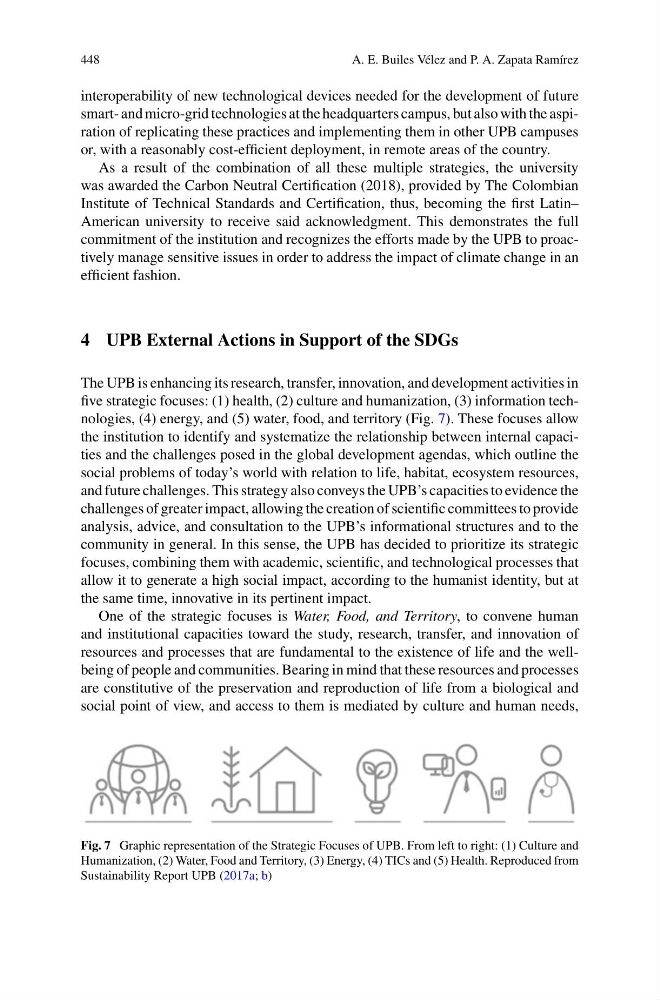
five strategic focuses: (1) health, (2) culture and humanization, (3) information technologies, (4) energy, and (5) water, food, and territory (Fig. 7). These focuses allow
the institution to identify and systematize the relationship between internal capacities and the challenges posed in the global development agendas, which outline the
social problems of today’s world with relation to life, habitat, ecosystem resources,
and future challenges. This strategy also conveys the UPB’s capacities to evidence the
challenges of greater impact, allowing the creation of scientific committees to provide
analysis, advice, and consultation to the UPB’s informational structures and to the
community in general. In this sense, the UPB has decided to prioritize its strategic
focuses, combining them with academic, scientific, and technological processes that
allow it to generate a high social impact, according to the humanist identity, but at
the same time, innovative in its pertinent impact.
One of the strategic focuses is Water, Food, and Territory, to convene human
and institutional capacities toward the study, research, transfer, and innovation of
resources and processes that are fundamental to the existence of life and the wellbeing of people and communities. Bearing in mind that these resources and processes
are constitutive of the preservation and reproduction of life from a biological and
social point of view, and access to them is mediated by culture and human needs,
Fig. 7 Graphic representation of the Strategic Focuses of UPB. From left to right: (1) Culture and
Humanization, (2) Water, Food and Territory, (3) Energy, (4) TICs and (5) Health. Reproduced from
Sustainability Report UPB (2017a; b)
A. E. Builes Vélez and P. A. Zapata Ramírez
interoperability of new technological devices needed for the development of future
smart- and micro-grid technologies at the headquarters campus, but also with the aspiration of replicating these practices and implementing them in other UPB campuses
or, with a reasonably cost-efficient deployment, in remote areas of the country.
As a result of the combination of all these multiple strategies, the university
was awarded the Carbon Neutral Certification (2018), provided by The Colombian
Institute of Technical Standards and Certification, thus, becoming the first Latin–
American university to receive said acknowledgment. This demonstrates the full
commitment of the institution and recognizes the efforts made by the UPB to proactively manage sensitive issues in order to address the impact of climate change in an
efficient fashion.
4 UPB External Actions in Support of the SDGs
The UPB is enhancing its research, transfer, innovation, and development activities in
five strategic focuses: (1) health, (2) culture and humanization, (3) information technologies, (4) energy, and (5) water, food, and territory (Fig. 7). These focuses allow
the institution to identify and systematize the relationship between internal capacities and the challenges posed in the global development agendas, which outline the
social problems of today’s world with relation to life, habitat, ecosystem resources,
and future challenges. This strategy also conveys the UPB’s capacities to evidence the
challenges of greater impact, allowing the creation of scientific committees to provide
analysis, advice, and consultation to the UPB’s informational structures and to the
community in general. In this sense, the UPB has decided to prioritize its strategic
focuses, combining them with academic, scientific, and technological processes that
allow it to generate a high social impact, according to the humanist identity, but at
the same time, innovative in its pertinent impact.
One of the strategic focuses is Water, Food, and Territory, to convene human
and institutional capacities toward the study, research, transfer, and innovation of
resources and processes that are fundamental to the existence of life and the wellbeing of people and communities. Bearing in mind that these resources and processes
are constitutive of the preservation and reproduction of life from a biological and
social point of view, and access to them is mediated by culture and human needs,
Fig. 7 Graphic representation of the Strategic Focuses of UPB. From left to right: (1) Culture and
Humanization, (2) Water, Food and Territory, (3) Energy, (4) TICs and (5) Health. Reproduced from
Sustainability Report UPB (2017a; b)